
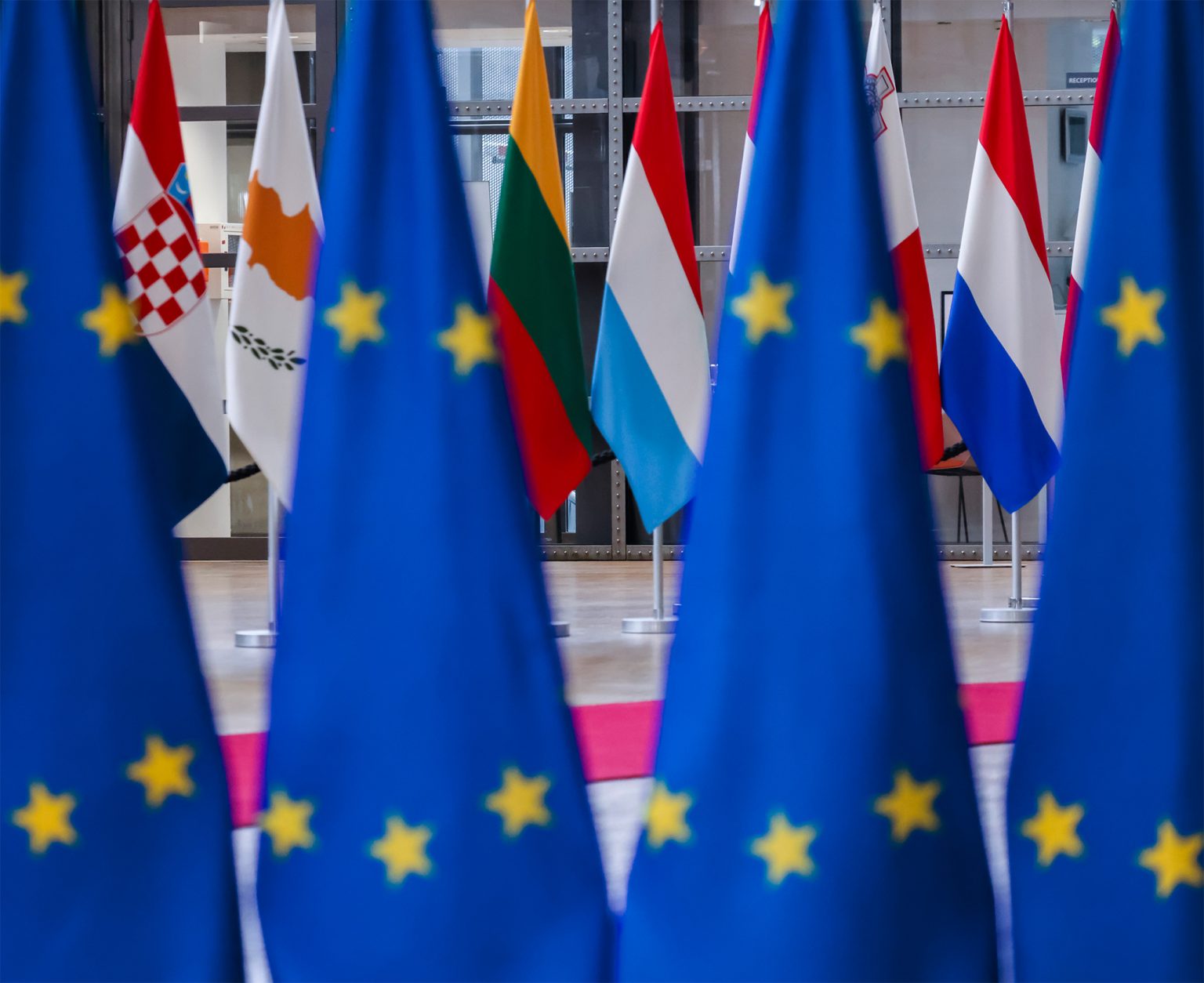
At a time when Europe’s liberal consensus is increasingly coming under fire, five EU countries – Germany, France, the Netherlands, Belgium and Luxembourg – have proposed temporarily limiting some voting rights of the bloc’s future new members and creating more rule-of-law safeguards.
While the news does not come as a surprise, if the EU were to accept the proposal, it would suggest that the idea of Europe as an egalitarian project, encouraging organic integration around a shared consensus, is increasingly dead in the water.
The five nations’ joint paper proposes stronger safeguards for newer members to prevent “democratic backsliding”, according to a report from Reuters.
Options outlined include a new monitoring mechanism and a safeguard clause to be written into future accession treaties, which would allow measures to be taken in case of serious backsliding in areas such as democracy and media freedom.
The paper also proposes “transitional limitations of voting rights” for new member states, particularly when it comes to areas requiring unanimity. Such areas include enlargement, foreign policy and EU budget decisions where consent of all member countries is currently needed.
Such an approach has been mooted for some months. Earlier this year, the Albanian prime minister said he would accept an initial membership that would leave his country with truncated voting powers.
But what else could the Albanians say? Membership is an incredible opportunity for a small nation, offering ease of travel for its citizens, better opportunities for its businesses and access to Europe’s deep pockets. The same could be said for Montenegro, Ukraine and Moldova, all of which are hoping to join the bloc in the near future.

Brussels’ Liberal Consensus
However, as Europe grows, the balance of power is threatened, particularly as regards Brussels' liberal consensus. Many of these new member states are conservative on issues of family, marriage and gender identity. Their bid to join comes at a time when conservative parties have gained some traction in the EU’s halls of power, as shown by the recent migration pact.
With this latest proposal, there is a sense Europe’s elites are circling the wagons against these new internal and external threats to their control of the bloc.
The proposals themselves may have some merit. There are legitimate institutional reasons for wanting safeguards against democratic backsliding or future deadlock. Yet the EU's record suggests these mechanisms are often applied in ways that reflect ideological preferences as much as constitutional concerns.
It prefers the views and practices of some member states over others and has increasingly used the rule of law in particular as a smokescreen for attacks on the social, cultural and religious practices within countries like Poland, Slovakia and Hungary.
It is unsurprising that the Reuters article cites the example of Hungary’s “democratic backsliding” under former Prime Minister Viktor Orban as a motivating factor in the desire to develop “stronger safeguards” for future members.

The Rule of Lawfare
Orban was a thorn in the side of Brussels throughout his almost 16 years in power, continually at odds with the establishment over migration, LGBTQ issues, Russia and more.
There may be legitimate concerns over how Orban utilized his power – his successor, Peter Magyar, certainly believes there are and has proposed a number of investigations.
Regardless, it is also clear that Europe uses the rule of law as an ideological mechanism, as shown by the decision of the EU court that deemed Hungary’s child safety law discriminatory for barring age-inappropriate material about gender identity and LGBTQ matters from being shown to children.
This is not an isolated case. Consider the EU’s requirement that all member states recognize same-sex marriages lawfully concluded in another member state, even where the country in question does not allow the practice. Or its intervention in Romania’s elections over questions of outside interference. Or its use of social media regulations to exclude views it does not like from being expressed in the run-up to national elections.
In these cases, the rule of law has become the rule of lawfare – meaning the use of the law as a political weapon.

EU’s Migration Hypocrisy
As regards transitional voting rights, on the face of it, this does not seem a wholly unfair proposal, given that new member states will need time to adjust to the mechanisms and workings of the EU’s gargantuan bureaucracy.
However, this proposal is marked by a deep hypocrisy. Consider that, for years now, if one were to protest that the levels of mass immigration currently seen in Europe pose a threat to the unity and security of a nation, you were accused of being far-right.
The establishment claimed, and largely continues to claim, that there were no essential differences between native populations and migrants – or that where there were differences, these would add to the cultural diversity of the nation and thereby strengthen it.
For some reason, however, when it comes to the EU itself, this logic breaks down. Why? Because, as has been shown by Poland and Hungary, new nations are a threat to the settled liberal consensus that reigns in Europe. Suddenly, it appears possible that a “mass migration” of new member states with their own political, cultural and religious values could threaten the security and integrity of the union.
If cultural and political diversity are inherently strengths, as Europe’s leaders often argue in the migration context, it is difficult to see why a more politically diverse union should be regarded as a threat requiring special safeguards.
But in the face of a threat to their power, Europe’s leaders are moving to impose their narrow vision on new states, instead of permitting increasing diversity in the bloc and allowing integration to occur organically around the growth of a shared worldview.
This poses a serious threat to the future of the European project, far more than the increasingly diverse views and practices of an enlarged bloc do.