

Australia became the first country in the world late last year to ban children under 16 from holding their own social media accounts nationwide. Since then, several Western governments have begun considering similar measures. Support is also growing across Europe for age limits, identity verification and stricter rules for platforms.
At first glance, the trend appears to be a necessary response to a real problem. For many children, TikTok, Instagram, Snapchat and YouTube are no longer simply forms of entertainment. They provide a constant influence on attention, self-image and social status. Many families have experienced how difficult it has become to keep children away from these platforms.
That is where the more difficult part of the debate begins. A state that bans children from social media takes on a responsibility that traditionally belongs in the home. The popularity of such bans therefore also reflects a shift in parenting culture. Many parents appear able to enforce rules only when the state stands behind them.
The first results from Australia have been sobering. According to Australia’s eSafety Commission, seven in 10 parents whose children already had accounts on affected services said in March that their teenagers were still active on at least one of the platforms. Young people circumvent age checks with false birth dates, use accounts belonging to parents or siblings, or simply remain logged into existing accounts.
The New York Times has highlighted several cases that illustrate why the law still has an impact. Naomi Parrish, the mother of a 12-year-old boy, said her son had been asking several times a day since Christmas for permission to download TikTok. She has remained firm and points to the law. “It’s given me a reason he can’t have it, and that’s powerful”, she said. The law does not make the decision for her, but it provides an argument.
Europe Wants to Follow
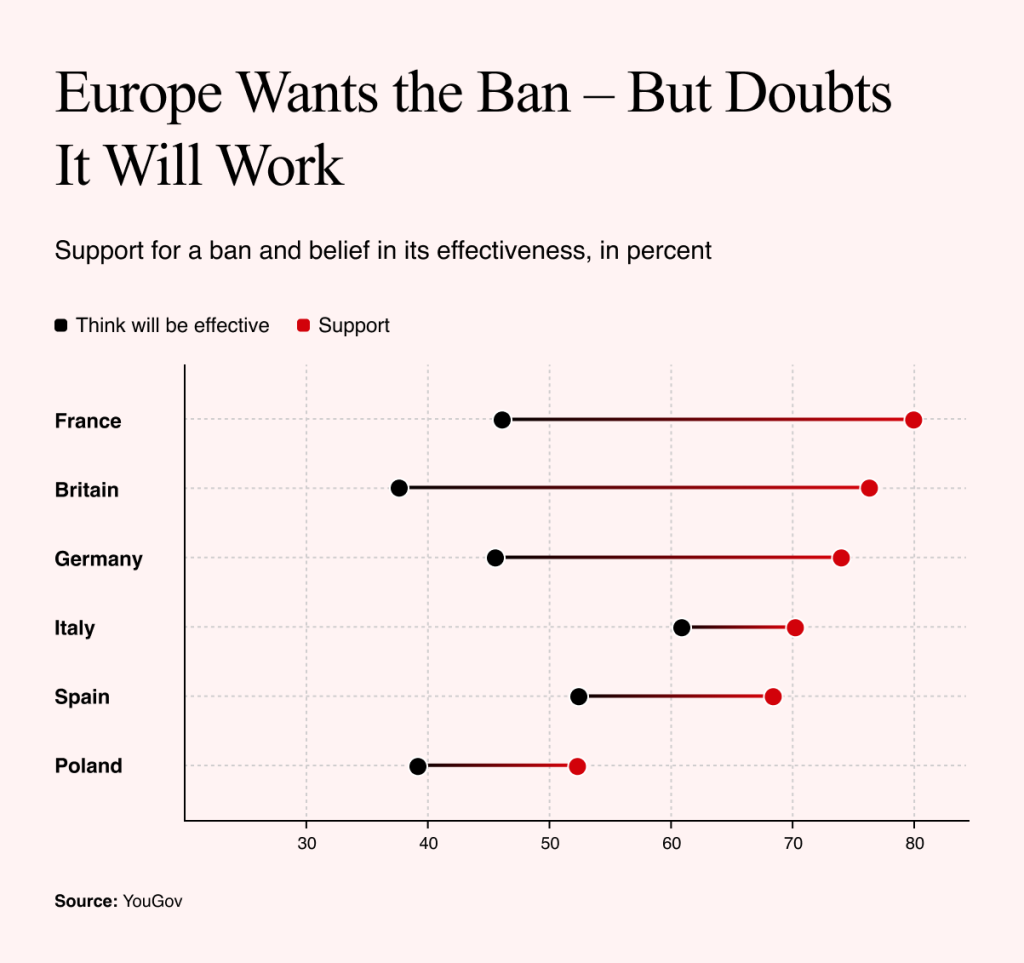
A new YouGov survey shows how strong support has become across Europe. France leads with 79% backing a law prohibiting under-16s from using social media. Support stands at 76% in Britain and 74% in Germany. Italy records 70% and Spain 68%. Even in Poland, where support is considerably lower, a majority of 53% still favors such a ban.
France’s National Assembly passed legislation in January barring children under 15 from social media. The British government is considering similar measures. In Germany, the Christian Democratic Union (CDU) recently adopted a proposal to prohibit access for under-14s. In Italy, a cross-party initiative supports an age limit below 15, while Spanish Prime Minister Pedro Sanchez has announced plans for a ban on children under 16.
Support extends across much of the political spectrum. In Britain, supporters of the main parties are almost evenly aligned. Approval is similarly broad in France and Italy. The issue has moved beyond the traditional left-right divide because it affects the daily lives of many families.
Support is especially strong among parents of underage children. In Britain, Italy and Spain, 79% of that group support a ban. The demand is therefore not coming solely from older voters who dislike an unfamiliar youth culture. It is also coming from those who see the effects of screen time, peer pressure and apps every day.
The Chart Shows the Doubt
The YouGov data highlights the crucial point. In all six countries surveyed, a majority supports a social media ban for children under 16. The share of respondents who believe such a ban would actually be effective is much lower.
In Britain, 76% back a ban, but only 37% believe it would work. Germany shows a similar pattern. While 74% support the measure, expectations about its practical success are significantly lower. Italy and Spain are more optimistic, while Poland remains the most skeptical.
People are therefore not naive. They know that teenagers will find loopholes. They also understand that platforms have little incentive to exclude young users aggressively. Yet they still want a legal rule. Not because they believe the technology is reliable, but because they hope it will establish a new social norm.
Australia Shows the Limits
Australia’s experience confirms that skepticism. Teenagers draw beards on their faces, create new accounts using false birth dates or use accounts belonging to older siblings. Some report that nothing about their access has changed. A 15-year-old girl from Canberra told The New York Times: “I feel like nothing changed on that day.”
For supporters, however, the second effect remains important. Younger children who are not yet using social media may grow up in a different environment. If fewer children receive accounts at an early age, social pressure declines. It then becomes easier to enforce the idea of a smartphone without TikTok or Snapchat.
Australian mother Bec Barton describes that gradual shift in everyday life. At soccer practice and on the school run, she hears parents discussing how they are collectively trying to delay smartphones and social media accounts. “Kids are going to come up in an environment where none of their friends have access to it”, she said.
That is the strongest argument for the Australian model. It can alter social expectations. Its weakness remains enforcement.
Platforms Profit From Weakness
The platforms are not innocent in this debate. They design products that capture attention, establish habits early and create forms of social dependency. Underage users are economically valuable because they remain on the platforms for years and draw others into the ecosystem.
Australia formally places responsibility on the platforms. Facebook, Instagram, Snapchat, TikTok and YouTube are under scrutiny. Significant penalties are available for violations. The eSafety Commission is investigating several services for possible breaches.
Europe is likely to consider similar instruments. According to YouGov, stricter age verification at registration enjoys even greater support than the bans themselves. In Poland, 78% support such controls, while support is even higher in the other countries surveyed.
The debate is therefore shifting from parental responsibility alone toward the technical and legal obligations of platform operators. Platforms cannot indefinitely argue that children and teenagers simply want to use their products. They profit from that use and are therefore increasingly being held to account.
A Ban Cannot Replace Order
The surge in support for bans reveals much about Western societies. Many adults believe social media harms children. They see concentration problems, sleep deprivation, peer pressure and a culture of constant comparison. At the same time, there is growing willingness to address those concerns through legal age limits.
A legal ban can reduce social pressure. It can force platforms to take greater responsibility. It can help families delay the age at which children begin using social media. Its effectiveness, however, depends on whether it becomes more than a political signal.
Australia demonstrates how difficult that path can be. Technical enforcement remains incomplete, yet the social message still has an impact. For Europe, the lesson is a sober one. Such bans can reinforce rules, ease pressure on parents and increase pressure on platforms. They cannot replace the everyday decision about when a child should gain access to a digital world that many adults themselves struggle to control.