

The iPhone maker forecast strong sales growth last week, driven by demand for the iPhone 17 models. Chief Executive Tim Cook told investors he expects memory chip prices to rise sharply, but declined to answer analysts’ questions on whether Apple would raise prices in response.
“There are various levers we can pull, and who knows how successful they will be, but there are only a few options”, Cook said after the earnings release.
He did not comment on whether the global chip shortage presents an opportunity for Apple to increase its market share in iPhones and Macs by holding prices steady while competitors face tighter supply constraints.
Analysts say that despite the shortage, Apple has well-established relationships with long-standing suppliers such as Samsung Electronics, SK Hynix and Micron Technology, helping it secure sufficient memory chips to produce iPhones, unlike smaller manufacturers.
The rapid build-out of artificial intelligence infrastructure by tech groups such as Meta Platforms, Google and Microsoft has absorbed a large share of memory chip supply, pushing up prices as manufacturers prioritize higher-margin data center components over consumer devices. Memory chips, or DRAM (dynamic random-access memory), are crucial for smartphones because they allow energy-intensive applications to run smoothly.
Market Decline Expected
Apple’s decision is likely to have far-reaching consequences.
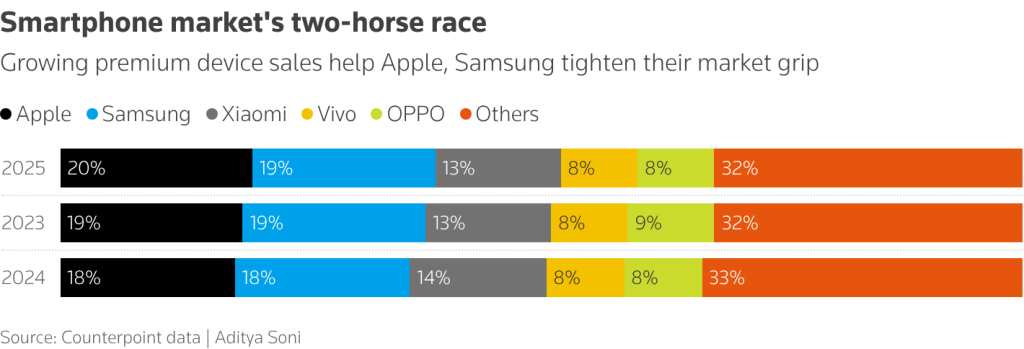
According to some estimates, the company led the global smartphone market last year, with shipments rising by nearly 10%.
If Apple holds prices while smaller competitors raise theirs, as analysts expect, iPhones could become more attractive. If it raises prices, it may give competitors room to follow.
“This is now the biggest question for the industry”, said Nabila Popal, head of research at IDC, one of the most widely cited IT analytics firms. “It is a double-edged sword because if Apple does not raise prices, it will help increase market share, but it will also worry investors.”
According to IDC data, the shortage of memory chips affecting competitors is expected to lead to the first year-on-year decline in the global smartphone market since 2023.
What Global Manufacturers Are Counting On
Qualcomm, the world’s largest smartphone chipmaker and a key supplier to high-end Android devices, added to those concerns with a forecast that fell short of Wall Street estimates due to a shortage of memory chips among its customers.
Chief Financial Officer Akash Palkhiwala said key customers in China do not have enough memory chips to manufacture phones, despite strong demand.
“We have seen several manufacturers that supply components or finished products to other brands, particularly in China, take steps to reduce their mobile phone production plans and inventory in distribution channels”, he said.
During Qualcomm’s conference call, analysts again pointed to Apple. “They appear to continue to capture a disproportionate share of available DRAM (dynamic random access memory)”, said Ben Reitzes of Melius Research.
One senior smartphone industry executive, who requested anonymity because he was discussing sensitive supply issues, said Android phone makers are watching closely to see whether Apple raises prices. Some investors believe it will.
Samsung’s actions could also influence the situation. Analysts say the South Korean company’s phone division may be able to absorb higher memory costs because it sources chips from another Samsung unit.
“We are watching Apple and Samsung”, said eMarketer analyst Gadjo Sevilla. “If they raise prices, they will raise the ceiling, and other manufacturers will likely have to adjust their prices as well.”
(Stephen Nellis, Aditya Soni, Reuters)