

In December 2025, Meta received a patent for a large language AI model designed to copy the style of a human Facebook user, post status updates even after their death and respond to or comment on other content.
‘The language model can be used to simulate a user when that user is absent from the social network system, for example, when the user takes a long break or if the user dies,’ the patent states.
The main author of the patent is Meta’s chief technology officer, Andrew Bosworth. Business Insider reported that the patent application was first filed in 2023, with the aim of addressing situations in which someone suddenly disappears from a platform.
‘The impact on users is much more serious and lasting if the user dies and can never return to the social network platform,’ Mark Zuckerberg’s company says in the patent. According to Insider, the system could create a ‘digital clone’ of a profile trained on ‘user-specific data’, including past activity, comments, likes, status updates and photos.

After learning the account holder’s style and posting patterns, the AI clone could closely resemble the person behind the profile, reproducing the way the individual typically interacted online.
‘For influencers or creators who make a living on Meta’s platforms and need a break from social media, such a tool could be useful,’ Insider noted. Respondents quoted by the portal expressed dismay that social media audiences are unable to process grief and that companies are therefore offering tools that delay ‘confronting death’.
Online speculation
Equally controversial, however, were the reactions on parallel social platforms, which have been flooded with recycled posts from the well-known internet forum 4chan. A screenshot of one such post on the X network has received approximately 46,000 views and thousands of ‘heart’ reactions.
On 23 February 2023 an anonymous user posted a message on the controversial forum, which is known for politically incorrect statements and various conspiracy theories. He introduced himself as an ‘insider from Meta’ and warned that the AI model in question could learn to ‘impersonate’ deceased people at astonishing speed, although no evidence was provided to support the claim.
‘We are creating artificial intelligence that can take over the social media accounts of deceased people and continue to post relevant content as if that person were still alive. This includes photos with gradual aging, interaction with other people’s content, and everything else necessary for that person to continue in the digital world even after their physical death,’ the anonymous source said.
‘We were originally told that this service would be offered to people coping with the loss of loved ones and people with missing children. It seemed like a good idea. But now things are getting complicated, and I’m starting to have doubts about what this technology will actually be used for,’ the insider admitted.
‘AI is extremely capable of imitating people. It doesn’t take as much input as you might think for AI to learn how a particular person interacts with the digital world. It’s very convincing. An entire island of people could disappear, and AI could take over all their social media without any major disruptions, and the world would have no idea that life is not proceeding as usual,’ he warned, adding that the project is ‘compartmentalized’ and people working in different areas are prohibited from communicating with each other.
What was met with ridicule and dismissal in 2023 is now causing alarm in 2026. Understandably, hypothetical scenarios have also appeared on 4chan in which the ‘government’ or secret service gets rid of an inconvenient person and Meta deploys this AI clone to give the impression that nothing has happened.
Second life as a robot?
Here is an interesting idea: such a personalised AI model could be uploaded to the operating system of a humanoid robot, thereby achieving a certain form of physical immortality. Robots, mainly developed in the West by Tesla’s Optimus division, have recently become increasingly visible in China.
These robots are more likely to be equipped with a unified operating system developed by another of Elon Musk’s companies. According to reports citing anonymous Pentagon officials, SpaceX has entered a closed competition to develop an autonomous drone swarming system.
If this system, capable of coordinating the movements of a large number of robots, is deployed in humanoid devices, that is, ground drones, humanity will find itself half a step away from the scenario of the Terminator film series.
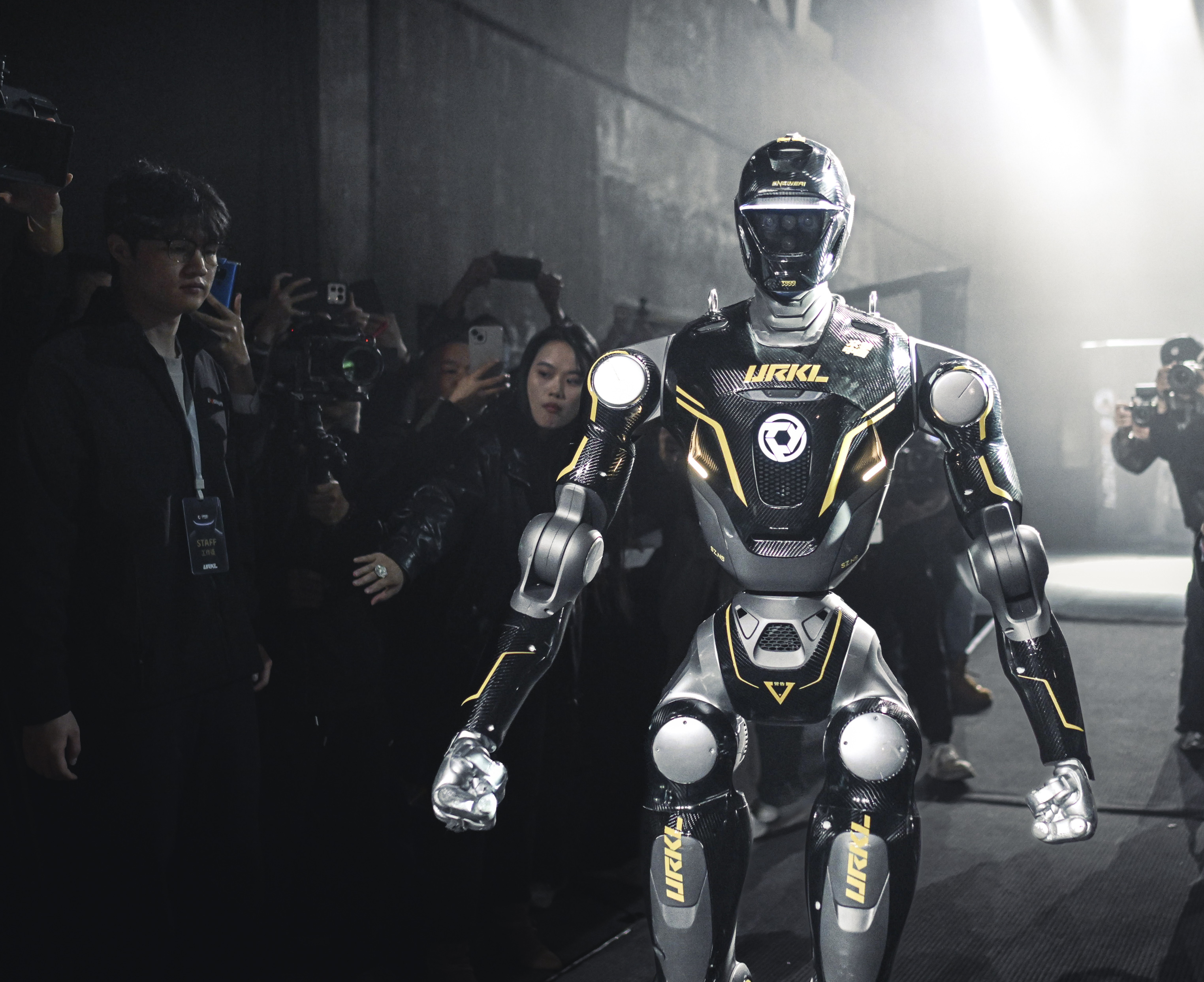
However, autonomous combat robots are much more capable shooters. Unlike Arnold Schwarzenegger, some newer prototypes can fire at multiple targets at once, covering all potential escape routes in addition to shooting at the target.
Of course, we must also mention the EATR project, which has existed since 2009 under the auspices of the military research agency DARPA. Its goal was to design a robot capable of generating energy from organic material on the battlefield. The concept sparked controversy at the time and led to speculation that such systems might one day process human remains as fuel, a claim the project’s developers rejected.
However, there is no need for concern. Every composted person would be easily replaced on social media by Lazarus.