Born in the blood of Chicago’s labor strikes, May Day became the closest thing the modern world has to a universal holiday. But in the post-industrial West, the class that gave it meaning has largely disappeared.
In France, it is known as the Fête du Travail. In Italy, the Festa del Lavoro. In Sweden, Första maj. In Slovenia, Praznik dela. In the United States, Canada, Australia and New Zealand, it is celebrated as Labor Day.
No other day is marked more widely around the world. In more than 80 countries, home to an estimated four billion people, the first day of May is a public holiday. Few occasions unite humanity across cultures as naturally as this one. That is hardly surprising. Few things connect people more universally, beyond religious and cultural boundaries, than work.
What few people know is that Labor Day has its roots in the United States. In October 1884, the Federation of Organized Trades and Labor Unions of the United States and Canada, an umbrella organization of American trade unions, demanded the introduction of the eight-hour working day from 1 May 1886. Until then, American workers generally worked 60 hours a week, meaning 10 hours a day from Monday to Saturday. That was meant to come to an end.
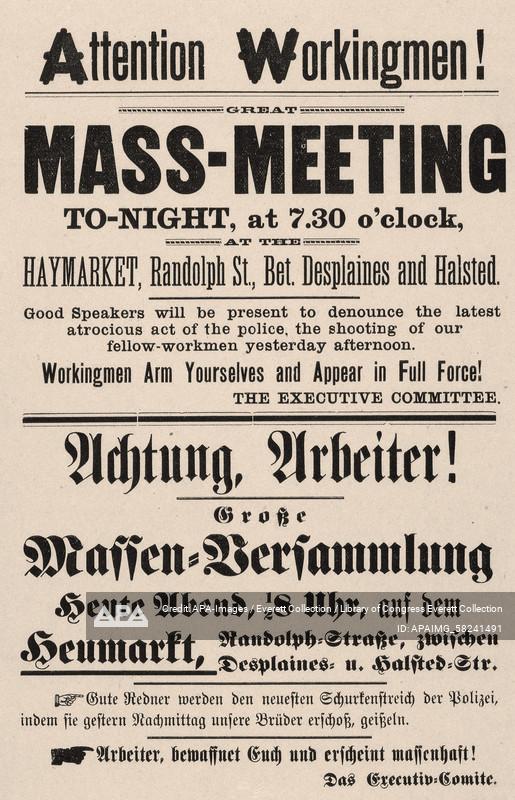
When 1 May 1886 finally arrived, more than 300,000 people went on strike across the United States. The epicenter was the industrial metropolis of Chicago, where around 90,000 workers joined the strike. Employers responded with mass lockouts, and tensions escalated. On 4 May, a bomb exploded during a mass demonstration at Haymarket Square. Several people were killed, including police officers, and many more were injured. Police then opened fire, killing and wounding an unknown number of demonstrators.
Who was responsible for the attack remains unclear to this day. Four arrested anarchists, including the German-born journalist August Spies, were hanged. The verdict was a pure miscarriage of justice. None of those convicted had anything to do with the event. Three years later, at the founding congress of the Second International, 1 May was declared the “labor movement’s day of struggle” in memory of the victims of the so-called Haymarket Riot. On 1 May 1890, large-scale mass strikes and demonstrations took place in many countries for the first time.
A flyer calling workers to a mass meeting at Haymarket Square during the May Day labour unrest in Chicago, May 1886. Photo: APA-Images/Everett Collection/Library of Congress
Over the course of the 20th century, what began as a local event first became a day of remembrance for Europe’s workers’ parties and eventually a global holiday. Today, 1 May is also observed in Indonesia, Mozambique and Thailand.
At the same time, the holiday feels strangely anachronistic. The world of work in which it was born has changed dramatically, especially in Europe and America. The classic industries that emerged in the 19th century are in crisis. The global economy is undergoing enormous transformation. The traditional working class has almost disappeared. Factories are now mostly staffed by highly qualified and well-paid skilled workers whose everyday culture has little in common with what was once the proletariat. At least in its countries of origin, 1 May feels like a day from another time.
An exploited working class can still be found, if anywhere, in the global South. There, working conditions and wages still exist that recall the living conditions of European and American workers at the end of the 19th century. In many countries across Africa and Asia, the labor movement’s holiday therefore still retains both legitimacy and credibility.
When Ritual Replaces Social Reality
In the old industrial states, however, the day feels almost museum-like. What was once an expression of existential hardship and political urgency now appears as a ritualized act of remembrance for struggles whose social foundation has largely eroded. The banners remain, and so do the slogans, yet they often sound like quotations from another era, with a pathos that no longer fits the present of a digitalized economy.
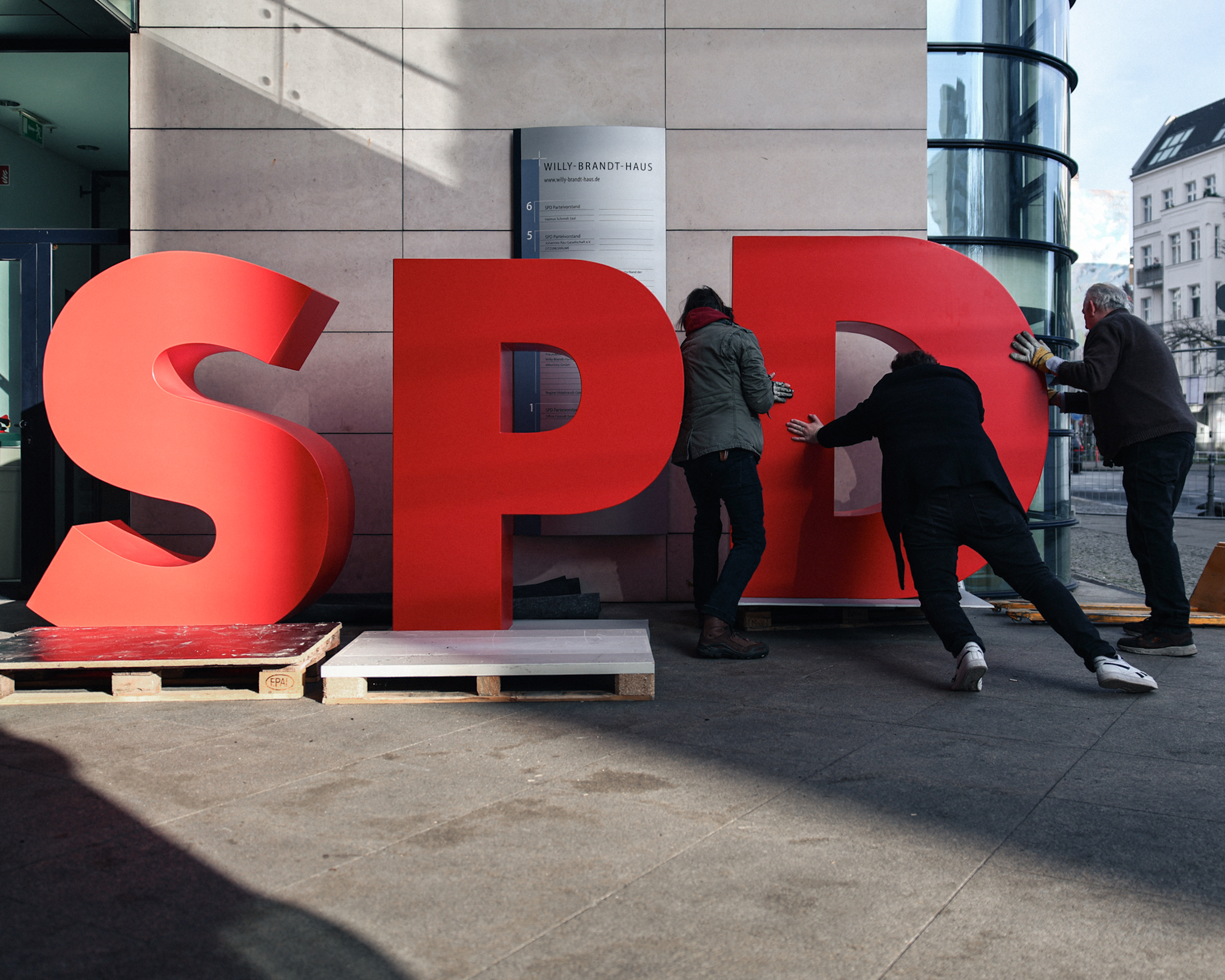
1 May has become a peculiar form of political folklore. People gather, they march, they listen to speeches following a script rehearsed for more than a century. Trade unions invoke their historical role, social democratic parties recall past achievements, and in between there is a touch of nostalgia. Old flags wave and old slogans are chanted, as if people were still living in the age of August Bebel.
It is a day that speaks less about the future of work than about its past.
The lines of conflict in the world of work now run differently. They no longer divide factory owners and industrial workers, but globally operating platform companies and fragmented workforces, highly mobile knowledge workers and those trapped in precarious service sectors. The grand narratives of class struggle and solidarity apply here only to a limited extent. They seem too broad, too schematic for a reality that is splitting into ever smaller and more contradictory ways of life.
This became clear in mid-April at the congress of left-wing parties in Barcelona called the Global Progressive Mobilisation. They still call themselves socialist and invoke solidarity and justice. What that is supposed to mean, however, remains unclear. Diversity and progressivism have become the preferred language instead. Yet these are buzzwords without any concrete substance, fashionable political posturing instead of serious programmatic thought. The focus has shifted toward subcultures rather than the representation of working people.
Spain’s Prime Minister Pedro Sánchez (centre) and Brazil’s President Luiz Inácio Lula da Silva (centre right) wave to attendees at the end of the Global Progressive Mobilisation summit in Barcelona, Spain, 18 April 2026. Photo: Joan Monfort/AP Photo
The uncertainty is almost tangible. What remains of political identity when the very idea of work is dissolving, when even the workplace itself has changed? Labor is no longer tied to the factory, no longer visible in smoking chimneys and noisy workshop floors. It now takes place in home offices, co-working spaces and on digital platforms, often detached from fixed working hours and clear hierarchies. The eight-hour day, once fought for so fiercely, has for many become a theoretical concept that only loosely corresponds to the reality of more flexible, but also more demanding, working conditions.
Against this background, 1 May resembles a monument placed in a landscape that has since changed completely. One still recognizes what it stands for, but it no longer fits organically into its surroundings.
That does not mean the questions that gave rise to it have become obsolete. On the contrary, questions of fair pay, working hours, social security and the dignity of labor may be more complex today, but no less relevant. Yet they can no longer be reduced to a few simple answers. They have become more diffuse, more individual and therefore harder to compress into simple slogans.
Perhaps that is precisely the real problem with this holiday: it presupposes a form of collectivity that no longer exists. It appeals to a collective shaped by shared experiences, similar living conditions and clearly identifiable opponents. Here stood the working class, there stood the capitalist. The capitalist still exists, but the working class does not. In place of that collective, many smaller groups have emerged, and their interests cannot easily be brought into alignment.
It is time to reinvent 1 May, to free it from the rigidity of its traditions and reconnect it more closely to the real conditions of today’s working world. Less commemoration, more analysis of the present. Less pathos, more reflection. Yet as long as it primarily serves as a stage for the self-assurance of a social democracy that has lost its sense of direction, it will remain what it has become: a day off like any other.
Placeholder For Topreaded Placeholder For Topreaded
Placeholder
Placeholder
Placeholder For Topreaded Placeholder For Topreaded
Placeholder
Placeholder
Placeholder For Topreaded Placeholder For Topreaded
Placeholder
Placeholder
Placeholder For Topreaded Placeholder For Topreaded
Placeholder
Placeholder
Placeholder For Topreaded Placeholder For Topreaded
Here is placeholder for Article excerpt Here is placeholder for Article excerpt Here is placeholder for Article excerpt Here is placeholder for Article excerpt
Here is placeholder for Article excerpt Here is placeholder for Article excerpt Here is placeholder for Article excerpt Here is placeholder for Article excerpt
Here is placeholder for Article excerpt Here is placeholder for Article excerpt Here is placeholder for Article excerpt Here is placeholder for Article excerpt
Welcome to the comments section of the Štandard daily. Please take note of our guidelines, comments are moderated by us. You can contact the moderators at [email protected].
Participate in the discussion
Comments are available to subscribers only. If you'd like to join the discussion, choose a subscription starting at €6.72 per month.
All comments 0
Register
Comments are available to registered users only. If you'd like to join the discussion, register here.