AI is reshaping drug discovery, but clinical trials remain the biggest hurdle. New AI-driven methods could make testing faster, cheaper and more effective.
AI is reshaping drug discovery. Researchers now hope it can make clinical trials faster, smarter and more cost-efficient. Photo: Getty Images
|
Google's parent company, Alphabet, has deepened its commitment to artificial intelligence-driven medicine through Isomorphic Labs, the London-based company spun out of DeepMind. The company has attracted billions in investment and has openly declared an ambitious goal: helping to “solve all diseases” through AI-powered drug discovery.
The promise is enormous. Artificial intelligence systems can now analyze proteins, predict molecular structures and identify potential drug candidates in a fraction of the time previously required by pharmaceutical researchers. AI models such as DeepMind’s AlphaFold have already transformed biology by predicting the structure of millions of proteins, a task that once took scientists years.
Yet despite the growing power of AI, one reality remains unchanged: drugs need to pass clinical trials before reaching patients.
No matter how sophisticated the algorithm, medicines must still be tested in humans for safety and effectiveness. That remains one of the most expensive, time-consuming and failure-prone stages of drug development.
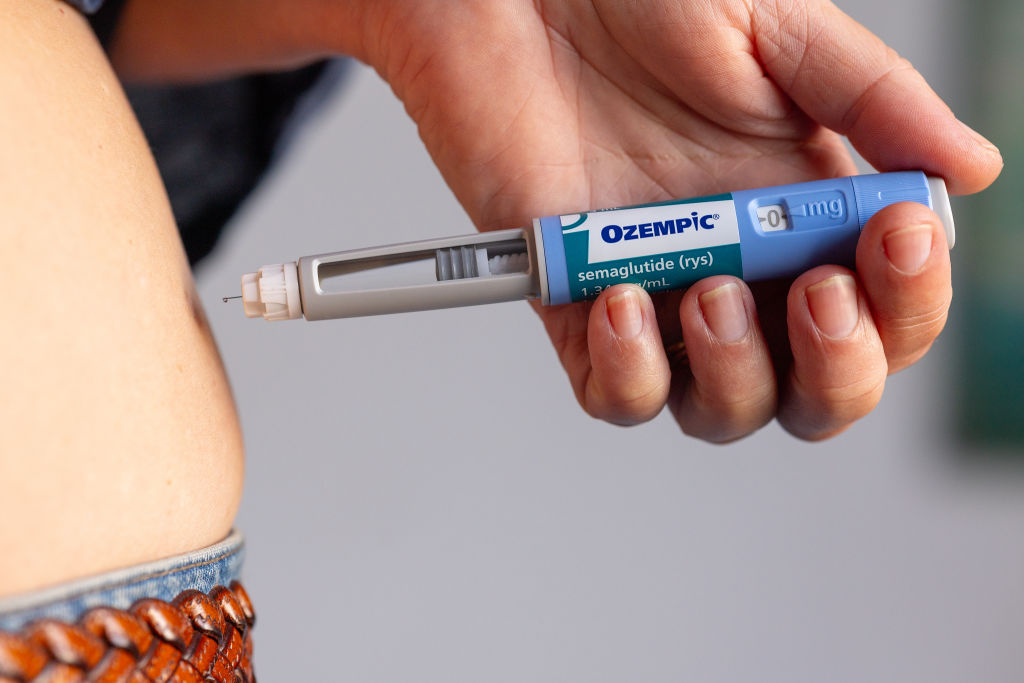
Ozempic sales reached about $17–18bn in 2024, underlining the huge rewards at stake when drugs survive the costly clinical trial process. Photo: Steve Christo/Corbis via Getty Images
The Billion-Dollar Problem
The pharmaceutical industry faces a brutal economic reality. Around 90% of drug candidates fail before reaching the market.
Many collapse during clinical trials after years of development and hundreds of millions of dollars in spending. According to industry estimates, Phase I trials cost around $5.3m, Phase II around $18.5m and Phase III approximately $52.8m. When failed programs and financing costs are included, the total cost of bringing a single approved drug to market is often estimated at between $1bn and $2.6bn.
The result is a system that favors pharmaceutical giants with large budgets while discouraging investment into rare diseases and smaller patient groups.
That challenge is particularly acute because more than 300 million people worldwide live with rare diseases. Many of these conditions affect relatively small populations, making traditional drug development economically difficult.
AI biotech companies increasingly argue that automation and predictive modeling could fundamentally change that equation.
A growing number of firms now focus not only on discovering drugs with AI, but also on speeding up the clinical trial process itself.
Companies such as Isomorphic Labs and Lindus Health aim to reduce the enormous inefficiencies involved in patient recruitment, trial monitoring and data analysis. Artificial intelligence can help identify suitable participants faster, predict which patients are likely to respond to treatment and detect problems in trials earlier.
The pharmaceutical industry has long struggled with delays caused by recruitment bottlenecks. Some clinical trials fail not because the drug itself is ineffective, but because too few patients enroll or because studies become too expensive to continue.
AI systems can scan medical databases and electronic health records to match patients with trials more efficiently than traditional methods. Machine learning models are also increasingly used to predict clinical trial outcomes before expensive late-stage testing begins.
Supporters argue that such tools could dramatically lower development costs. Some estimates suggest that AI-assisted drug development could eventually reduce the cost of bringing a medicine to market from Phase I testing to as little as $10m in certain cases, though such projections remain speculative.
Even modest improvements, however, could reshape the economics of medicine.
Smaller And Smarter Trials
One of the biggest changes AI may bring is the ability to conduct smaller and more targeted clinical trials.
Traditionally, pharmaceutical companies needed very large patient groups to demonstrate statistical significance. AI-driven patient selection and biomarker analysis may allow researchers to identify likely responders earlier, reducing the number of participants needed to prove a drug works.
This is especially important for rare diseases, pediatric medicine, personalized treatments and highly specialized cancer subtypes where patient populations are limited.
Smaller trials could dramatically reduce costs while also accelerating development timelines.
This shift is already changing the structure of modern clinical research.
Much of this transformation is tied to the increasing use of Bayesian statistical models in medicine.
Traditional clinical trials largely rely on so-called frequentist statistics. These systems typically use fixed hypotheses, predetermined sample sizes and a single final statistical test at the end of the study. Bayesian methods instead continuously update probabilities as new evidence emerges during the trial itself.
In simple terms, traditional statistics ask whether a result was statistically significant. Bayesian systems instead ask how likely it is that a treatment actually works.
That allows researchers to assess probabilities throughout a trial, make interim decisions, monitor results in real time and stop ineffective treatment arms early. It can also help shift patients into the most promising groups, adjust dosages as evidence emerges and end studies sooner when success or failure becomes clear.
The approach gained prominence during the COVID-19 pandemic when regulators and researchers sought faster ways to evaluate vaccines and treatments. The US Food and Drug Administration (FDA) has increasingly shown openness toward adaptive and Bayesian trial designs, particularly for rare diseases, cancer therapies and precision medicine, because they can produce faster and more flexible evidence without compromising safety standards. Fast-moving diseases like cancer and ALS need a quick turnaround, as time is essential for survival.
AI is expected to make these systems even more powerful by rapidly analyzing incoming patient data and identifying patterns that human researchers may miss. For biotech companies, the appeal is obvious: smaller and smarter trials could reduce costs, shorten timelines, improve ethical treatment allocation and accelerate the path toward regulatory approval. It could reduce costs by 20-40%.
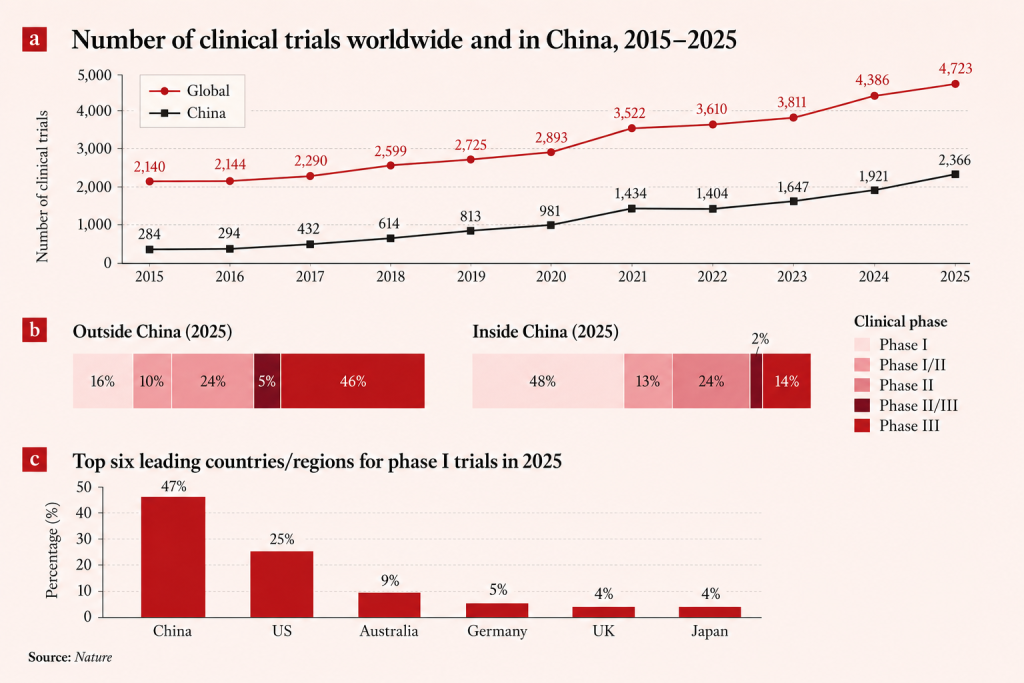
Source: Nature
China Emerges as a Clinical Trial Powerhouse
One of the biggest shifts in the global pharmaceutical industry is taking place in China.
For decades, China was primarily known as a producer of generic medicines and as a low-cost pharmaceutical manufacturing hub. Today, it is rapidly becoming one of the world’s leading centers for biotech innovation and clinical trials.
China now accounts for a substantial share of global Phase I clinical trial activity, with more than half of all Phase I clinical trials happening there, reflecting a dramatic expansion in research capacity. Chinese biotech companies have increasingly moved from copying Western drugs to developing their own original therapies.
Several factors have accelerated this rise.
Chinese regulators streamlined approval procedures, shortened review timelines and expanded support for biotech investment. The government also invested heavily in research infrastructure while encouraging partnerships between universities, hospitals and private companies.
The country’s large population provides another advantage. Recruiting patients for clinical trials is often faster and cheaper in China than in Europe or the United States, particularly for specialized diseases.
By contrast, many Western pharmaceutical companies continue to face slow regulatory processes, fragmented healthcare systems and rising compliance costs.
Europe in particular struggles with regulatory complexity across multiple jurisdictions. In the United States, although the biotechnology sector remains dominant globally, companies face mounting financial pressures and increasingly lengthy development timelines.
The speed of Chinese clinical development has therefore become a growing competitive concern for Western policymakers and pharmaceutical executives alike. For patients, however, this represents good news.
The greatest impact of AI-driven clinical trials may be felt in rare diseases, where small patient populations have traditionally discouraged pharmaceutical investment. Faster and cheaper development could change that equation.
Cystic fibrosis offers one of the clearest examples. Once considered a near-certain death sentence, the rare lung disease is now functionally manageable for around 95% of eligible patients thanks to decades of cooperation between advocacy groups, researchers and pharmaceutical companies.
That transformation demonstrates how scientific innovations can radically change the lives and health outcomes of groups with rare diseases. In turn, such successes offer a glimmer of hope for those still waiting for similar treatment for their own diseases. If AI can speed up that process, it will save many lives.
Welcome to the comments section of the Štandard daily. Please take note of our guidelines, comments are moderated by us. You can contact the moderators at support@statement.com.
Participate in the discussion
Comments are available to subscribers only. If you'd like to join the discussion, choose a subscription starting at €6.72 per month.
All comments 0
Register
Comments are available to registered users only. If you'd like to join the discussion, register here.