With Magnifica Humanitas, Pope Leo XIV has presented a social encyclical for the digital age. The pope warns against a technology that turns man into a data set and calls for artificial intelligence that upholds dignity, justice and peace. Technology must serve man.
Exactly 135 years after Pope Leo XIII published Rerum Novarum, the first social encyclical, Pope Leo XIV signed Magnifica Humanitas (MH) at the Vatican on 15 May 2026. The document offers a philosophical and theological reading of artificial intelligence, a subject whose full depth cannot be explored in a single article.
For the secular world, the message is clear: the pope has not banned AI, but he wants to place moral limits on it and disarm it. Public attention may soon move on, but the Church has left a mark not only on theology and philosophy, but also on technological research. With MH, it has placed itself at the center of the ethical debate on AI.
The encyclical opens with a question that gives the text its spiritual arc: are human beings building a new Tower of Babel or helping to build the city of God? It ends with a reflection on the Magnificat. Between those two poles, the document reads like a programmatic statement for the pontificate. Peace, social justice and Christian humanity are its key themes, though even they do not capture the full breadth of the text.
The Sorcerer’s Apprentices
This was also evident when Christopher Olah, the atheist AI researcher who contributed to the encyclical, asked the pope during the presentation of MH to keep the conversation going. Olah is a co-founder of Anthropic and leads its research into the interpretability of AI systems. His work sits at the intersection of technical AI research, transparency and safety.
Even genuine AI experts know what kind of potential monster they are dealing with. Even some leading figures in the tech industry have already called for an AI moratorium after recognizing that they, too, had become sorcerer’s apprentices.
The guiding idea behind MH is that AI is a social phenomenon. Here, the basic principles of Catholic social teaching come into play: subsidiarity, solidarity, the common good and justice.
AI’s social dimension is already clear from the fact that it will not only replace a wide range of jobs, but also reach deep into daily life. Applications for dental prostheses will travel from the dentist’s computer to an AI system at the health insurer and return without any human involvement. That is only a minor example.
An Anthropological Teaching Document
AI’s place within Catholic social teaching is therefore clear. Pope Leo XIV compares the upheavals expected from its wider use with those of the Industrial Revolution. The spread of machinery made industrial production possible, but it also turned the growing misery of workers into a social question.
Leo XIV goes a step further. He approaches technology from the standpoint of the human person. This makes it entirely reasonable to read the encyclical not only as a social document, but also as an anthropological teaching text.
Man is not a data set, a user profile or a machine to be optimized, but a creature and a person. His dignity is inalienable because it does not come from performance, health, intelligence, efficiency or social success, but from his existence before God.
For that reason, Pope Leo XIV rejects all ideas and ideologies that recognize man only when he is useful, productive or technologically enhanced. Man is made in the image of the triune God and is therefore relational by nature. He does not find himself in self-enhancement, but in love, responsibility and self-giving.
For the encyclical, Christ is the measure of humanity. In him, greatness is shown not as domination, but as freedom for communion and solidarity with the vulnerable.
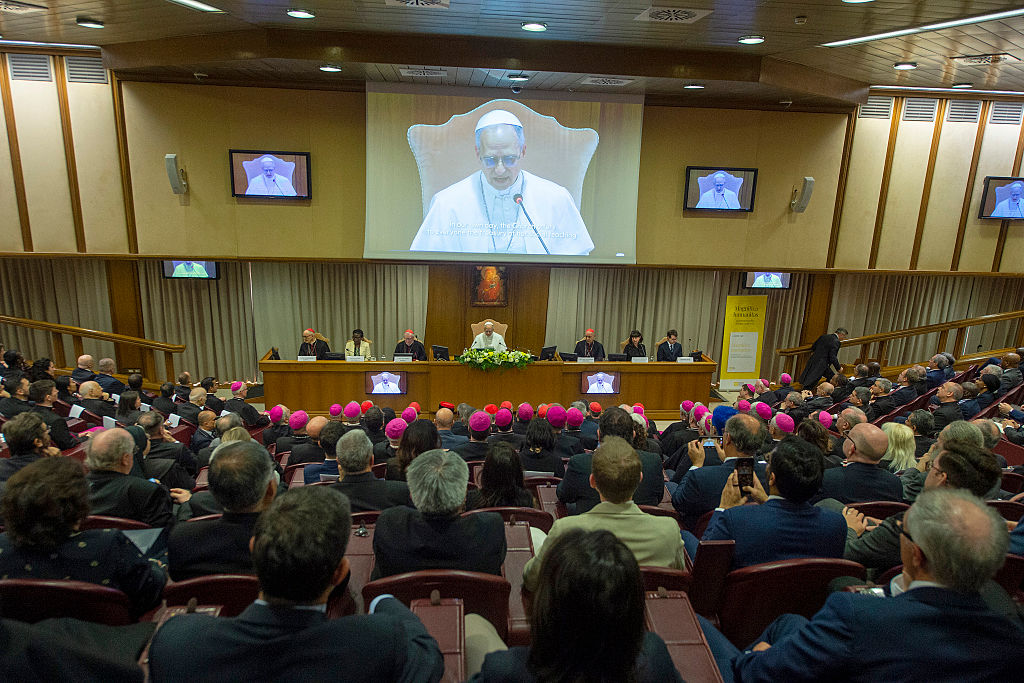
Pope Leo XIV attends the presentation of his first encyclical, Magnifica Humanitas, in the Synod Hall at the Vatican on 25 May 2026. Photo: Alessia Giuliani/Catholic Press via Vatican Pool/Getty Images
AI and Man
The encyclical presents AI as a global anthropological challenge. Machines can calculate, simulate and accelerate, but they have no body, no experience, no conscience, no guilt, no forgiveness and no love.
Man, the pope stresses, always remains more than data processing. His vulnerability, limits, work, freedom and longing for meaning all belong to his dignity.
At this point, the encyclical becomes a fundamental critique of transhumanism and posthumanism.
Against transhumanist dreams of technological self-overcoming, Leo XIV sets out a Christian alternative. Man does not become greater by casting off his finitude, but by accepting it and becoming more human through relationship, care, education, work, solidarity and grace.
Technology that heals and liberates can be an expression of human solidarity. It becomes dangerous when weakness, old age, illness, disability or limitation are treated only as defects.
Against Optimized Human Beings
A hierarchy between enhanced and non-enhanced human beings would then begin to take shape. Personal dignity would be tied to capacity. The encyclical is therefore a protest against every culture that makes man available or dreams, in posthumanist terms, of replacing him altogether.
Yet MH is not a rejection of AI. It is a plea for a future in which technology serves man, rather than man serving technology. In medicine, education, communication, administration, disaster response and research, AI can be of enormous help. Precisely because it is so powerful, however, it must not be misunderstood as a mere tool. It intervenes in decision-making, shapes perception, sorts information, influences communication and changes work. It is part of an infrastructure that helps shape human life.
Leo XIV uses the key concept of non-neutrality here. For the pope, it is not enough to judge AI morally only when it is applied. Its development, financing, regulation and ownership structure are ethical questions from the outset.
A Critique of Power
This is the point at which Leo XIV’s critique of concentrated digital power begins. At its center is the privatization of power without democratic legitimacy. By this point, every reader of Rerum Novarum will hear the alarm bells. Leo XIII affirmed the right to private property, but tied it to social responsibility. The same principle runs through MH.
Whether the issue is ownership of productive capital or power over algorithms, both are legitimate only when bound to the common good.
The pope is particularly forceful on war. AI is changing not only the economy, science and communication, but also the nature of violence. Autonomous systems, cyberattacks, disinformation, drones, target recognition and automated decision-making can lower the threshold for violence and obscure responsibility. That is why MH calls for AI to be “disarmed”.
This does not mean renouncing technology. It means freeing AI from a logic of domination, rearmament and dehumanization. No algorithm can assume moral responsibility for life and death.
He Casts the Mighty Down From Their Thrones
When the pope ends his document with a meditation on the Magnificat, this is not merely a pious flourish. Mary praises God, who looks upon the lowliness of his handmaid, casts the mighty down from their thrones, raises up the lowly, fills the hungry with good things and sends the rich away empty.
In the encyclical, this canticle becomes the answer to Babel. Babel stands for self-exaltation, uniformity, control and power. The Magnificat stands for humility, hope, justice and God’s concern for the lowly.
That is the moral horizon in which the pope wants artificial intelligence to find its place.
Placeholder For Topreaded Placeholder For Topreaded
Placeholder
Placeholder
Placeholder For Topreaded Placeholder For Topreaded
Placeholder
Placeholder
Placeholder For Topreaded Placeholder For Topreaded
Placeholder
Placeholder
Placeholder For Topreaded Placeholder For Topreaded
Placeholder
Placeholder
Placeholder For Topreaded Placeholder For Topreaded
Here is placeholder for Article excerpt Here is placeholder for Article excerpt Here is placeholder for Article excerpt Here is placeholder for Article excerpt
Here is placeholder for Article excerpt Here is placeholder for Article excerpt Here is placeholder for Article excerpt Here is placeholder for Article excerpt
Here is placeholder for Article excerpt Here is placeholder for Article excerpt Here is placeholder for Article excerpt Here is placeholder for Article excerpt
Welcome to the comments section of the Štandard daily. Please take note of our guidelines, comments are moderated by us. You can contact the moderators at [email protected].
Participate in the discussion
Comments are available to subscribers only. If you'd like to join the discussion, choose a subscription starting at €6.72 per month.
All comments 0
Register
Comments are available to registered users only. If you'd like to join the discussion, register here.