As Britain reduces compulsory psychiatric treatment, a growing debate asks whether public safety is paying the price.
Valdo Colcane, who had been diagnosed with schizophrenia, was repeatedly released by authorities despite concerns about public safety. Photo: Nottinghamshire Police
|
The shocking images of Valdo Calocane carrying out his attacks remain etched in British public memory. After murdering three people, he stole a van and drove it into pedestrians, extending the trail of violence. Nearly three years later, one question still hangs over the case: how was a man suffering from severe mental illness able to go without medication and avoid compulsory treatment despite repeated warnings about his condition?
To understand how this could happen, it is necessary to examine the British health service's (NHS) approach to mental health care and the evolution of policies governing the treatment of severely mentally ill patients.
Calocane's case provides a good example. He had been repeatedly identified by his healthcare professionals as suffering from paranoid schizophrenia. His condition deteriorated over time and concerns were raised on multiple occasions about his behavior and mental state.
Despite a previous violent assault and repeated warnings from those around him, he was not subjected to compulsory treatment under the Mental Health Act. Subsequent reviews of his case found that some clinicians were reluctant to pursue detention, citing concerns about the disproportionate representation of black men in mental health custody.
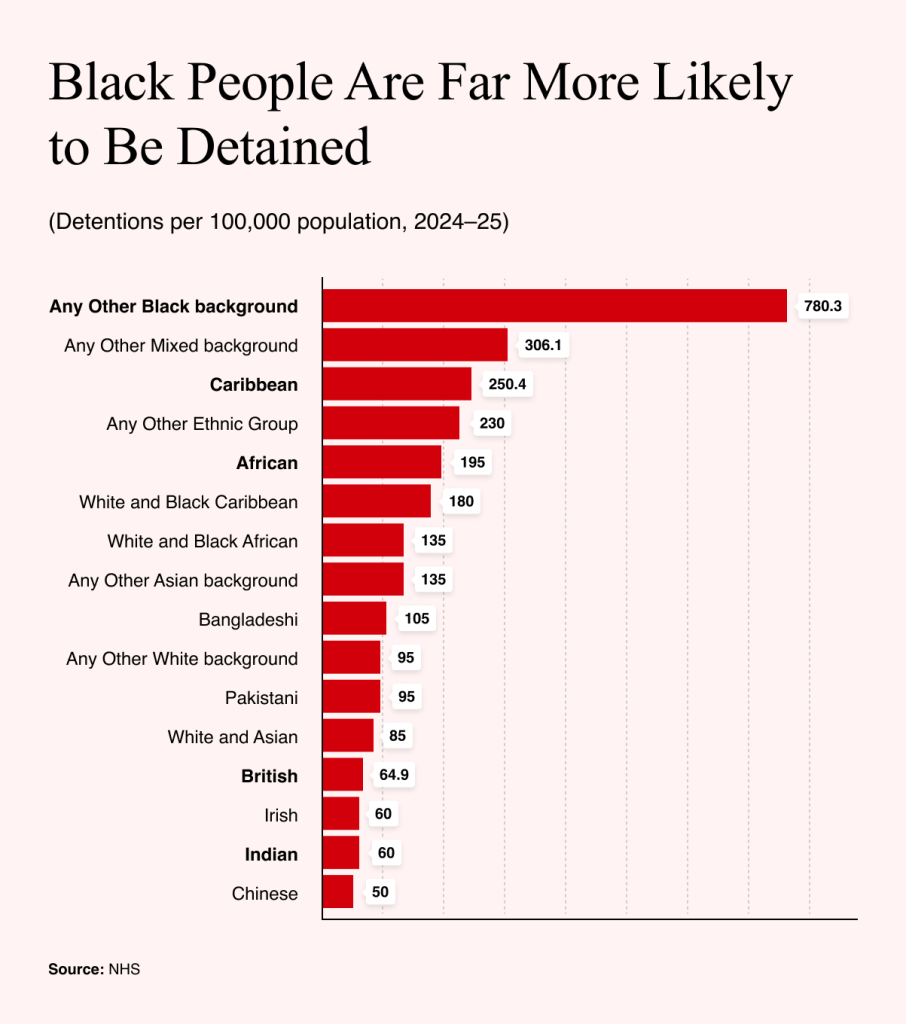
Source: NHS
The Role of the NHS
Recent NHS data appears to support the concerns that influenced some of the clinicians involved in Calocane's case. Black people continue to be disproportionately represented among those detained under the Mental Health Act, with some black ethnic groups experiencing detention rates several times higher than their white counterparts. Mixed-race and Afro-Caribbean people are also overrepresented in compulsory admissions.
Addressing these disparities became a central objective of mental health policy reform. The 2018 Independent Review of the Mental Health Act, chaired by Simon Wessely, identified the disproportionate detention of black people as one of the major challenges facing the system. The review argued that reducing the compulsory admission of Black African and Black Caribbean patients should be a priority and called for reforms aimed at lowering rates of detention while strengthening patients' rights.
The NHS in England in 2023 advised that trusts look at mental health admissions and “over time should be able to demonstrate reduced inequalities”, which in effect means not sanctioning minorities. That in turn has led to cases like Nottingham.
These mental health reforms have made clinicians more hesitant to pursue compulsory treatment as it has now become more difficult to get someone sectioned. At the same time there is a wider societal problem, with rates of mental illness rising. The NHS England Adult Psychiatric Morbidity Survey found that roughly 22.6% of adults aged 16-64 live with a common mental health condition, up from 17.6% in 2007.
The NHS England in 2023 advised that trusts look at mental health admissions. Doctors have argued that the term "over-representation" is "morally loaded". There is a range of factors that may contribute to higher detention rates among black people beyond the supposed racism in the NHS, including family breakdown, school exclusion, absent fatherhood, poverty and cannabis use.
Besides the arguments about anti-racism, there is also a practical consideration: the cost of detaining and institutionalizing someone indefinitely, which can reach around £700,000 ($936,974) per patient.
Mental health beds are scarce, while large psychiatric institutions have been politically controversial since at least 1961, when Health Minister Enoch Powell criticized the Victorian asylum system in his famous Water Tower speech. Since the early 1980s, the number of psychiatric institutions has steadily declined as governments shifted towards community-based care.
This approach has contributed to tragedies, such as the case of Axel Rudakubana, who murdered several young girls despite reportedly having been flagged repeatedly by teachers and other authorities over concerns about his behavior. Similarly, Zephaniah McLeod, who killed one man and injured seven others in Birmingham in 2020, had a documented history of severe mental health problems, claimed to hear voices and had repeatedly threatened to harm people before carrying out his attack.
These cases raise serious questions about whether warning signs are being acted upon effectively. As the National Health Service faces mounting financial pressures and seeks to reduce costs, it has become increasingly common for individuals with severe mental illnesses to remain in the community rather than receive long-term institutional care. While most people suffering from mental illness pose no threat to others and can live safely with appropriate treatment and support, there remains a small group of individuals whose behavior demonstrates a clear risk to public safety.
When authorities fail to intervene despite repeated warnings, the consequences can be devastating. The financial savings achieved by reducing inpatient care may appear attractive on paper, but when serious failures occur, the true cost is measured in human lives. Public safety cannot be treated as a secondary consideration when individuals have repeatedly demonstrated violent tendencies or made credible threats of harm. Cases such as Rudakubana and McLeod highlight the potentially fatal consequences of ignoring warning signs until it is too late.