This system, while very appealing, has, like any new technology, one flaw that needs to be addressed: “The problem with predictive policing is that it often reflects state-defined threats rather than genuine crime prevention,” warns a Beijing-based legal scholar, speaking anonymously. The danger is that such systems don’t just predict crime; they define it.
Robo-Cops on the Beat
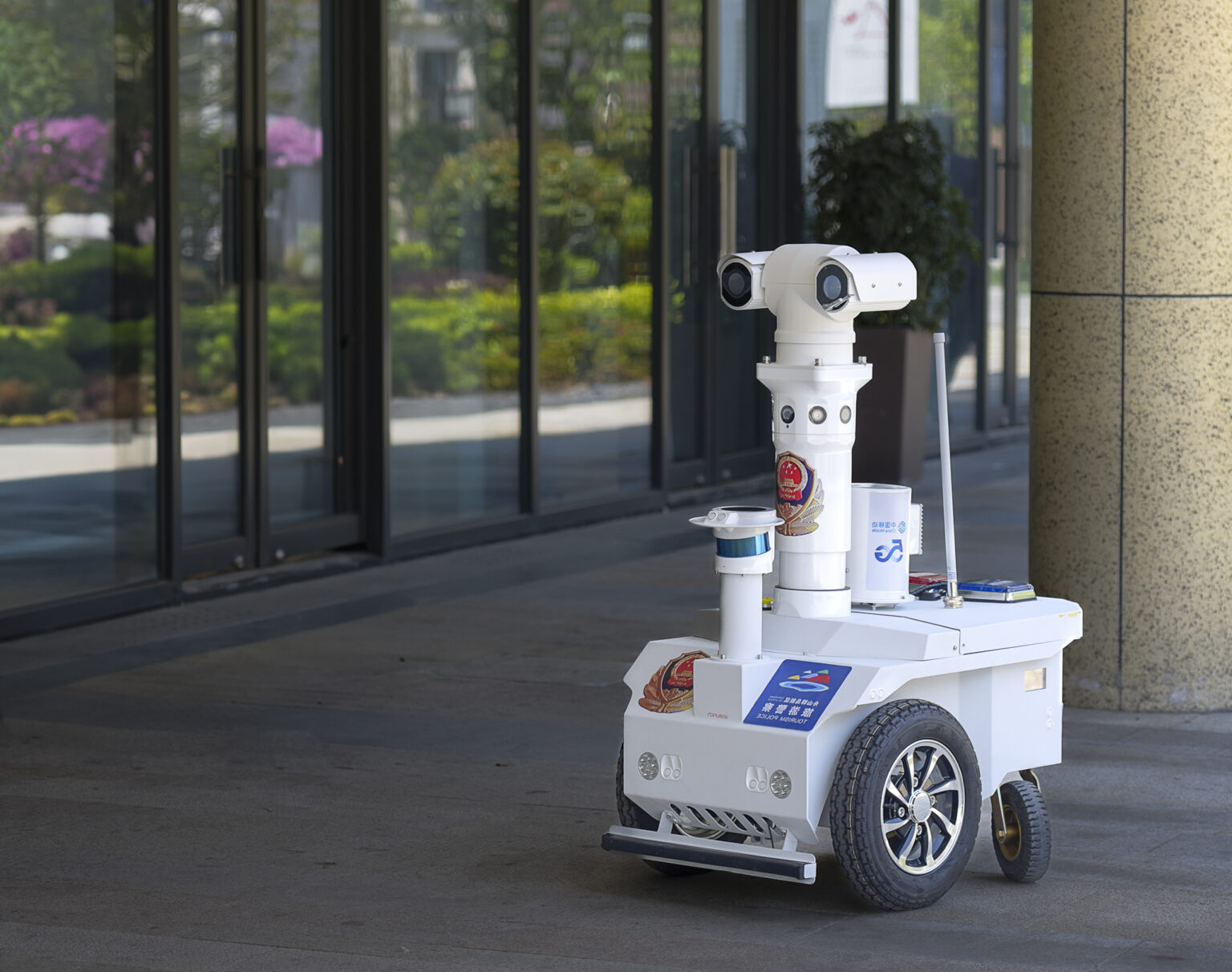
Patrol robots, outfitted with thermal imaging and license plate recognition, have been deployed in cities such as Zhengzhou and Guangzhou, autonomously scanning for anomalies. In Hangzhou, traffic enforcement robots issue citations without the need for human intervention.
Smart police stations, now appearing across the country, use facial recognition and AI-powered identity verification to allow citizens to report crimes, file complaints, or renew documents, all without ever interacting with an officer. At the 2017 Qingdao International Beer Festival, authorities used facial recognition cameras to identify and apprehend a suspect who had been on the run for a decade. In Beijing and Zhengzhou, officers are now equipped with smart glasses—AI-powered eyewear that scans faces and instantly cross-references them against national databases. The technology, officials say, dramatically speeds up suspect identification and response times.
The Impact on Crime and Law Enforcement
With relatively few officers per capita—the country ranks 128th globally in police-to-citizen ratios—authorities have turned to technology to fill the gap. Automation has allowed China to police its vast population without drastically expanding its workforce. Police officers are replaced by spherical police robots, such as the Rotunbot RT-G, to patrol the streets.
Crime rates have dropped. In 2023, Chinese authorities registered the lowest criminal cases in a decade. Theft cases have plummeted, with 980,000 incidents recorded, while fraud cases stood at 1.7 million. Even violent crimes have declined, with 5,443 murder cases reported in 2023. Officials credit AI surveillance and predictive analytics for much of this trend, arguing that real-time monitoring has a deterring effect.
The Cost and Benefit of Smart Policing
China’s investment in AI policing has come at a high cost. In 2023, the country spent approximately $224 billion on public security. In comparison, the U.S. allocates around $190 billion to its police forces, making American law enforcement the third-most expensive security apparatus in the world.
Unlike in China (which in absolute terms spends the most on it globally), where spending is focused on AI and automation, much of the American budget goes toward traditional policing, which does not deliver the same results as Chinese police.
Is it worth it? Smart policing offers the people comfort and an undeniable feeling of safety, making a visit to China more appealing to tourists.
Speaking from personal experience—having lost his phone, passport and credit card in a Beijing taxi around 1am—the author of this piece is very happy that such technology exists. The police used AI technology to understand the situation and then to find the taxi. Everything was returned in less than an hour. Would such an outcome be possible in any Western city?
The Future of AI Policing: Chinese Technology Everywhere?
Legal scholars and cybersecurity experts warn of the risk of embedding bias into law enforcement—AI systems, after all, are only as objective as the data they are trained on. “As we integrate AI into public governance, establishing robust legal protections is essential to ensure that citizens’ rights are not compromised,” argues Zhang Linghan, a professor at the China University of Political Science and Law.
Beyond China, the AI policing model is gaining traction. Through the Belt and Road Initiative (BRI), China has exported surveillance technology to dozens of nations, including Ecuador, Serbia, and Zimbabwe, but also France and the UK. For Europeans, then, the prospect of AI-driven robots patrolling their streets feels uncomfortably close.
Statement
At home, the headlong push toward AI-driven policing continues. With advancements in cloud computing and deep learning, the next generation of AI surveillance will be even more precise and efficient—and intrusive. China’s experiment with AI policing is reshaping the future of law enforcement, creating new standards which countries will have to decide to either compete with or face the risk of losing the technological race.