
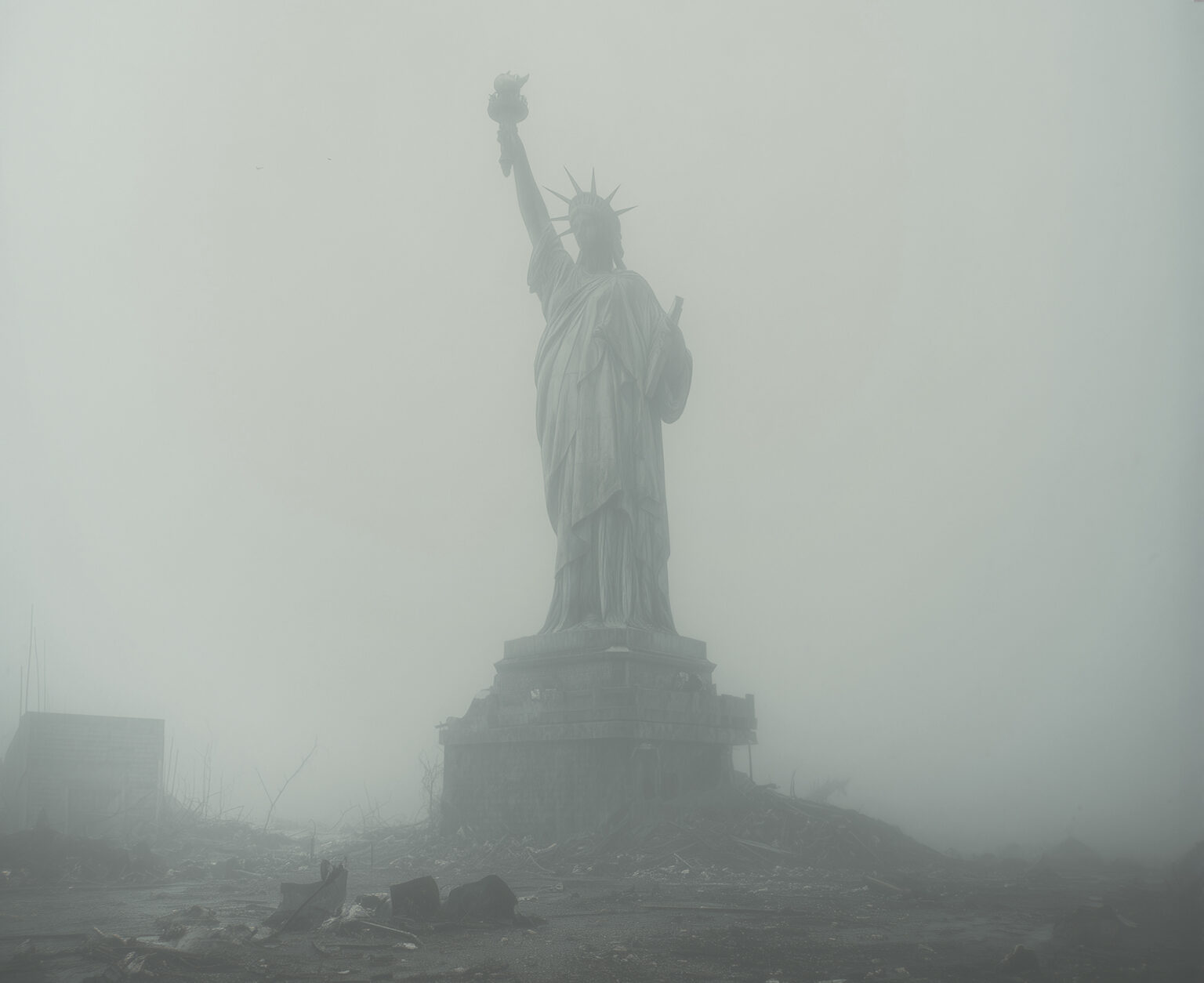
Every culture needs an Ur-myth. Without one, it slips into what Franz Borkenau (1900–1957), the unjustly forgotten philosopher of history, called a ‘barbarian interlude’—a chrysalis stage in which it searches for a founding story.
In his posthumously published End and Beginning, Borkenau adroitly traced the processes by which cultures shed their old skins and grope for new myths. His account of how the West forged its Ur-myth—through the doctrine of transubstantiation—was not just convincing, but epic in scope.
The shock, for today’s reader, lies in how eerily his diagnosis matches our own times. For we are living through a battle over a new Ur-myth, having quietly shelved the old one.
Between Gods
The collapse of the Soviet Union and Francis Fukuyama’s ‘end of history’ announced what looked like a final consensus: liberal democracy, paradise for consumers, and hedonistic self-expression. History, supposedly, was over. But after a while, that new paradise felt suspiciously like a soulless shopping mall. By the 1990s, cracks started showing. New Age therapies, self-help mysticism, and DIY spirituality filled the vacuum.
Then came 9/11, and Islam returned to centre stage as a global counter-myth. The message was stark: against the soft decadence of the West, here was a culture that still believed in absolutes.
The Western response was not to rediscover its own Christian roots, but to improvise. Climate change became the stuff of religion: original sin in the form of CO₂ emissions; indulgences sold as carbon credits and ESG scores; prophets of doom rallying the faithful. The one thing missing was salvation. No paradise awaited—only endless penance.
So a shinier creed stepped forward: artificial intelligence. To its believers, AI is a god-in-waiting, poised to bring order, meaning, and perhaps immortality. That it still struggles to quote Wikipedia correctly is hushed up.
Borkenau wrote in End and Beginning:
‘In a decaying high culture and in a barbarian phase, the same tendencies of disintegration and preservation operate as in times of growth and bloom. Only their chances of success differ. The longing for culture, the attempt to piece together its fragments, are typical of decline and barbarism. But so long as those fragments remain disparate, such efforts often deepen disintegration.’
He was describing the past. He could just as well have been chronicling our present. Climate cults, AI worship, postcolonial guilt trips—all aspire to become the unifying story of the West. Yet all lack the force to coalesce into one.
The Old Quarrel
Why is this so hard? Borkenau thought the roots of Europe’s dilemma lay in the early fifth century, when Augustine squared off against Pelagius. The question was salvation: was it God’s grace alone that saved (Augustine), or could human virtue win redemption (Pelagius)?
This was not mere hairsplitting. It mirrored two incompatible outlooks: the Romanised peoples long since accustomed to empire, and the Germanic tribes who resisted incorporation. Those divergent realities made agreement impossible. The echo is audible today in the tensions between native Western societies and migrant cultures, especially those of Muslim origin, which follow a different civilisational logic.
History, alas, offers little reassurance. In late antiquity, resolving the contradiction took five centuries; after waves of failed revivals of Roman unity, both cultural blocks had dissolved into something else.
Yet Borkenau was no fatalist. Unlike Oswald Spengler, who saw civilisations as ‘monads without windows,’ sealed in their fates, Borkenau borrowed from Arnold Toynbee. Cultures, he argued, can feed on the fragments of their predecessors, reworking them into something new.
That is why Christianity—specifically Catholicism—remains a potential foundational stone. It still offers an architecture strong enough to support a high culture. The terms of coexistence with the forces shaping a ‘new Occident’ would need renegotiation. But the working materials are there.
We would simply need to remember that fact.
Statement
Franz Borkenau foresaw our moment: a civilisation adrift, post-myth, grasping at fragments. Liberal democracy once seemed our destiny; now it limps along, replaced by rituals of carbon guilt, AI messianism, and performative atonement. Yet none can unify. Borkenau traced decaying cultures’ wild search for new stories, often deepening the chaos. Today’s West mirrors late antiquity—divided, tired, waiting for synthesis. The Pelagius-Augustine divide lives on, refracted through culture wars and migration tensions. But unlike Spengler’s doom-loop, Borkenau left space for rebirth. Catholicism, though tattered, remains the only myth with scaffolding. Whether we recall that—or drown in techno-liturgies—may decide what replaces the West’s fading script.