
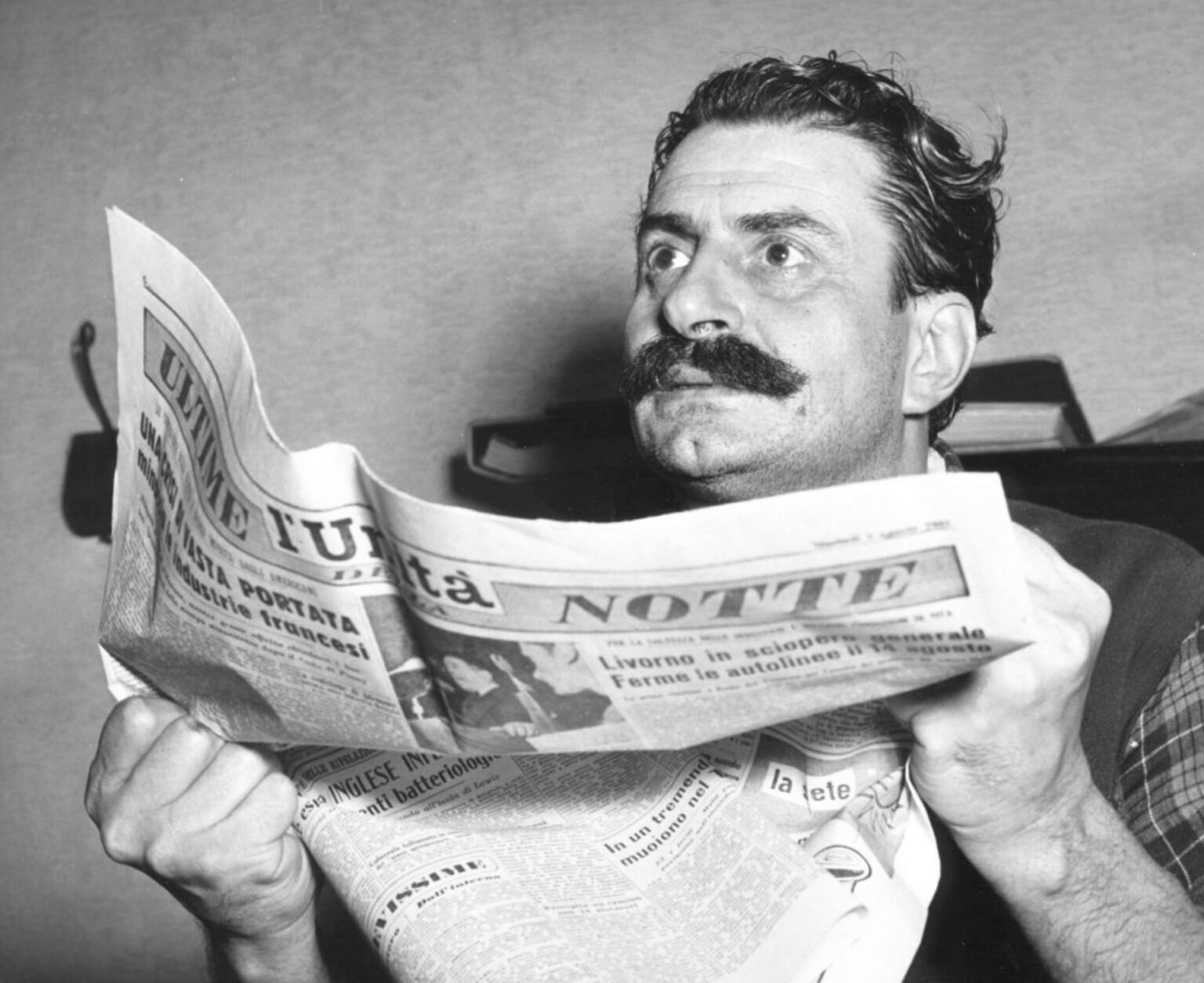
Giovannino Guareschi, best remembered for the Don Camillo stories, has often been treated as a provincial humorist. Yet beneath his tales of a priest and a mayor in the Po valley lies a prophetic vision. He anticipated the collapse of Italy’s post-war duopoly of Christian democracy and communism, the crisis of conscience in mass politics, and even the liturgical controversies that would convulse the Catholic world.
He was not a systematic theologian or political philosopher. But his instincts were sounder than those of many professional thinkers. He distrusted ideology, defended the primacy of conscience, and predicted that corruption would enter not only politics but also the Church itself.
Conscience Versus the Masses
The heart of Guareschi’s message is the dignity of the individual. Don Camillo’s conversations with Christ make clear that God judges each soul alone. For him there were no ‘collective consciences’, no delegation of responsibility to party or public opinion.
This made him sceptical of the mass parties that dominated Italy. Communism demanded obedience to class, Christian democracy to party. Both eroded the moral agency of individuals. In this, he foresaw today’s mobs (which are increasingly found online) and identity blocs: the personal voice being drowned out by the loud drone of ideology. The lesson was simple but enduring—one must stand alone before the Cross, not get caught up in the crowd.
The Corruption of Christian Democracy
If he feared communism, he loathed the hypocrisy of Christian democracy. Guareschi campaigned for its victory in 1948, only to see it squander its moral capital within a decade. Its leaders embraced clientelism, silenced dissent, and traded faith for expediency. When he was jailed for allegedly libelling Prime Minister De Gasperi, he saw it as proof that the party was no longer Christian but simply another machine of power.
His words proved prophetic. By the 1990s Democrazia Cristiana imploded in scandal, leaving no lasting legacy beyond disillusionment. For Guareschi, this was inevitable. A party that tried to embody faith in politics would end up corrupting both. The Church that had lent it support paid a price in credibility that has still not been restored.
Already in 1954, Guareschi remarked that Italy needed ‘a Polish Pope who will spit on all the walls’ . Two and a half decades later John Paul II emerged from Kraków to confront communism and pry its hands off Eastern Europe. The image is crude but telling: he sensed that only an outsider, untainted by Italian intrigues, could restore vigour to the papacy.
Where the papacy’s renewal required strength from abroad, the Church’s renewal required fidelity to its own tradition. For him the old Mass was not nostalgia but armour against the dilution of doctrine. The Tridentine liturgy safeguarded reverence and prevented the faith from being turned into spectacle. Its revival today among young Catholics vindicates his instinct that what was true yesterday cannot be false tomorrow.
Politics Inside the Church
Guareschi also foresaw the corruption of the Church by politics. The aggiornamento of the 1960s, while claiming to open the Church to the world, often meant bending the knee to secular ideologies. He mocked the Italian bishops’ willingness to provide ‘messages that could be interpreted in four different ways’ to accommodate a centre-left coalition .
To capture this climate he invented the Bianchi family. Cesare Bianchi, a bourgeois parrot of the newspapers, symbolised the Catholic who surrendered clarity for fashionable equivocations. His son Gypo, in contrast, voiced the conservative retorts that echoed Guareschi’s own misgivings. Through them he exposed how the Church’s flirtation with politics undermined its moral voice.
Against Clericalism
Contrary to what his critics accused him of, Guareschi did not want priests to dominate public life. His quarrel was with clericalism, by which he meant the abuse of the sacred to serve the political. Priests who reshaped the Mass to suit their own agendas, or who treated faith as an extension of party platforms, were guilty of this.
In this suspicion of clericalism he foreshadowed Joseph Ratzinger. As Benedict XVI, Ratzinger spoke of the Church as a ‘small bark of Peter’ that must weather storms without succumbing to politics. Guareschi had put the same thought in Don Camillo’s mouth: the Church was not a grand ship steered by ideologues, but a small vessel kept afloat by faith. Both men rejected a politicised Church and affirmed one rooted in prayer, sacrifice, and truth.
The Italy Guareschi knew—split between Christian democracy and communism—no longer exists. Both parties collapsed, their ideologies exhausted. What remains are precisely the dilemmas he identified: the tension between conscience and conformity, between clarity and compromise.
Statement
The prophetic force of Guareschi is that he spoke not to only his century but also to ours. In an age again tempted by ideological polarisation, media uniformity, and liturgical confusion, his insistence on conscience, clarity, and tradition rings true.
He anticipated that when politics and faith mingle too freely, both decay. He foresaw that the Church, seduced by trying to appear relevant, would risk emptying itself of substance. And he grasped that tradition, embodied in the old Mass, might prove a source of renewal when modernity exhausted itself.