
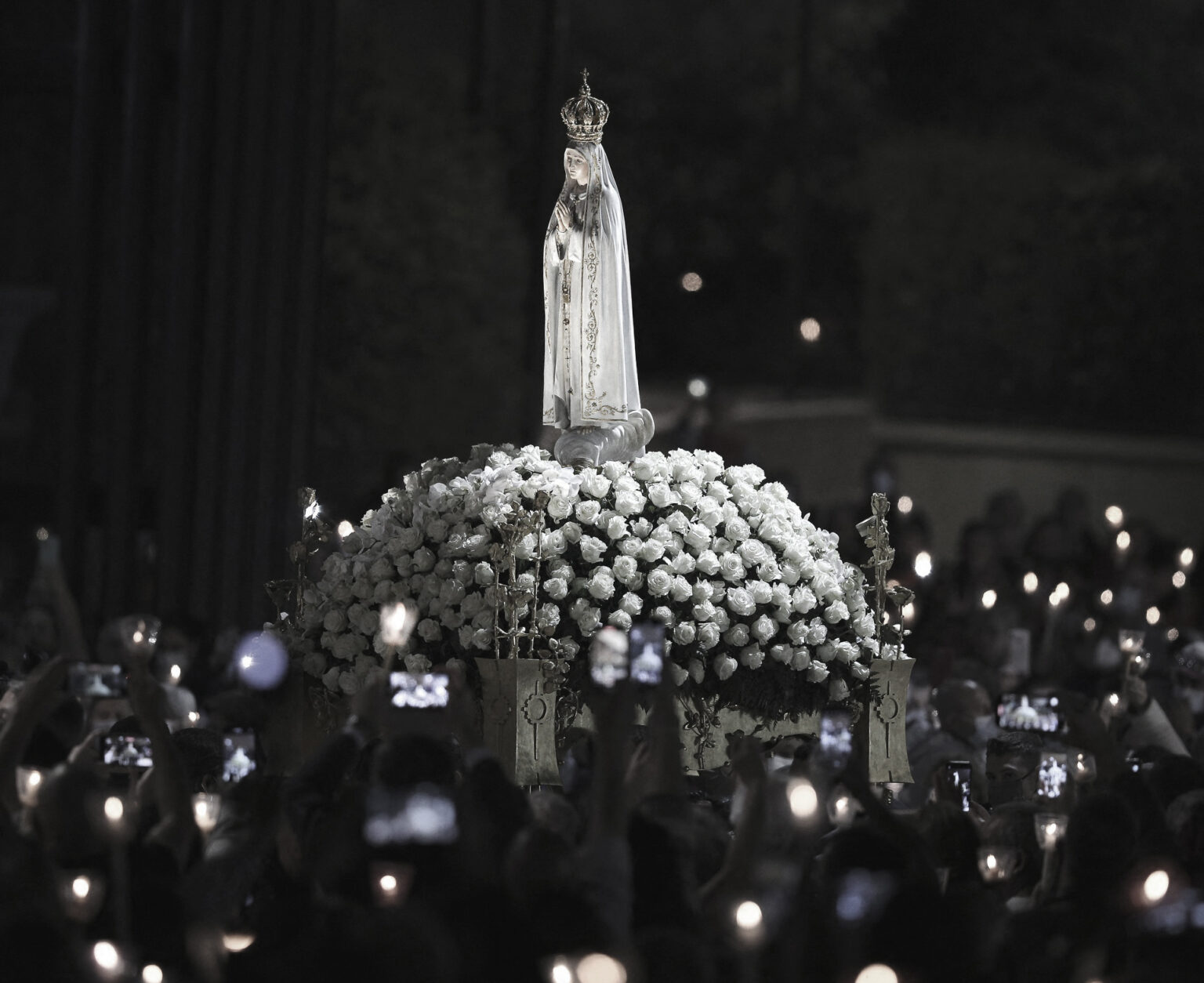
The most compelling prophecy from the 20th Century is intensely strange; its visible human countenance is that of an illiterate child turned Carmelite nun.
Fatima’s story and Sr Lucia’s role in it are well known. In the Summer of 1917, three shepherd children from the rural village of Fátima, Portugal reported a series of visions of the Virgin Mary. Francisco and Jacinta Marto, along with their cousin Lucia dos Santos, became the unlikely recipients of what would grow into one of the most poignant Marian apparitions of all Christian history.
Between May and October, the figure they called ‘Our Lady of the Rosary’ appeared to them on the thirteenth day of each month. The visions culminated in an astronomical phenomenon later known as the ‘Miracle of the Sun’, which thousands of bystanders witnessed.
Central to the apparitions was a prophetic message entrusted to the children: a ‘secret’ articulated and revealed, both to them and to the wider world, in three parts: a harrowing vision of hell, accompanied by an appeal to prayer and penance, so that souls might be spared; the imminence of a new war, even worse than the then-unfolding First World War, if humanity did not repent, as well as the need to consecrate Russia to Mary’s Immaculate Heart. The third part, written down by Sister Lúcia decades later, contained the enigmatic vision of a ‘bishop dressed in white’ walking through a ruined city and then up a hill, before being killed alongside other clergy and faithful.
The first two parts became public in the 1940s, whereas the third one remained sealed for four decades in the Vatican archives, and attracted sensationalistic speculation until the Holy Year of 2000, when Pope John Paul II decided to release it. Its disclosure has remained the object of enduring polemics, with some arguing that only a (possibly redacted) selection of Sr Lucia’s original text was published—something she, still lucid in her nineties, vigorously denied. Regardless of the amount of transparency involved, from a Catholic vantage point Fatima’s secret continues to represent a unique source of insight into contemporary history.
Russia at The Secret’s Heart
One hallmark of Fatima’s prophetic role in accounting for contemporary history is its focus on Russia. In Sister Lúcia’s memoirs, the Virgin warns that without conversion and consecration, Russia would ‘spread its errors throughout the world, causing wars and persecutions of the Church.’ At the time of the apparitions, the Russian empire was on the brink of collapse, whereas atheistic Communism was on the rise—as unaware of it as most, not just the little shepherds, might have been then.
Throughout the subsequent decades, successive popes responded to the Communist threat and its global spread with acts of consecration. Pius XII, at the beginning of the Cold War, consecrated ‘all the peoples of Russia’ in 1952; in 1984, John Paul II, profoundly marked by the attempt on his life in 1981 and by his Polish background, performed an act of universal ‘entrusting’ before a statue of Our Lady of Fátima. More recently, Pope Francis consecrated Russia and Ukraine to the Immaculate Heart of Mary in March 2022. Theologically versed observers have argued that only the last of these consecrations got close to the kind of universal act, performed in communion with all Catholic bishops, which the Virgin had required.
At the same time, this prophetic insistence on consecration reveals that the Catholic concern for Russia is spiritual as much as geopolitical. Just as intensely as at the time of the apparitions, present-day Russia still stands at the edge of Western civilisation; the deep rooted faith of Orthodox Christianity has long coexisted with brazen manipulation and brutal persecution. Communism equipped Russia with modern technical infrastructure to project and, indeed, spread its might and contradictions to the outside world; Fatima, for its part, sheds a light onto the need to integrate this frail geopolitical giant, reclaiming it from its ancestral, self-imposed liminality—and to properly reinvigorate Western Christendom to that end. ‘My Immaculate Heart will triumph’, said the Lady to Sister Lucia. Russia stands right at the centre of it, as the vehicle and condition of that victory.
Mobilised for the Present
When the Holy See released the secret’s third part in 2000, then Prefect for the Doctrine of Faith Cardinal Ratzinger was tasked with offering an interpretative framework for the Fatima experience as a whole. ‘Prophecy’, he explained, ‘in the biblical sense does not mean to predict the future but to explain the will of God for the present, and therefore show the right path to take for the future’.
Pope Francis’ 2022 consecration, projecting the message of Fátima beyond the logic of past conflicts onto Ukraine and the threat of nuclear destruction, isn’t the only instance of Fatima’s ongoing viability. What was true of 1917 Portugal, suffering under a violently anti-clerical regime, or the Cold War, when Fatima became a rallying point for anti-communist Catholicism, remains true today. In fact, the secret’s emphasis on the martyrdom of several Christians, including a ‘bishop in white’, needs not be limited to foretelling the 1981 attempt on John Paul II’s life, as has been suggested. Rather, it unveils an often forgotten fact of contemporary history: that the 20th Century has been the single century mostly marked by the persecution and slaughter of Christians, in any respect.
In dramatic consistency with the prophecy’s first and second part, the third secret shows that a world turned away from God and subjugated to ideology is by necessity one that strives to do away with Christians in a final fashion. Appreciating this fully frees the Fatima message from being reduced to conspiracy theories or chronological decoding. Instead, it invites reflection on how divine providence aims to ‘mobilise the powers of change’ as then-Cardinal Ratzinger put it, and alert people to the urgency of understanding persecution and, through that, resisting de-Christianisation of the West—the only civilisation ever known where self-giving love and forgiveness have some space. Sr Lucia’s dedication to reinvigorating the Virgin’s prophetic message serves as a wake-up call for those who still think debate sessions can actually save it.
Statement
The Fatima apparitions, often treated as dubious relics of Catholic piety, are better read as a prophetic template for the 20th and 21st centuries. Delivered through shepherd children in 1917 Portugal, their three-part ‘secret’ discloses the century’s twin fault lines: ideological conflict and the relentless persecution of Christians. Russia sits at the prophecy’s core—as a geopolitical and spiritual hotspot, where faith, ideology, and violence converge most visibly. From Pius XII to Francis, consecrations have sought to reclaim its history through prayer. Meanwhile, Fatima endures as a plea to see persecution and conversion as the highest challenges for Western civilisation.