
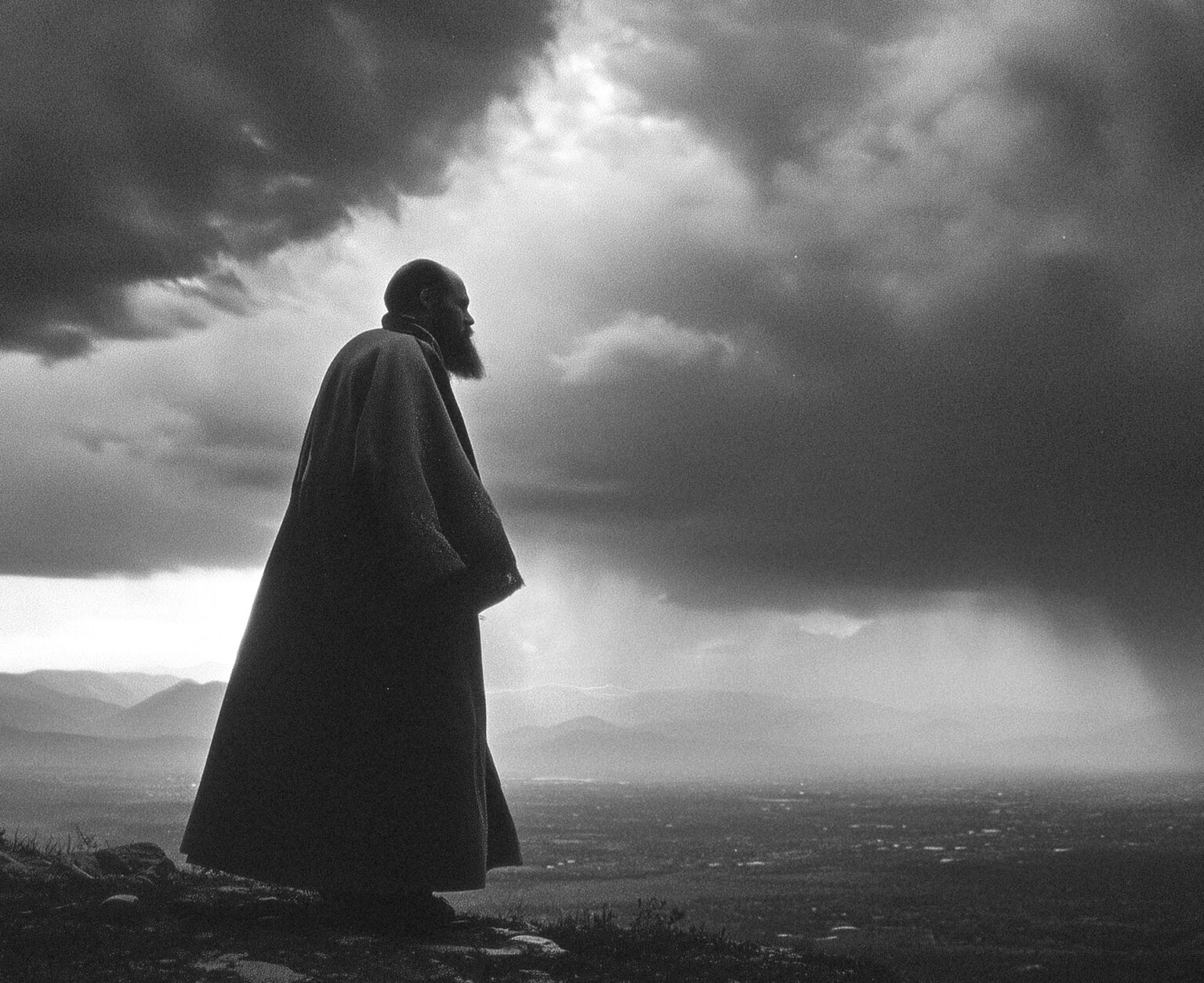
Like an Old Testament prophet, Aleksandr Solzhenitsyn emerged from the horror of the gulag to denounce Soviet tyranny. His stern calls for moral renewal, steeped in ascetic resolve, warned of societal collapse if ignored. His voice still echoes in a divided West, urging reflection to avert ruin.
Embodying the Prophetic Ethos
Aleksandr Solzhenitsyn did not merely reflect the inner qualities of a prophet revealing uncomfortable truths; he bore their outward likeness as well. His face, stature, and demeanour could have served as a model for painters or filmmakers depicting Old Testament prophets. This was coupled with a pronounced personal asceticism. Solzhenitsyn was known for his almost monastic dedication to his writing, tireless study, and meticulous gathering of materials. He shunned worldly pleasures; his only ‘secular’ indulgence was tennis, which he viewed primarily as care for the body—the temple of the immortal soul.
His most significant contribution to the West was the publication of his monumental testimony, The Gulag Archipelago. Its dissemination made it difficult to defend the communist system as a moral exemplar. Yet it would be a mistake to view Solzhenitsyn’s work solely through this lens. Concentration camps, he argued, were merely the visible manifestation of evil. The true cause of the eternal struggle between good and evil lies within the soul of every individual. Here, the drama unfolds: will a person align with evil and remain silent, or embrace goodness and bear the consequences of their choice? This battle transcends time and space, remaining relevant regardless of era or regime.
A Warning to the West
Solzhenitsyn’s timelessness extends beyond the universal battle of good and evil. His work, rich with universal truths, also carried a specific warning for the West. Yet, when pressed for advice, he demurred, insisting his insights were rooted in the Russian experience, as seen in How to Rebuild Russia (1990), The Russian Question (1994), and Russia in Collapse (1998). These warnings went largely unheeded. He believed Russia’s challenges were primarily for Russians to solve, urging the West to refrain from imposing solutions on a nation it did not fully understand.
Yet Solzhenitsyn deliberately crossed Russia’s borders once, delivering a prophetic address aimed directly at the West. In 1978, he spoke at Harvard University during its 327th commencement. Drawing on three years of exile in the United States, he highlighted the divided nature of Western society. Though the Iron Curtain no longer divides us, the term ‘divided society’ has resurfaced with an uncomfortable regularity over the past decade. Solzhenitsyn went further: despite this weakness, the West persistently clings to a sense of superiority. This blindness endures, even though anyone who has visited Shanghai or Dubai in the last decade must recognise that the West no longer can lay claim to being the sole mover and shaker in the world. Yet, as Solzhenitsyn warned, the West compensates for its predicament by judging whether other nations are sufficiently democratic—an example of the New Testament’s speck in a neighbour’s eye.
A Third War on the Horizon?
According to Solzhenitsyn, the West’s decline is most evident in the erosion of courage—not only on an individual level but, crucially, on a collective one, particularly among intellectuals. This lack of courage manifests as a loss of ‘manliness,’ a trend the Russian prophet precisely foresaw. Forty-five years later, this loss has become a societal issue, permeating not just the elite but society as a whole—despite the fact that climbing the social pyramid requires at least a modicum of courage.
Solzhenitsyn’s diagnosis continues: consumer culture breeds an idle lifestyle, while the dominance of legalism turns what used to be ordinary social conflicts into lawsuits. People have lost the courage to resolve issues themselves, reinforcing an egotistical conception of freedom—freedom understood as the right to satisfy one’s personal desires. This moral decline, driven by materialism, undermines liberty and weakens society. A weakened society, Solzhenitsyn warns, loses its capacity to maintain peace, for strength is essential to peace. His prophetic warning of a third European war, triggered by spiritual and moral decay, finds an echo in Europe’s current hesitation over the war in Ukraine. The West lacks the courage for decisive action—whether in providing effective aid to Ukraine or accepting its fate as being the war’s loser.
True to his prophetic role, Solzhenitsyn offers a solution: a return to a spiritual perspective on the world. This does not entail blind adherence to Orthodoxy but a shift from humanity as the centre of the universe to the spiritual dimension of existence. This path out of crisis remains his timeless message to a divided and wavering West. Solzhenitsyn offers no easy fixes but an urgent reminder: without a moral and spiritual backbone, no society can endure. The sad truth is that, since his Harvard address, we have learned little. His message—courage to face the truth and embrace responsibility—is a challenge not only to elites but to anyone seeking to avert the next crisis. Will future generations heed this voice crying out from the Siberian wilderness?
Statement
Aleksandr Solzhenitsyn, a modern prophet, emerged from the gulag to warn the West of its moral decline. His Gulag Archipelago exposed Soviet tyranny, but his broader message transcends time: evil lies within every soul, and only courage and repentance can avert collapse. In his 1978 Harvard address, he decried the West’s division, arrogance, and eroded courage, foreseeing a consumerist slide into weakness. His call for spiritual renewal remains urgent. Solzhenitsyn’s voice, echoing from Siberia, challenges us to confront truth and take responsibility to avert a major crisis. Will we heed his warning?