
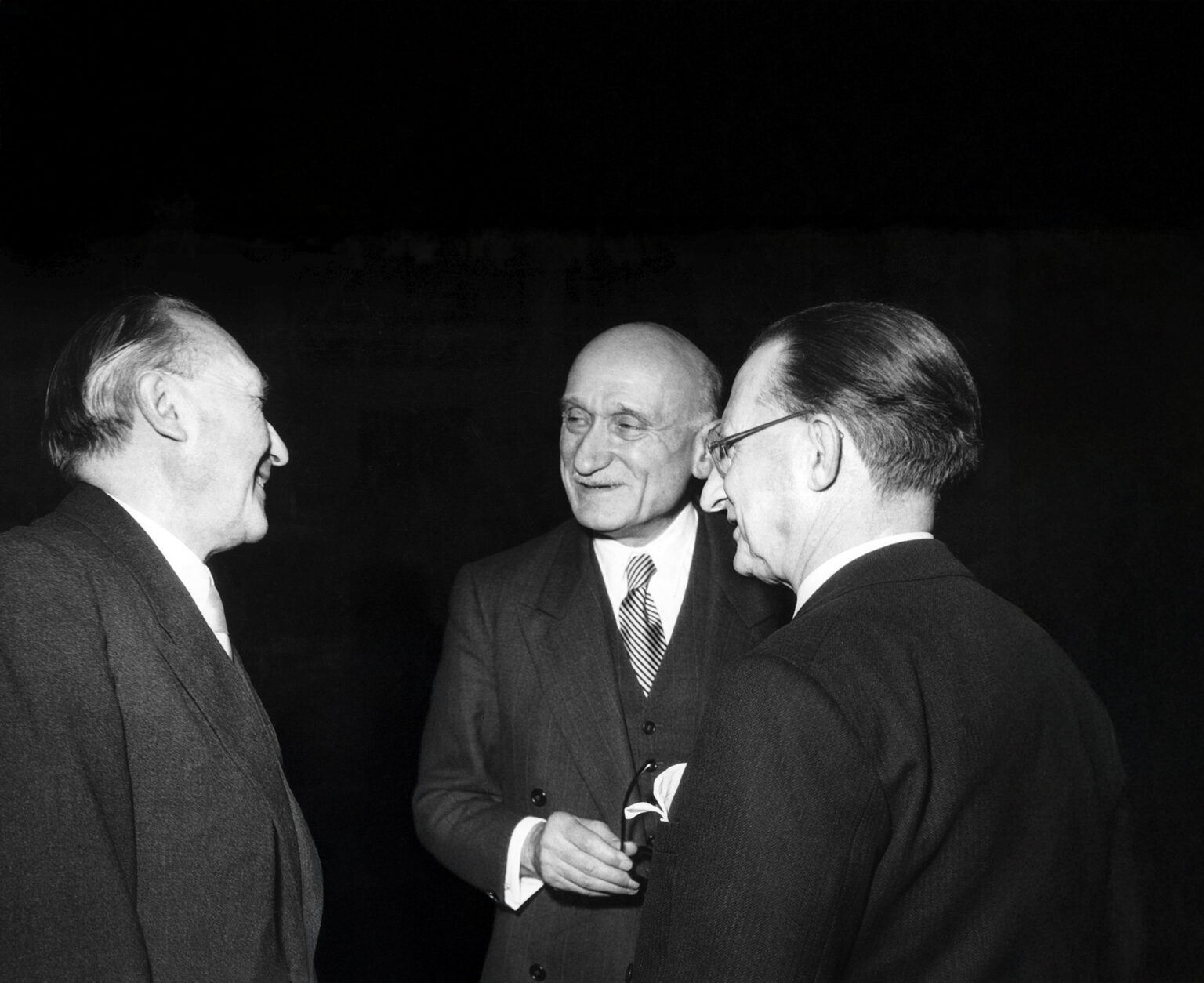
The success story of European integration is also the story of its personalities. The revolutionary leap towards European co-operation rested not least on shared historical experience, ideological alignment and religious conviction. This held true for the original founding fathers: Konrad Adenauer, Robert Schuman and Alcide De Gasperi. They were not only devout Catholics, but also hailed from the periphery of their respective nations: Schuman, a Moselle Frenchman by birth; Adenauer, a Rhinelander; and De Gasperi, a Trentino. By virtue of their regional Catholic roots, they walked in the intellectual footsteps of the Holy Roman Empire. The mental and ideological universe in which they moved was the same.
Today’s historiography treats with deep scepticism the idea that great history is made by great men. Among the EU’s weaknesses is the admission that, for the past three decades, no one of the stature of a Charles de Gaulle or a Helmut Kohl has stepped onto the stage to lift Europe to a plane beyond that of a soulless bureaucratic state. Since the Lisbon Treaty, none has even come close to rekindling the spirit of the post-war years or the optimism of the post-Cold War era.
From tandem to vacuum
A civilisational unification cannot be decreed from behind a desk. Had the unification of Italy or Germany been pursued with the same bloodless verve as today’s European project, the freedom fighters and advocates of unity would quickly have reverted to small-state particularism—precisely the so-called “populist” current now sweeping the continent, and causing Brussels’ functionaries such anxiety.
Beyond the dearth of historic personalities, the EU’s internal balance of power has fallen victim to a silent revolution. European integration began as a Franco-German-Italian enterprise. Thereafter the Franco-German tandem dominated. But who, today, is the motor of Europe? Brussels fancies itself an autonomous power centre. The sorry figure cut by Commission President Ursula von der Leyen, both at home and abroad, shows that the EU can keep its members in line internally through laws, regulations and directives—yet also that it swiftly hits its limits when its all-powerful bureaucracy cannot dispatch a problem with a stamp. It functions in the climate it has built for itself, but not in the harsher weather of the real world. And that weather had begun to change well before Russia’s assault on Ukraine.
Europe still needs its nation-states to lend the Union weight and to translate national strengths into European strength. Yet little can be expected from France and Germany, from Emmanuel Macron and Friedrich Merz. Both are in phases of weakness—whether owing to tricky domestic majorities, to migration and demographics, or to the economy and public finances. Italy, too, faces these problems, yet under its national-conservative government it has, for three years, pressed to turn the tandem back into a triumvirate. Italy enjoys one advantage over Macron and Merz: it has a charismatic, unspent leader with appeal beyond its borders.
Rome’s unexpected contender
Ironically, the only current European figure of historic calibre is Giorgia Meloni. Contrary to press caricatures, she is no anti-European. She does not love Brussels, but she can deal with it. She also knows that Brussels is not Europe. Meloni does not think in the Carolingian mould of Adenauer and de Gaulle. Her frame of reference is unmistakably cultural-European—for instance, when she calls Rome the true capital of Europe. Here resonates a Roman-Latin consciousness: integrative, yes, but grounded less in functional-administrative logic than in an imperial-cultural dimension.
The patina of media opinion and Brussels bigotry has not yet fully registered this Italian turn, because their claim to interpretive authority clouds reality. Much as the EU cannot comprehend its own condition, it cannot break free of its stale paradigms. It still trusts that Germany, in some fashion alongside France, will put things right. Witness the anticipation of Friedrich Merz’s chancellorship, as though his arrival would automatically restore the Franco-German leadership role. In truth, that role had only barely persisted under Angela Merkel, who, much as she did at home, tended to manage the colossus—or use it for her own ends—rather than govern, shape and create.
From this Merkelian habit of muddling through, the EU has not emerged in 20 years. It assumes that history runs on rails, that it is destined—by historical necessity, in a way recalling Hegelian-Marxist historicism—to become an ever-closer union through bureaucracy and paper. That on this path to “Europe” the Europeans themselves have been lost is now a truism.
Statement
The EU’s inability to prove itself was laid bare by the disastrous deal between von der Leyen and Donald Trump. It is not enough to consider oneself grand and important if there is no leadership capable of turning such self-regard into genuine weight—beyond harassing citizens or stifling progress with fresh regulations. The EU lacks not only a soul, but also flesh and blood. A soldier, Napoleon once said, does not die for pay alone. In the EU’s case, there is not even a pay it would be worth dying.