
In the summer of 2014, German Chancellor Angela Merkel celebrated together with the national football team at their World Cup win. Her uncharacteristically jubilant expression, captured in photographs, made headlines worldwide. It was not merely a German victory—it symbolised, for many, a resurgent Europe.
After the euro crisis had shaken the continent, the European Union, under Merkel’s leadership, appeared to be regaining its footing and reasserting itself on the global stage. Yet this image of European unity and strength was deceptive. Much like the German football team, which failed to advance from the group stage four years later in Russia, Europe soon revealed the fragility of its presumed sovereignty. Today, even the most ardent advocates of European integration are beginning to acknowledge the Union’s limitations, as its illusion of power crumbles under the weight of three critical weaknesses: dependence on foreign military protection, fragile economic self-sufficiency, and lagging digital and technological sovereignty.
A Combat-Ready European Army?
The European Union has one undeniable achievement: it ensured lasting peace between Germany and France, two nations that waged devastating wars in the 20th century. While their rivalry persists, physical confrontation is unthinkable. European integration has made the unimaginable possible—most European countries no longer face immediate military threats. Maintaining large armies lost its purpose, and defence spending plummeted as a result. European nations shifted towards smaller, professional forces rather than sprawling militaries. This trend is reflected in armaments investment: between 2005 and 2018, the EU’s total annual defence spending remained below €200 billion. This allowed European countries to redirect resources to education, healthcare, and infrastructure.
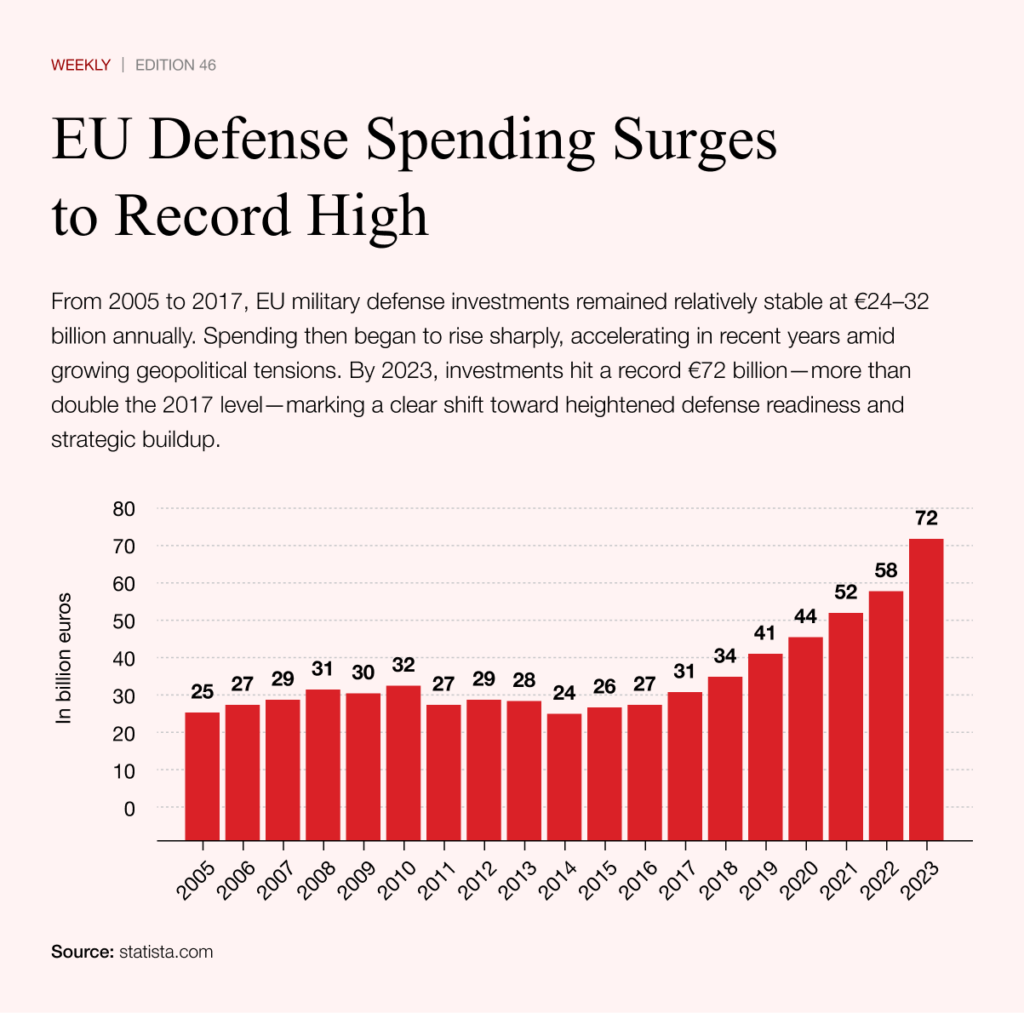
Low defence budgets gave Europe an economic edge. While the United States consistently allocates over 3.4% of GDP to defence, Germany in 2024 reached only 1.9% of GDP, despite (nearly) meeting NATO’s 2% target for the first time since 1992. From a purely economic perspective, investing in military hardware that is either destroyed in conflict or left unused seems inefficient. Yet this logic has collided with a new reality.
The final blow to Europe’s low-spending model came from Donald Trump. At the 2025 NATO summit, he demanded that member states increase defence spending to 5% of GDP by 2035. Most European countries, with exceptions like Spain, acquiesced. The reason is stark: without US support, NATO is ineffective, and Europe lacks a credible, independent military. For most states, this means doubling defence budgets—a challenge for countries like France, which, despite its relatively robust military, faces a 5.8% GDP deficit. The notion of a unified European army remains, in 2025, a mere fantasy, with no consensus on its structure or operation.
Europe’s Economic and Technological Dependence
Donald Trump’s return to the White House has reshaped global economic thinking. Trump uses trade balances as a key metric for determining relations with other nations, viewing the US’s import-heavy economy as a cause of its decline. Long-standing trade ties now face scrutiny through tariffs and protectionism. For Europe, a long-time champion of free trade, this is a harsh blow. In 2023, the EU recorded a €228 billion trade surplus with the US. Trump responded by imposing 15% tariffs to correct this imbalance. European leaders, rather than resisting, readily accepted these demands, further exposing the fragility of European sovereignty.
Yet Europe held cards it failed to play. Trump’s trade focus is on goods, not services. In 2023, the EU exported €319 billion in services to the US while importing €427 billion, largely due to the dominance of American tech giants like Google, Amazon, and Microsoft. The EU could have threatened taxes on these services to strengthen its negotiating position but did not. Europe’s sovereignty is faltering not only in defence but also in economic and technological domains.
Technological Capitulation
Ursula von der Leyen’s speech following a disadvantageous trade deal with Trump included a telling line, overlooked by most media: ‘American AI chips will power our AI factories and bolster US technological dominance.’ This effectively admits the EU’s surrender in technological self-sufficiency for the next decade. It is no surprise that artificial intelligence and robotics will define a nation’s technological prowess. These technologies rely on data centres, which in turn depend on chips. True technological sovereignty requires control over the entire production chain, including chip manufacturing. In this race, two powers dominate: the US and China.
Europe has skilled engineers and a technically advanced population, giving it a chance to compete—not as a leader, but as a significant player capable of influencing the balance of power. That opportunity is now all but lost. American chips will not enhance Europe’s technological prowess but deepen its reliance on the US. Europe thus loses another pillar of its sovereignty, becoming a mere consumer of technology rather than its creator.
Europe faces a stark choice: invest heavily in defence, industry, and technology, and accept the associated short-term costs, or resign itself to permanent dependence on others. Delay is not a neutral option—it is an implicit acceptance of the latter.
Statement
Europe’s claim to global power is an illusion, undermined by its reliance on NATO for security, economic dependence on the US and China, and it lagging behind technologically. The 2014 World Cup, celebrated by Angela Merkel, briefly hinted at a resurgent Europe, but this unity has frayed. Modest defence spending, like Germany’s, and Trump’s bold demands expose military vulnerabilities. Economically, the EU’s trade edge weakens as it ignores service imbalances. Technologically, Ursula von der Leyen’s admission of dependence on American AI chips reveals a grim truth: can Europe forge its own path or remain a bystander in innovation?