

A Burberry coat, a well-worn Barbour jacket—these are more than garments; they are whispered declarations of belonging. While the world chases trends, Europe dictates them, refusing to trade heritage for ephemerality. This sprezzatura is more than style—it is a testament to an industry that dares to lead.
In the ateliers of Milan, the cutting rooms of London, and the runways of Paris, there is no equality of mediocrity—only excellence or irrelevance. The world rushes toward disposability, but Europe’s fashion industry stands immovable, evolving heritage without erasing it.
To create is to command, a lesson forgotten by much of Europe, and even sometimes by its own fashion industry, where over-the-top, performative wokeness overshadows the very craft it claims to celebrate.
Where Style Commands: Mastery Over Mere Production
Europe doesn’t just make clothes. It sets the global standard. Italy’s sartorial masters, Parisian haute couture, and London’s tailors are not relics—they are architects of permanence in an era of ephemera. Excellence without compromise is their doctrine.
Heritage brands like Barbour, with its century-old tradition of waxed jackets, prove that legacy and innovation are not opposing forces. They are the same force, refined over time. That is why a Savile Row suit or a Chanel gown becomes an heirloom, not a purchase.
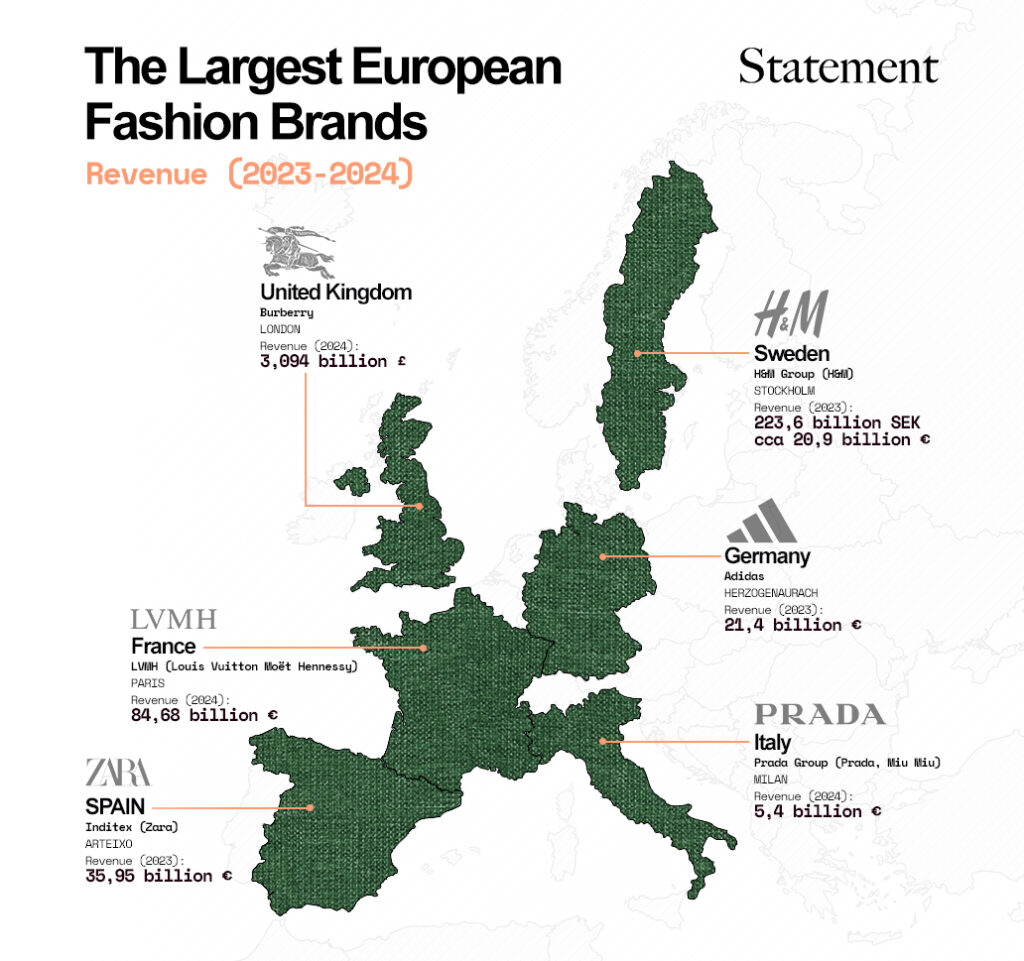
Indeed LVMH, Europe’s most powerful luxury holding, saw revenues soar to €86.2 billion in 2023—not because it followed fleeting trends, but because it never has. Compare Adidas, which generated only €21.4 billion the same year, thriving on mass-market performance wear and global branding.
Refinement: The Art of Innovation Without Erasure
Elsewhere, Europe’s industries have misunderstood innovation. Tech preaches disruption as though destruction is the only path forward.
But true innovation refines rather than replaces. Gucci’s Material Innovation Lab pioneers sustainable fabrics while keeping luxury at its core, and Portugal’s reborn footwear industry blends automation with artisanship, proving that machines enhance craftsmanship rather than replace it.
Even in fast fashion, European ingenuity leads. Inditex—the empire behind Zara—has built a machine that reacts faster than the market, proving that adaptability and ambition are not mutually exclusive. The Spanish giant prioritises speed, flexibility, and design leadership, ensuring even mass-market clothing adheres to Europe’s tempo, a model also followed by an unlikely contender, Japan’s Uniqlo, slowly growing in sales.
Meanwhile, in Brussels, other industries drown under regulation. Tech is tangled in compliance. Energy is smothered by contradictions. Manufacturing waits for permission to move forward. And yet, fashion defines global aesthetics without waiting for approval.
If Europe’s other industries followed fashion’s example, progress wouldn’t be a wrecking ball but a tailor’s needle—refining, adjusting, and improving with precision.
The Last Unchained Industry: A Rare Exception to Europe’s Self-Sabotage
Fashion thrives as one of Europe’s last unburdened creative strongholds. Unlike its shackled industrial counterparts, it creates without apology. Their designers create, artisans refine, and names lead.
No one waits for the European Parliament to approve the next collection at Pitti Uomo, and the European Commission does not dictate the silhouette of tomorrow. Dior, Prada, Givenchy do.
Now imagine if Europe’s other industries had the same audacity. If manufacturing, technology, finance, and energy reclaimed the spirit of those who shape fabric and steel with nothing but vision and will, the results would not just be impressive. They would be revolutionary.
The Outsourcing Illusion: Who Still Sets the Standard?
Some think outsourcing means Europe’s decline, and while the factories of fashion may be elsewhere, the standard remains European. There is a reason “Made in Italy” still carries weight. Select Italian manufacturers are repatriating production—not out of nostalgia, but because Europe still sets the terms of craftsmanship.
As Donatella Versace said, "the elegance and craftsmanship rooted in European fashion houses continue to inspire designers worldwide”, even when production moves offshore.
Meanwhile, European energy, tech, and manufacturing have surrendered leadership rather than reinforced it.
Tailoring Europe’s Comeback: The Fashion Model for Industrial Revival
What separates European fashion from its other struggling industries is not magic—it is method. One that should be studied, replicated, and adapted to every corner of innovation. Respect the past. Protect the institutions that produce excellence. Embrace the future. Use technology to refine, not replace. Remove the barriers. Let innovation flourish, free from bureaucratic sabotage.
The Draghi Report on European competitiveness makes it painfully clear: overregulation is suffocating Europe’s ability to build, invent, and lead. Europe missed the digital revolution and risks repeating the failure.
Where European fashion advances, the rest of Europe lags. But it does not have to. The answer is not more hesitation, intervention, or timid reform. The answer is what fashion has always understood: confidence, vision, and execution. Europe’s cloth is cut. Can it still tailor a future worth wearing?
Statement
Europe’s fashion industry thrives because it has been left alone to do what it does best: create, refine, and lead. It is a rare example of what happens when excellence is cultivated rather than strangled by regulation. The lesson is clear: industries flourish when they are free to pursue greatness, not when they are micromanaged into mediocrity. If Europe wants to lead again—in technology, energy, or any other sector—it must learn from its own tailors. Progress and excellence are not imposed by committee. They are crafted, stitch by stitch, by those who understand its value.