

Unlike cinema, TV lacked prestige and was rarely considered a serious storytelling medium. However, the early 21st century saw a shift with the rise of “prestige television,” led by series like The Sopranos, Breaking Bad, and Game of Thrones.
Longform television emerged as a rival to cinema, offering complex narratives that thrived in the era of streaming. Platforms like Netflix and HBO Max capitalised on this shift, making longform storytelling the industry norm.
Yet, the golden age of longform television may be behind us, as Hollywood’s over-reliance on the model is now revealing its limitations.
The Streaming Era and the Dominance of Longform Storytelling
The early 2000s marked a turning point in television as season-spanning narratives replaced the long-dominant episodic format. Shows like Mad Men and The Wire embraced slow-burn storytelling, deep character development, and complex themes traditionally reserved for film.
The presence of A-list actors, such as Kevin Spacey in House of Cards and Matthew McConaughey in True Detective, further legitimised longform television as a serious artistic medium. This shift coincided with the rise of streaming services, led by Netflix, which capitalised on the “binge-watching” model.
What truly cemented its dominance, however, was its financial viability. Unlike films, which had limited engagement beyond their release, shows kept audience interest for years. While the exact contribution of individual shows to a platform’s total revenue remains difficult to quantify, Netflix’s explosive growth speaks volumes. The company’s revenue surged from $3.2 billion in 2010 to over $20 billion by the next decade, fueled by hit series like The Crown, Orange Is the New Black, and Stranger Things. Seeing the success of this model, competitors like Amazon Prime Video followed suit, investing in flagship series such as Bosch and The Marvelous Mrs. Maisel.
From Boom to Backlash: The Decline of Longform Storytelling
Despite its meteoric rise, the longform format is now facing significant challenges as the COVID-induced streaming bubble is destined to pop upon settling into the “new normal”. Financial strains and an audience which experiences fatigue with the glut of content that is on offer, have cast doubt on the prospect of ambitious multi-season storytelling as witnessed before.
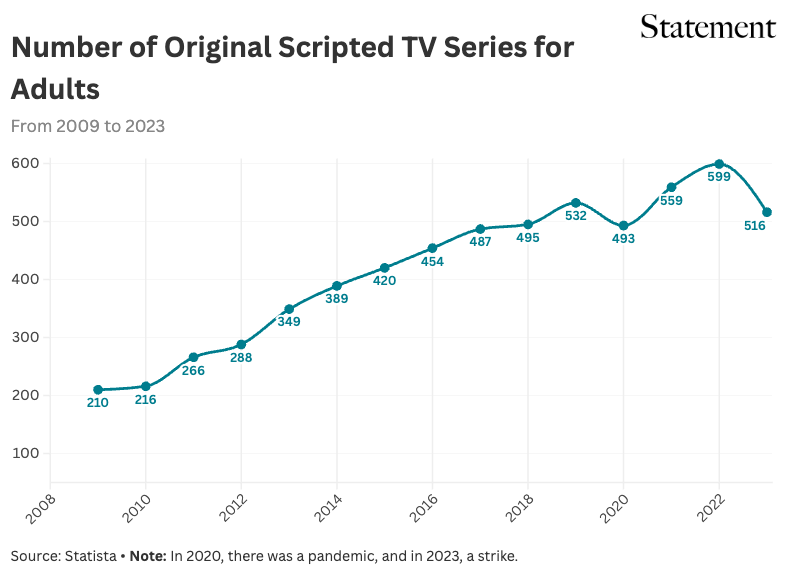
Studios are now scaling back their TV ambitions, with fewer greenlights for expensive multi-season shows in the wake of dismal post-COVID numbers. A record high of 600 original scripted TV series aired in the U.S. in 2022, but this number dropped by 14% in 2023 due to industry strikes and a strategic shift from growth to profitability. The decline in production also reflected clearly in studio spending. Hollywood studios spent 20% less (only $11.3B USD) in 2024’s second quarter compared to the same period two years earlier. Add to this data Netflix’s monumental subscriber losses in 2022 and Disney+’s multi-billion dollar losses in 2023, and it’s clear the model of virtually limitless spending on new content has proven unsustainable.
Recent TV series’ budgets have ballooned. High-end television series have seen per-episode production costs ranging from $3.1M to a whopping $15M USD. For example, the first season of “The Crown” averaged $10M per episode.
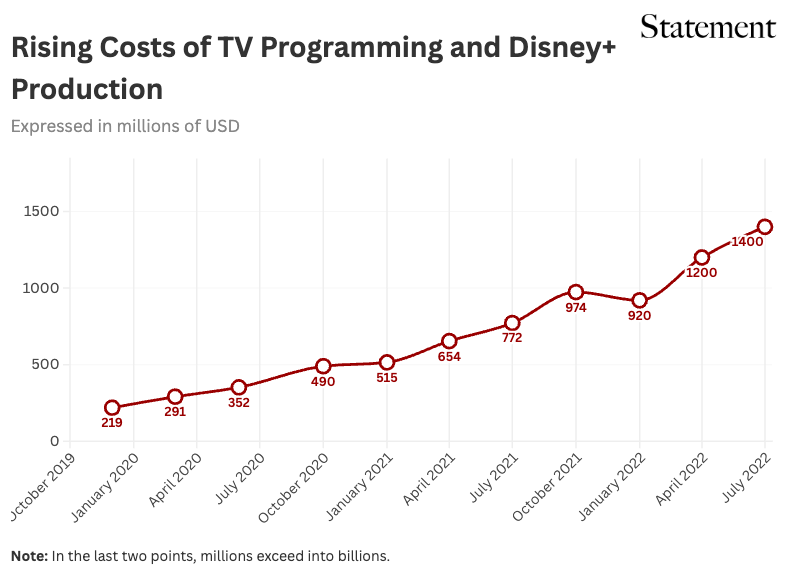
Many studios have pivoted away from original content toward large budget productions with existing, “safe” intellectual properties. The “Andor” series, under the Star Wars franchise, reportedly cost $645M between 2022 and 2024. Similarly, ”The Acolyte,” another Star Wars series, cost $230M in 2024. The underwhelming performance of both are grossly out of sync with their budgets.
Audiences are becoming increasingly frustrated with shows that drag out stories unnecessarily. Many series that initially captivated viewers (Westworld, Stranger Things, The Witcher) have struggled to maintain their quality and/or narrative momentum, leading the latter to stop watching. Overextended franchises (The Walking Dead, Marvel’s Disney+ shows, The Mandalorian’s spin-offs) showed diminishing returns, proving that quantity and longevity do not necessarily translate to success.
End of an Era
The era of longform television dominating the entertainment industry appears to be on the wane. What was once a profitable and innovative storytelling approach has, over time, led to creative stagnation and bloated budgets. As streaming platforms tighten their budgets and audiences seek more concise, impactful narratives, we are witnessing a return to shorter storytelling formats, as seen in HBO’s Chernobyl (2019) and Netflix’s The Queen’s Gambit (2020), which delivered gripping narratives in just five and seven episodes, respectively. Streaming platforms are also embracing event-driven productions, such as Disney+’s Obi-Wan Kenobi (2022) and Netflix’s Squid Game (2021), proving that concise, self-contained storytelling can be just as impactful as multi-season epics.
That being said, longform storytelling will not disappear, but instead will adapt, bringing tighter narratives and better-planned series arcs. Hollywood may have milked the longform model, but future television will likely embrace a more diverse approach—producing both longform and shortform while avoiding the over-saturation and excess which have plagued the industry in recent years.
Statement
Longform TV, once the dominant force in entertainment, is showing signs of decline. Once celebrated for its rich storytelling and financial success, the model is now struggling with rising costs, audience fatigue, and diminishing returns. Studios are cutting back on expensive multi-season productions, while viewers grow frustrated with bloated narratives and overextended franchises. The future of TV lies in resurrecting the dynamic, self-contained stories of shortform TV, as these coexist with longform, yet tightly plotted, narratives.