
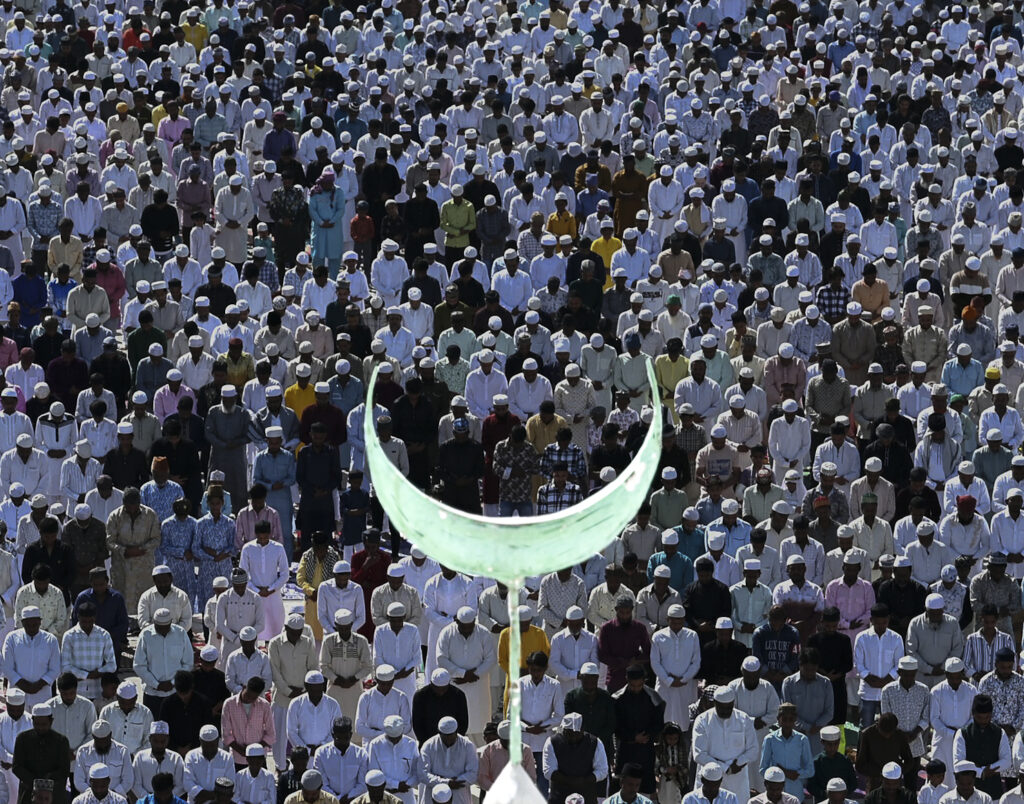
Each year, as the crescent moon during the month of Sha’ban marks the beginning of Ramadan, nearly two billion Muslims worldwide observe a month of fasting, prayer, and community. More than a religious ritual, Ramadan serves as a profound expression of Islamic identity, reinforcing spiritual discipline while fostering social cohesion. It is meant to be a time of introspection and heightened religious consciousness, but it has also become a period of public celebration, commercial activity, and—inevitably—political debate.
As Islam’s global presence expands, so too does the visibility of Ramadan. Once confined primarily to the Middle East, North Africa, and Southeast Asia, the fast is now widely observed in cities across Europe, North America, Sub-Saharan Africa, South Asia, and even China. With this growth come pressing questions: How does Islam adapt to new environments, and how do these environments, in turn, react to Islam? What tensions arise between local societies and a new faith that retains a strong legal and communal dimension, best exemplified through Ramadan? And as Western societies struggle with cultural and demographic shifts, will Islam follow a path of assimilation, or will it assert itself as a distinct and influential social model?
The Western Catalyst: Colonisation, Migration, and the Reawakening of Islam
The global dimensions of Ramadan do not come as a real surprise. Like Christianity and Manichaeism before it, Islam was founded as a universalist religion, designed to transcend ethnic and cultural boundaries. In theory, Islam is adaptable to any society, offering a framework for governance, social order, and personal conduct. And even if Islam’s expansion has mostly been successful in regions that already bore certain cultural affinities (e.g., through monotheistic traditions, Semitic linguistic influences, and the interplay between nomadic and urban societies) and reached its essential territorial limits in the Middle Ages, Islam’s appeal was paradoxically revived by the very force that threatened to overwhelm it: Western civilisation. The colonial era forced Muslim societies to confront stagnation, leading to reformist and revivalist movements aimed at modernising Islam in response to European dominance. Figures such as Muhammad Abduh and Rashid Rida sought to reconcile Islamic law with Western governance and technology, while others, like Hassan al-Banna and Sayyid Qutb, saw modernity as a threat to be resisted.
This interaction did not stop at the colonial frontier. The rise of Orientalism and spiritual movements like perennialism brought an intellectual fascination with Islam into the West, even as the West marginalised Muslim influence in Islam’s own core territories. With mass migration in the latter half of the 20th century, Islam was not merely influenced by the West—it became a permanent part of it. Today, millions of Muslims shape the cultural and demographic landscape of Europe, particularly in France, Germany, the UK, and the Benelux nations. Given current fertility rates and migration trends, these communities are not temporary enclaves but enduring features of Western society: migration, though long-time underestimated and downplayed by the elites, brought with it one of the most revolutionary cultural shifts in the entire history of the West.
Naturally, this has led to resistance, particularly in Europe, where migration has historically been seen not as an intrinsic part of nation-building, as in the United States, but as a temporary economic measure. The rise of anti-immigration movements, endless debates over integration, an obvious political interest of the left in increasing its voters, Europe’s demographic decline and contradictory policies aimed at addressing economic needs as well as human misery made things even more complicated. Yet even if migration were halted tomorrow and illegal migrants led back to their home countries, the presence of Islam in Europe would remain a defining issue. At least the West of the continent is no longer culturally and spiritually homogenous, and it is unlikely to be again.
Beyond the West, Islam’s expansion follows distinct but interconnected patterns. In China, state action—particularly in Xinjiang—has curtailed Islamic practice deemed as separatist among Uyghurs, although their growing population is seen as a challenge to Han dominance. In sub-Saharan Africa, high birth rates, economic ties, and Gulf-state funding for mosques and schools fuel Islam’s growth, particularly in Nigeria, Senegal, and the Sahel, where it competes with Christianity. In Southeast Asia, Islam thrives in Indonesia, Malaysia, and southern Thailand, balancing local traditions with increasing Saudi-funded conservatism.
Ghettoization as a Strategy of Survival and Expansion
One paradox of Islam’s expansion is that instead of assimilating, it often reverts to a historical model of self-contained existence—the ghetto. From the early days of Islam’s presence in non-Muslim lands, Muslim communities have frequently opted for economic, cultural, religious, and even judicial autonomy. In medieval Spain, Ottoman Europe, and British India, Muslim minorities maintained distinct institutions rather than merging into the dominant society.
This pattern persists today in Europe, Africa, Asia, and China. Rather than integrating fully, many Muslim communities form parallel societies, sustaining their own economic networks, cultural norms, and religious structures. In some cases, this reflects a conscious rejection of assimilation; in others, it is the consequence of host societies failing to facilitate effective integration. Either way, the result is an enduring "us vs. them" dynamic, which becomes even more pronounced as Muslim populations grow while local populations age and shrink.
Adding to this complexity is the fact that Islam does not evolve in a single direction. On the one hand, Islam undergoes Westernisation by adopting not only modern technology but also elements of secular nationalism, gender equality, and economic liberalism. However, Islam’s internal divisions and lack of a centralised religious authority have made large-scale modernisation—akin to Japan’s Meiji Restoration or China’s economic transformation—far more difficult. On the other hand, Islam experiences radicalisation, retreating into purist and politicised forms of religious expression. The struggle between these two tendencies remains unresolved. While classical Westernised Islam—exemplified by figures like Gamal Abdel Nasser, Saddam Hussein, and Hafez al-Assad—has largely collapsed, Islamist movements have gained traction. Yet even within these, tensions persist: Islamism is often a reaction to modernity’s existential challenges rather than a fully developed alternative to it.
Ramadan as a Marker of Identity
Ramadan is no longer just a religious observance—it has become a global phenomenon, reflecting the tensions between faith, modernity, geopolitics, and the “clash of civilisations”. Public prayers, street celebrations, and economic activities linked to Ramadan have expanded significantly, turning the holy month into both a cultural spectacle and a point of political contention. Employers navigate fasting-related workplace accommodations, schools debate how to handle students’ participation, secular institutions struggle to balance religious tolerance with societal norms, even schools and sports fields struggle to accommodate religious observance. But beyond culture and politics, Ramadan is also big business. Global brands commercialize iftar, the fast-breaking evening meal, while halal finance expands globally. Stock markets react differently during the fasting month, and blockchain is reshaping zakat payments, the obligation to give alms. Mecca is becoming a tourist attraction resembling more a Muslim Disneyland than a place of worship and introspection. And while Ramadan markets revolutionise European cityscapes, technology is transforming religious practice with AI-generated sermons and virtual mosques.
As Islam continues to expand and assert itself globally, Ramadan serves as a litmus test for the relationship between Muslim communities and their broader societies. The question is no longer whether Islam will remain a significant part of the world outside its traditional boundaries, but rather how this presence will manifest—through cultural clashes, the rise of a hybrid "Euro-“ or “Sino-Islam" or a shift in political dynamics where Muslim communities play an increasingly decisive role in shaping their host society’s future.
Statement
Ramadan is no longer just a religious observance—it is a global event shaping economies, cultures, and politics from Europe to Africa, China, and beyond. Unlike past expansions, Islam’s modern growth is driven by migration, demographics, and political influence rather than conquest. In many regions, it mirrors its early history: Muslims form self-contained communities rather than fully integrating. Ramadan, once a spiritual practice, now serves as a symbol of Muslim visibility and influence, raising urgent questions: Is Islam adapting to the modern world, or is the world adapting to Islam?