
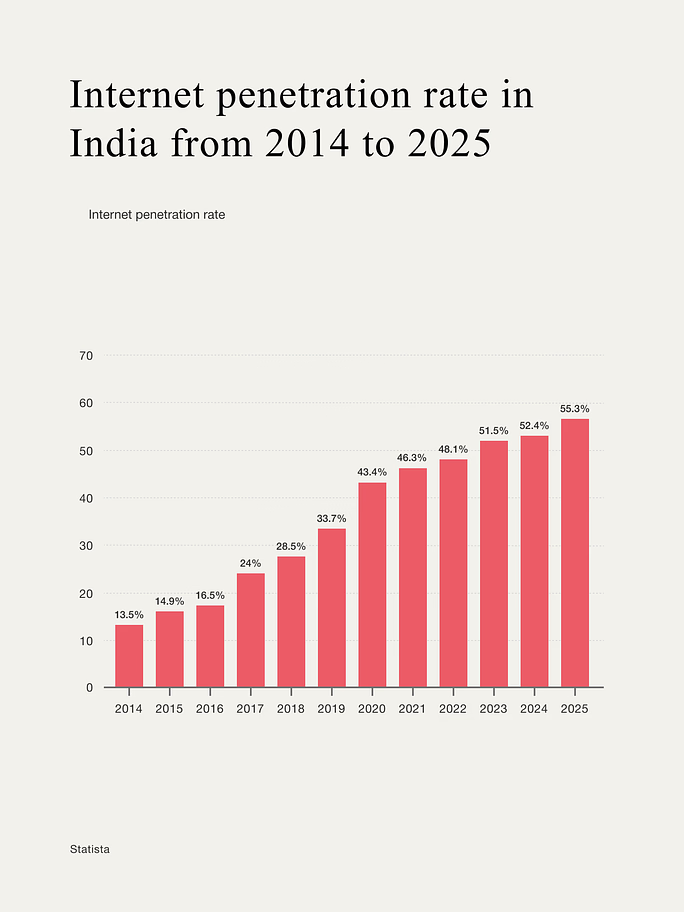
Tucked away in the hills of Uttarakhand, a state in northern India that rises into the lower slopes of the Himalayas, the village of Ghes has long followed the old ways. There are no paved roads, no connection to the national power grid, and life moves at a slow, familiar pace. But even here, something has changed. High-speed internet has arrived, powered by solar panels and public schemes. Children attend online classes, farmers check market prices, and families call relatives far away. Across India, the story is the same on a grander scale: nearly 700 million people have come online over the past 15 years, reshaping the country’s economy, politics, and daily life—one village, one connection at a time.
The huge jump in India’s internet access is due in large part to Digital India, a government plan launched by Prime Minister Narendra Modi in 2015. Its aim was to spread internet access across the countryside, bringing public services online for people who, in many cases, had rarely left their villages or dealt with the Indian state. Pakistan, too, has seen a sharp rise over the past decade, driven by cheap smartphones, better mobile networks, and new money from both public and private sides. Today, about half the people in both countries are online, the vast majority through smartphones. Together, India and Pakistan account for nearly a billion internet users—roughly one out of every six people on the web worldwide. But everything has its dark side, and internet access is no exception.
Two Nuclear Powers, One Online Firestorm
For many, the internet has been a gateway to learning, trade, and work. You can use it to stream science lessons to children in villages with no teachers, book doctors in towns with no clinics, and send forms to places where the postman barely shows up. And you can also use it to insult your neighbouring country, twenty-four hours a day. To each his own. In April 2025, after a deadly attack on tourists in Indian-held Kashmir that left 26 dead, the internet became a battleground. Fake videos, AI-generated images, and hostile hashtags flooded social media within hours. Pakistani accounts pushed the idea that the attack was a false flag operation, while Indian users called for open revenge. Old footage was repackaged as new proof, real grief was twisted into propaganda, and outrage raced across feeds faster than any army could have moved.
It was not the first time. After the Pulwama attack in 2019, online hate campaigns flared across both countries, pushing tensions toward the brink of war. We are talking about two countries that together hold nearly 1.7 billion people—more than a fifth of the planet—and about 350 nuclear warheads. Nor is the anger confined to the subcontinent. In 2022, heat whipped up on social media helped spark street fights between Indian and Pakistani communities in Leicester, a British city where more than a third of the people are of Indian heritage. Economic hardships, political mistrust, and old grudges now move at the speed of a click. With India boasting the largest diaspora in the world, and Pakistan ranking among the top as well, the strains between Delhi and Islamabad often echo far beyond their borders.


