
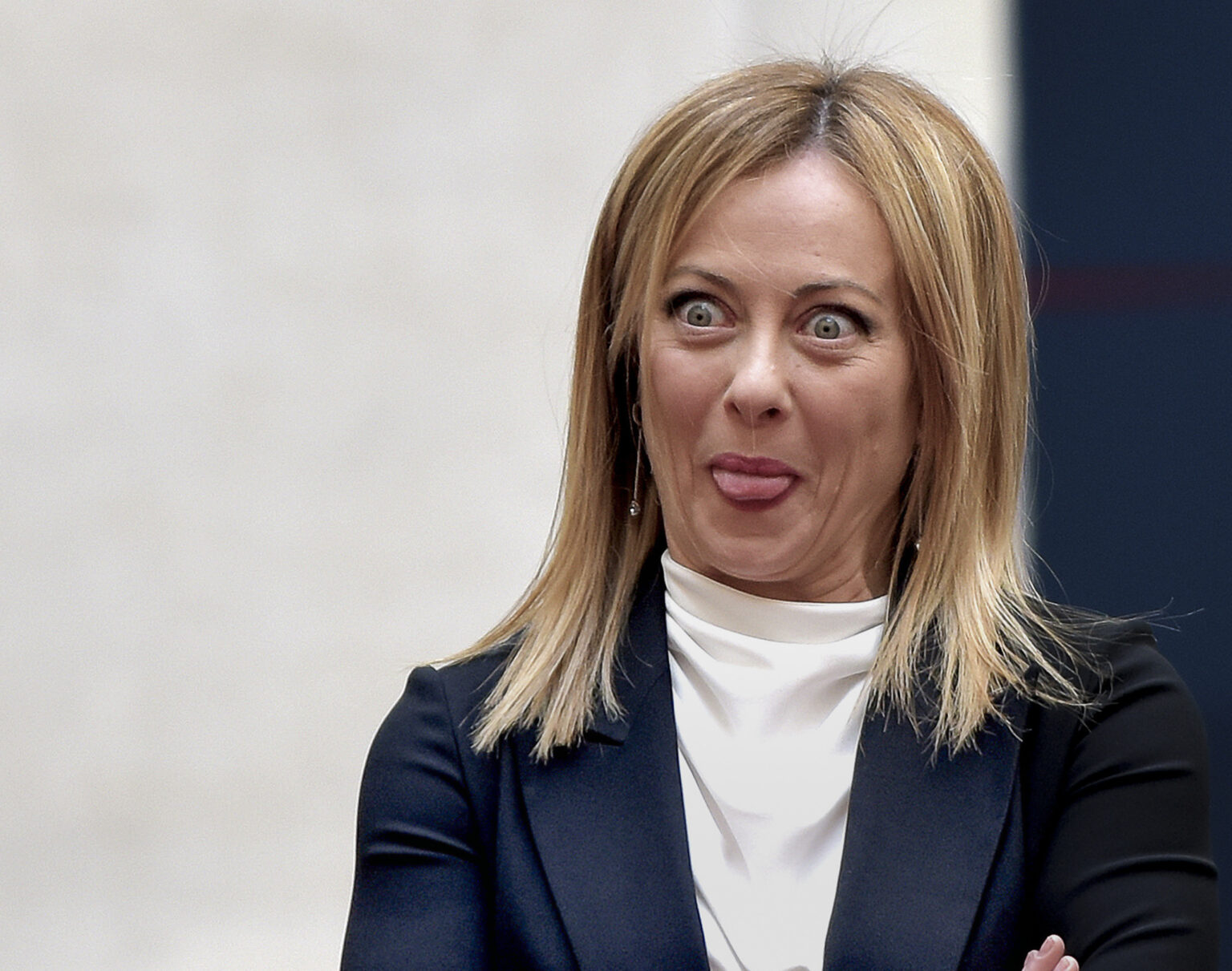
Giorgia Meloni, Italy’s prime minister since October 2022, has managed to consolidate power in a way that sets her apart from her male center-right colleagues. The image of resolvedness and strategic discipline she has cultivated distances her from Matteo Salvini’s bath-in-the-crowd populism or from the antiquated chauvinism of Silvio Berlusconi, whose symbolic influence still looms large and by in Italian politics, even after his death in June 2023. Despite these cumbersome competitors, Meloni has found her own style—assertive, pragmatic, and culturally resonant. She has defied the cliché of Italian politics as a melange of charisma, passion, drama, and instability, and has done so successfully, as her term is already twice as long as the average 1.1 years a government survives in Italy’s political arena.
Playing the Long Game
In 2012, Meloni co-founded the Fratelli d’Italia—literally the Brothers of Italy. Initially polling in the low single digits, she transformed the Fratelli into a force to reckon with, culminating in winning 26% of votes in the 2022 elections. Compare that to German AfD, comparably young and founded in 2013: even in a time of domestic political crisis, when populist parties thrive the most, AfD achieved a comparatively meagre 20% in the 2025 national elections.
Unlike Salvini, who adapts his positions to the ever shifting public sentiment, Meloni kept her political brand’s core defined: a pragmatic conservatism, advocating for national identity, opposing unchecked immigration, and resisting an EU she called "an invasive bureaucratic giant“. Critics argue that her firm stance on these issues weakens Italy’s position within the Union. But it might be just this consistency that helped her appeal to the many voters that have grown weary of erratic leadership and ever changing fragile alliances in Italian politics. Her calculated patience was evident in how she handled tensions with Berlusconi, who initially resisted her leadership. Instead of engaging in an open power struggle, she stood firm, refusing to concede to his demands for key ministerial posts. With the Fratelli securing three times as many votes as Forza Italia, she could let the numbers speak for themselves, allowing internal dynamics, and Berlusconi’s waning influence, to settle the dispute in her favour. This ability to combine firmness with a low time preference has been one of her defining political strengths.
Political Sense-making
One of Meloni’s distinctive characteristics is how she employs cultural symbols to resonate with a broad public. A 2019 speech at a rally in Rome gained widespread attention, when she declared, "I am Giorgia, I am a woman, I am a mother, I am Italian, I am Christian!“, shaping her political brand’s core of family values, national identity, and traditional conservatism. With an instinct for the catchyness of the formula and the potential ‘memability’ of her own persona, she later used the “Io sono Giorgia” slogan as the title of her autobiography.
A self-confessed fantasy nerd, she has called The Lord of the Rings a sacred text: "I think that Tolkien could say better than us what conservatives believe in“. Her use of Tolkien’s themes—heroism, tradition, and resistance against an overbearing power—transports a broader political messaging. It’s political sense-making in a pop-cultural language understood by the masses. She also taps into music as a cultural signifier. At campaign rallies, one can hear songs by Rino Gaetano, a 1970s Italian singer known for his satirical and socially critical lyrics. Gaetano’s anti-establishment tone frames Meloni as an advocate of the people, not the elites. Criticising John Lennon's Imagine as an emblem of naive globalism, she distanced herself from the progressive ideas of the EU mainstream.
Her ability to lightheartedly weave pop culture into her political communication also sets Meloni apart from her female peers on the European right. German AfD’s Alice Weidel, with her stiff, humourless appearance, or France’s Marine Le Pen, whose appeal relies on traditionalist nostalgia, lack Meloni’s connection to a broader public. It’s a success, and the internet’s bro-sphere has already memed a Meloni-Musk-romance.
Control without Confrontation
Giorgia Meloni reigns without theatrics and aggressive confrontation. On the other hand, her leadership style, though effective in the male-dominated political landscape, has also been criticised as expressing masculine traits of control and authority, instead of offering a progressive-feminist model for women in politics. Being Italy’s first female prime minister, she has sparked a gender debate, refusing the feminine designation for her new role, opting instead for the traditional “il Presidente“, arguing that this masculine designation reflects the institutional dignity of the position, not her gender.
Expressing a strong stance on traditional values, conservatism, nationalism – all combined with the ability to deliver passionate populist speeches, irony and meme-potential (remember: the Left can’t meme) – Giorgia Meloni illustrates that a sis can be a bro, too. In a time when it is often claimed that political positions correlate with gender–females are said to be left, the right toxically masculine–Meloni can indeed be a female role model. If not for girls, at least so for female right-wing politicians.

Statement
Meloni’s political communication suggests that she is not just reacting to day-to-day politics, but is pursuing a larger project: the revitalisation and modernisation of conservative values at a national level: family and identity, national sovereignty and security. While Meloni is already successful in the political arena, it is yet to be seen whether she also delivers as a State leader. The second half of her term in office will show whether her policies translate into measurable successes in tackling the big issues of migration, economic stability, and unemployment—though, making it through the term would already be unusual for an Italian prime minister.