Why Meloni, not Macron, may shape Europe’s next chapter.
The European project was born out of the Franco-German-Italian triangle; a post-war dream, which bore the signatures of Konrad Adenauer, Robert Schuman, and Alcide De Gasperi. But history, and above all domestic volatility, would soon reduce Italy’s status to that of an observer. As Paris and Berlin became the axis around which Brussels turned, Rome became Europe's underestimated cousin – passionate, volatile, often sidelined. Even figures of considerable stature, such as Giulio Andreotti, could do little to alter such dynamics: even during France’s moments of weakness, Paris remained Germany’s partner of choice. The Franco-German friendship, elevated by Berlin to the status of a European creed, endured.
Today, that hierarchy is wobbling. France, for decades the self-appointed architect of European direction of travel, finds itself hollowed out by internal unrest and political fragmentation. Emmanuel Macron, once hailed as Europe’s centrist lodestar, is politically marooned: a president without a parliamentary majority, a reformer without reform. Italy, long cast for the role of institutional underdog, has become, somewhat paradoxically, the EU’s new pillar of stability.
Meloni’s rise, and Rome’s return
Giorgia Meloni’s 2022 accession to the premiership marked more than just a right-wing swing. It heralded the return of a governing coalition with enough cohesion to pursue a long-term strategic agenda — something Italy had not experienced for over a decade. Her victory closed the door on years of technocratic patchworks, short-lived coalitions, and executive improvisation.
Meloni, ironically a political heiress of Silvio Berlusconi, has not forgotten the moment Europe turned on its heels. In 2011, amid eurozone panic, the “markets” — read: Brussels, Berlin, and Paris — helped unseat Berlusconi and replaced him with the technocrat Mario Monti. For many Italians, that was not European salvation, but a Brussels coup. That moment also sparked a decade of euroscepticism in a country that had once been enthusiastically pro-European.
Now, Meloni is reclaiming agency. Unlike previous eurosceptics, she has embraced the EU as a strategic arena rather than a punchbag. She plays by the rules — for now — but wants to rewrite them from within.
A tale of two trajectories
Macron’s early presidency had the force of myth: a young, modernising centrist with a vision of European renewal. But second terms are unkind to visionaries. The pension reform crisis, riots in the banlieues, and a legislative minority have turned Macron from Jupiter into Sisyphus. France lacks a working majority, and Macron’s international activism increasingly seems like projection — a quest to appear relevant abroad while power slips away domestically.
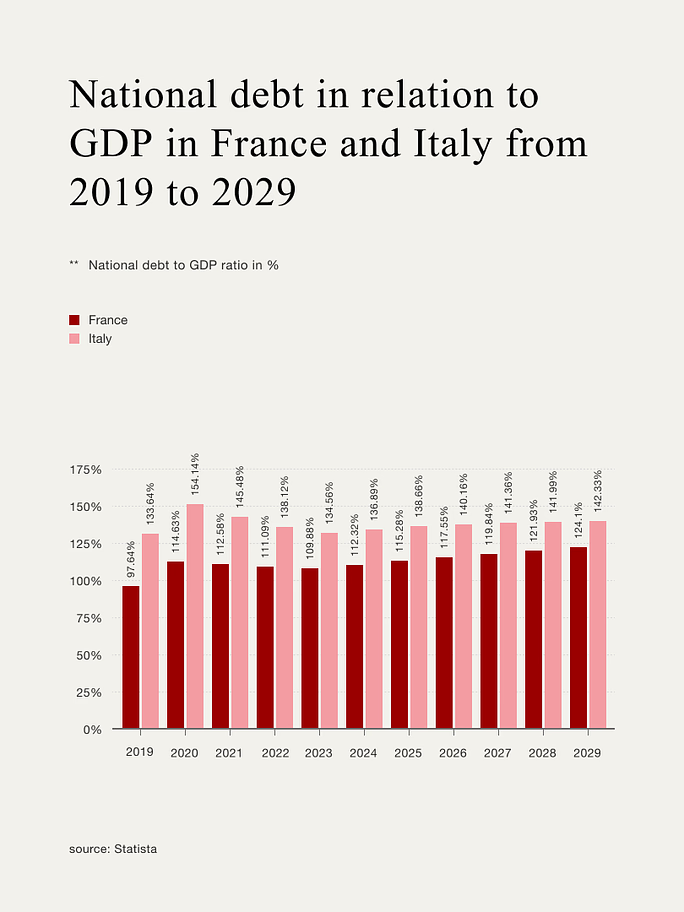
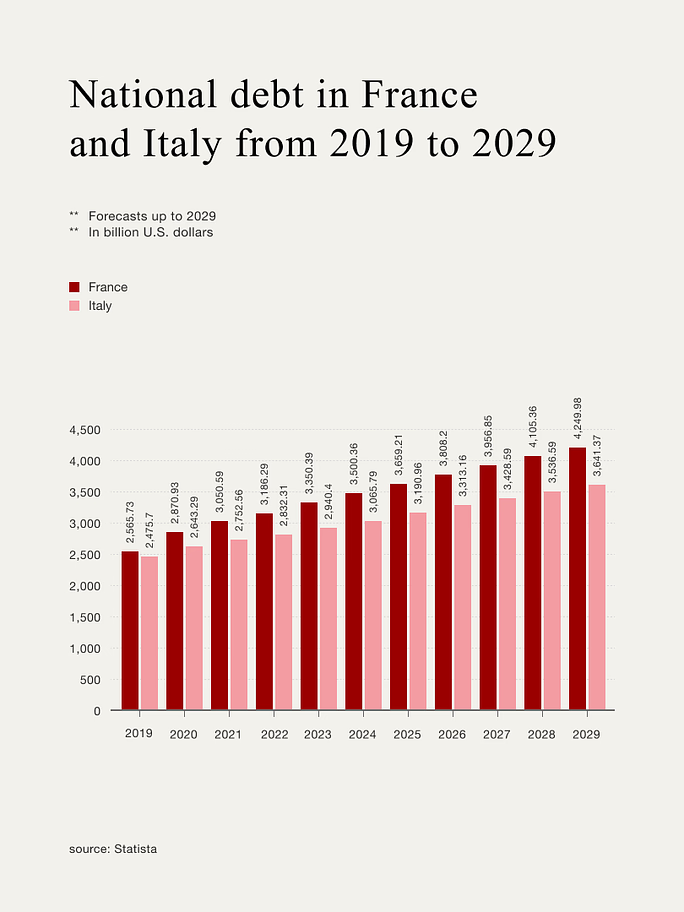
Meanwhile, Italy is making quiet inroads. Its economic outlook is brighter than expected. It has tamed its debt trajectory relative to GDP. Meanwhile France’s public debt has surpassed 3.2 trillion euros, making it the largest in the eurozone in absolute terms.
Stellantis, subsidies, and symbolic struggles
The economic duel between Rome and Paris found an unexpected stage in Stellantis, the Franco-Italian auto giant born of a merger between Fiat Chrysler and PSA. Under Carlos Tavares, Stellantis tilted investment and focus toward France, prompting quiet fury in Italy. The French state, through Bpifrance, holds sway in corporate governance. Italy, despite being home to Fiat’s industrial legacy, felt shortchanged.
Meloni changed that narrative. With the departure of Tavares and the ascension of John Elkann — a Franco-Italian dynast with deep Agnelli roots — Stellantis has recalibrated. Rome secured new investment promises and manufacturing commitments. This wasn’t just industrial policy. It was a test of sovereignty. And Italy passed.
The European stage
Meloni’s foreign policy has surprised critics. At the G7 summit she hosted in Apulia, she struck a balance between Atlanticist firmness and Mediterranean pragmatism. She has become a key broker in EU migration deals with Tunisia. She has echoed Macron on strategic autonomy, but insisted on a slower, national-interest-driven tempo.
Notably, Ursula von der Leyen has increasingly sought support from Meloni — rather than Macron or Scholz — in key dossiers, including the Green Deal, defence cooperation, and tariff policy. With Berlin paralysed by coalition bickering and Paris consumed by unrest, Rome has emerged as Brussels’ most stable interlocutor.
The Trump variable
Macron and Meloni are both alert to the risks and rewards of a second Trump presidency. Macron cast himself as Europe’s chief negotiator on Ukraine, flying solo to Washington—yielding intent but few results. Back in Europe, Meloni positioned herself as the voice of those opposing troop deployments, in contrast to Macron’s overtures.
She may yet become the transatlantic whisperer—a conservative bridge between Brussels and Mar-a-Lago. Not just due to her relationship with Elon Musk, but because—unlike Macron, Scholz or Merz—she switches effortlessly between statesman’s rhetoric and populist vernacular. That makes her a more versatile interlocutor across the Atlantic.
A special relationship of her own
London drifts away from Washington. Berlin sulks behind technocracy. Paris shouts but is no longer heard. Rome, of all places, may be closest to defining the post-Atlantic moment. Meloni has cultivated strong ties to the UK’s Conservative Party and US Republicans. She has signalled interest in deeper defence and economic cooperation beyond EU confines.
As tariffs return to the geopolitical chessboard, Meloni may play an unexpected role as arbitrator. Her ideological flexibility and nationalist credentials give her access to both the protectionist right and the liberal centre. In an age where pragmatism is the new idealism, she is paradoxically better suited than Macron to mediate between competing worldviews.
Statement
It is unlikely that Italy will replace France as Europe’s engine. But the old binary — Franco-German leadership vs. everyone else — no longer holds. A new triangle is emerging: Paris still relevant, Berlin still rich, but Rome — at last — stable, assertive, and ideologically equipped to shape the debate. In his early years, Macron looked south for admiration. Today, he looks south with unease. Meloni is no longer the junior partner, but the rival architect of Europe’s next chapter. And, this time, it may be Italy that writes the draft.
Welcome to the comments section of the Štandard daily. Please take note of our guidelines, comments are moderated by us. You can contact the moderators at support@statement.com.
Participate in the discussion
Comments are available to subscribers only. If you'd like to join the discussion, choose a subscription starting at €6.72 per month.
All comments 0
Register
Comments are available to registered users only. If you'd like to join the discussion, register here.