
Picture a street in a typical Middle Eastern town: veiled women guiding children through bazaars, toddlers tugging at sleeves, crowds of young men arguing in the background. To many in the West, the region still evokes youthful abundance—fast-growing families and, perhaps, a subtle demographic threat to ageing Europe. But the noise is fading. In several of the region’s most influential countries, families are shrinking and the old image of endless baby booms is giving way to a more varied reality.
In 2024, Iran’s fertility rate stood at 1.44 children per woman—on par with the European average. The country offers a striking demographic paradox. After the Islamic revolution in 1979, the new regime scrapped all family-planning efforts. Fertility soared to 6.5 children per woman. But by the late 1980s, alarmed by the risk of famine and economic strain, the state reversed course. With clerical backing, Iran launched one of the most ambitious birth-control campaigns in the developing world. Sex education became widespread; the region’s first state-run condom factory was built. The result was perhaps the fastest fertility collapse in recorded history: from 6.5 to below 2 in just two decades. Today, Iran is ageing. Although the population is still growing, thanks to a large cohort in childbearing years, its demographic profile is shifting. The median age is 32 and rising. The country may cross 100m people in the coming decades, but the era of endless youth is over. Iran is starting to resemble a developed country—with fewer children and more pensioners. Secularisation is gathering pace in turn: surveys suggest only a third of Iranians now identify as Shia Muslims, with a similar share defining themselves as irreligious or atheists. Discontent is growing too, especially among young women, many of whom openly defy the morality police and the clerical order behind it.
Middle Eastern Modernity
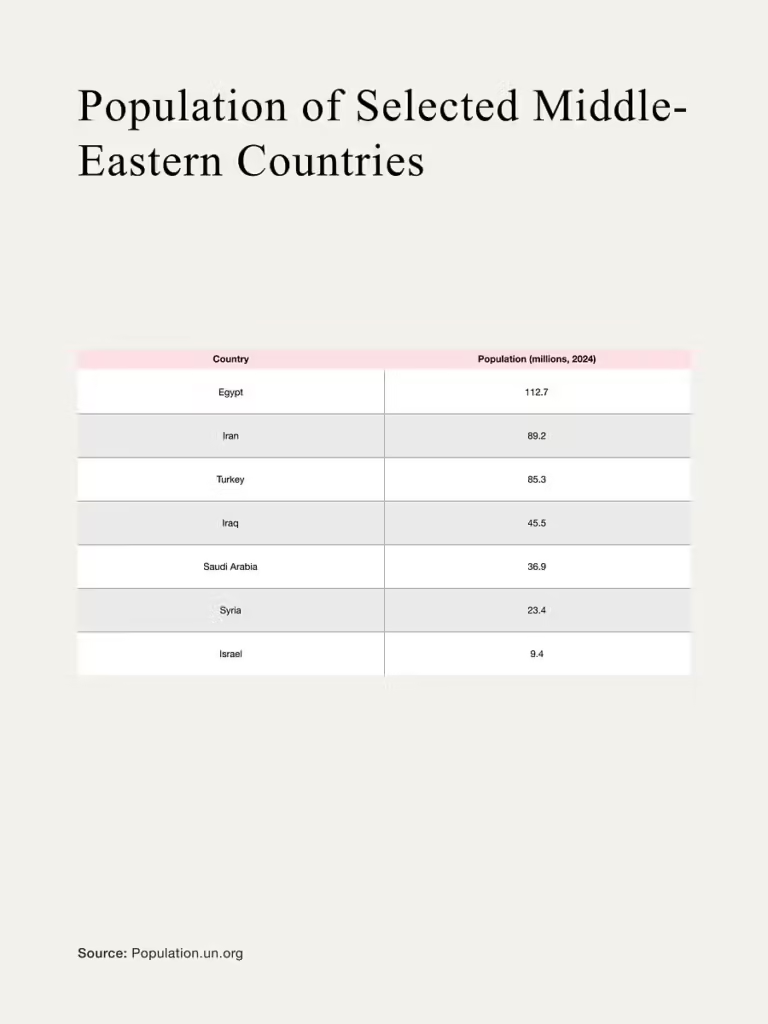
Turkey, another demographic heavyweight with over 85 million people, tells a similar story—though with pronounced regional variation. The national fertility rate hovers around 1.5 children per woman, but this average masks deep internal divides. The secular, urbanised west, long oriented towards Europe, now has a fertility rate closer to that of southern Europe than the Middle East—just 1.3 children per woman. Even central and eastern provinces, once bastions of large families, have seen sharp declines. Only the country’s far southeast—its poorest, most rural region, and home to much of Turkey’s Kurdish population—still records a birth rate above the replacement level.
Saudi Arabia, the largest and most powerful of the Gulf monarchies, presents a very different picture. Its fertility rate remains above the replacement level, and the median age is just under 30—a profile many ageing nations might envy. But like its neighbours and unlike most other states, Saudi Arabia’s economy is not powered by its own citizens. Over 40% of residents are foreign nationals—one of the highest shares in the world. Migrant workers dominate the private sector, where roughly three-quarters of employees are foreign-born: from construction crews from South Asia to engineers and managers from East Asia and the West. Attempts to ‘Saudise’ the workforce have made only modest headway. If they work at all, Saudi citizens still gravitate overwhelmingly towards public-sector roles—many of which exist to distribute state patronage. While ageing alarms most countries by swelling the ranks of dependents, Saudi Arabia faces a different structural burden: a large segment of the population remains permanently reliant on the state, either through direct public expenditure or through imported labour.


