Across the Pacific Ocean, a trade system, unbound from China and the US, is rising.
While headlines focus on China’s foreign capital and US disengagement, two mid-sized integration systems are quietly engineering a trade corridor built on legal and economic alignment.
In April, the Association of Southeast Asian Nations and the Pacific Alliance (PA) concluded their seventh ministerial meeting, renewing their joint trade, digital economy policy, and regional logistics cooperation, expanding the horizons that have allowed bilateral trade between them to double over a decade.
These two blocs, with ten Southeast Asian countries and four Latin American economies on the Pacific Rim, are building a market with no bureaucracy nor hegemon, spanning 880 million people and over USD 5.9 trillion in combined GDP.
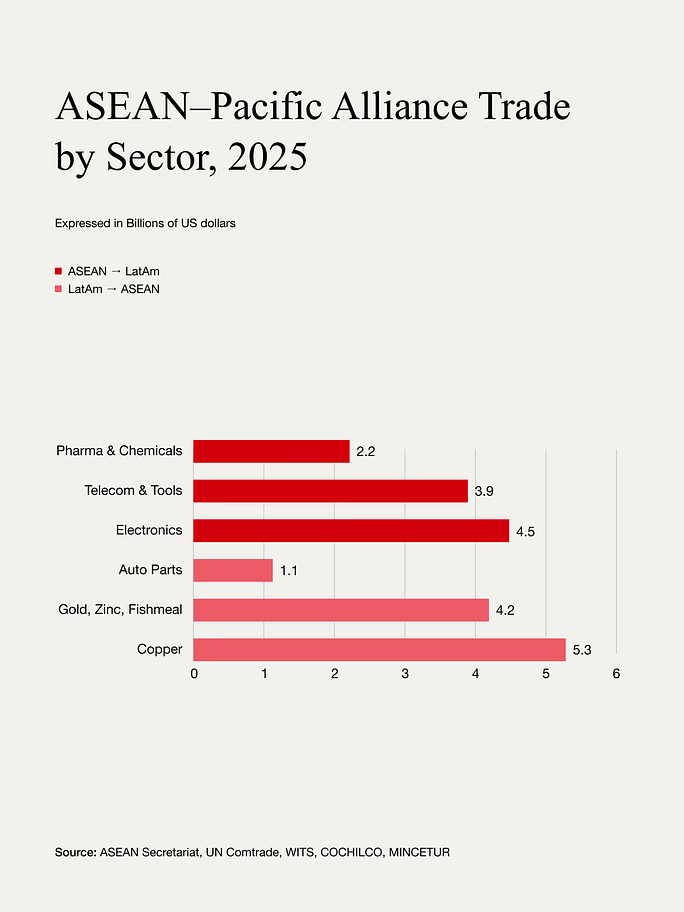
Their non-ideological initiative advances through matching systems, and aims to reduce the need to depend on global powers. ASEAN supplies capital, industrial manufacturing, and refined goods, and the PA provides raw inputs and agri-foods, while both benefit from each other's integration, trade openness, and geographic leverage over the Pacific Ocean.
The result is a shared, rules-based operational structure, unbound from Washington and Beijing.
A System Built on Frameworks
ASEAN, formed in 1967, built coordination through non-binding agreements, while the PA, founded in 2011, aimed to integrate Latin America’s Pacific economies outward.
Their 2016 common Framework for Cooperation established a formal structure linking both blocs with routine joint ministerial meetings, and PA observer status has been granted to Indonesia, Thailand, and the Philippines, three of ASEAN’s largest economies, representing over USD 2.1 trillion in GDP and 500 million consumers.
For both trade blocs, legal integration is already embedded in the Comprehensive and Progressive Agreement for Trans-Pacific Partnership (CPTPP), which includes seven ASEAN and PA countries: Chile, Mexico, Peru, Singapore, Vietnam, Malaysia, and Brunei cover 13.5% of global GDP, eliminate 95% of internal tariffs, and standardise rules on investment, digital trade, and dispute resolution.
The PASFTA agreement, built on this base, signed in 2022, and implemented in 2023, extends national treatment to Singaporean firms in all PA countries, harmonising procurement and customs standards. As of 2025, over 100 Singaporean companies operate in logistics, finance, infrastructure, and agritech across the PA, while Latin American multinationals, namely Cemex, AJE, and ISA Intervial, use Singapore to springboard Southeast Asian operations.
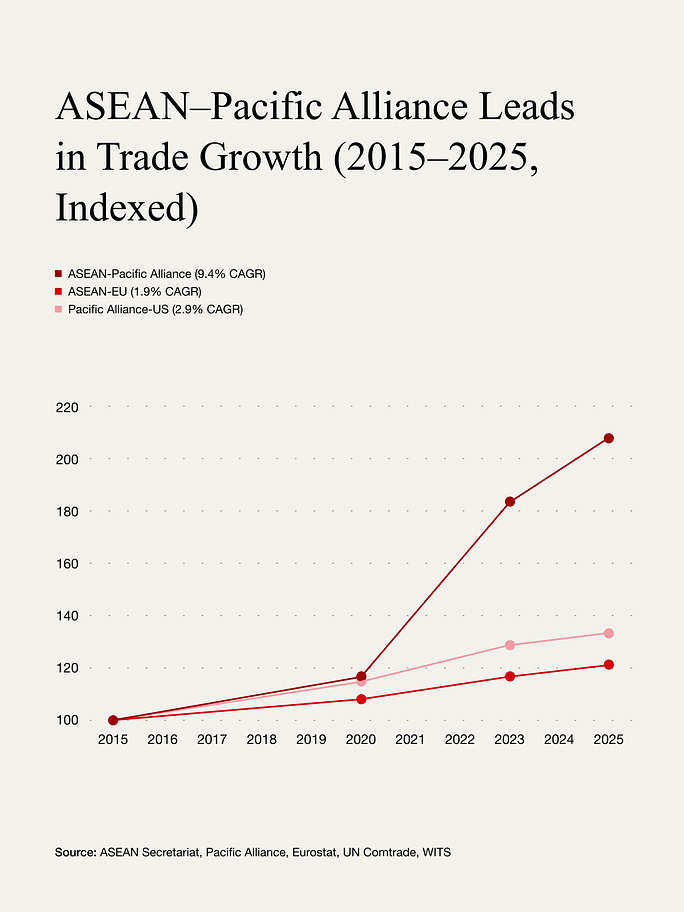
ASEAN-PA Trade growth between 2015-2025.
Commerce from Shore to Shore
Trade between the two blocs reached USD 36.4 billion by 2024, up from USD 32.1 billion in 2023, and their growth rate since 2015 is 9.4%, higher than ASEAN-EU or PA-US trade.
Infrastructurally, the Chancay port in Peru, scheduled to open this year, will cut trans-Pacific shipping time by 12-14 days, and while backed by China’s Belt and Road Initiative, its operating model is open-access, with ASEAN logistics platforms, namely PSA International, Viettel Post, J&T Express, already integrating the port into regional routes. Moreover, digital services are increasingly part of the exchange, with CPTPP data, licensing, and fintech rules now applying and PASFTA enabling ecommerce over both blocs, as ASEAN’s data transfer clauses are reviewed by PA regulators.
ASEAN-PA Trade by sector (2015-2025).
All Eyes on the Pacific
This imminent Pacific Market rests on one fact: neither bloc is anti-China nor fully dependent on Washington, as both hedge by design.
This gives both blocs leverage, not over each other, but over their own arrangement vis-a-vis the rest of the world: ASEAN states use this structure to diversify outbound supply chains without provoking Beijing, and the PA uses it to lock in market access and investment terms without waiting for the next shift in US trade posture.
In 2024, ASEAN and Pacific Alliance countries jointly lobbied the WTO for revised rules on subsidies in sustainable agriculture. They also issued coordinated positions on digital trade governance, calling for data frameworks that ‘respect autonomy without creating artificial silos.’
Their quiet convergence has not gone unnoticed: Japan and India maintain stakes in the corridor as both PA observers and ASEAN partners, whereas fellow Latin American integration bloc MERCOSUR simultaneously signed its own trade agreement with Singapore.
As Washington’s economic influence in the Pacific declines following the US CPTPP withdrawal in 2017, and China’s CPTPP accession bid remains frozen, ASEAN and the PA are writing a different script in their absence, assuming no permanent patrons and intending to stop needing any.
Statement
The imminent Pacific Market is not just a vision but a functioning system built by ASEAN and the Pacific Alliance through trade agreements, regulatory symmetry, and sectoral complementarity. CPTPP and PASFTA provide the legal spine, Chancay and Singapore anchor its logistics. Bound by no single power, it does not aim to confront China or restore US centrality, it bypasses both powers, offering both blocs a way to operate within global commerce without yielding to it. In a world defined by overreach and retreat, this corridor avoids both and instead offers quiet, precise, and rules-based control for a handful of nations who dream of Pacific economic autonomy by design.
Welcome to the comments section of the Štandard daily. Please take note of our guidelines, comments are moderated by us. You can contact the moderators at support@statement.com.
Participate in the discussion
Comments are available to subscribers only. If you'd like to join the discussion, choose a subscription starting at €6.72 per month.
All comments 0
Register
Comments are available to registered users only. If you'd like to join the discussion, register here.