At the 2025 ASEAN Summit, Indonesia wants more than consensus. It wants control.
As ASEAN convenes in Kuala Lumpur this week, the region’s familiar choreography will unfold: unity statements, hedged communiqués, and handshakes all around. But behind the diplomatic theatre, one country is quietly redrawing the script. Indonesia is not hosting the summit to manage ASEAN. It’s hosting it to steer it.
For decades, ASEAN has thrived on ambiguity—strategic nonalignment, lowest-common-denominator diplomacy. Indonesia, the region’s largest economy and most populous nation, is no longer satisfied with that formula. It views ASEAN not as a club of equals but as a lever for regional relevance. And it intends to push.
Nonalignment is not Neutrality
Indonesia’s foreign policy has long resisted formal alignment with any major power. But that doesn’t mean it’s neutral. In 2025, Jakarta conducted naval exercises with India in the Java Sea, signed a digital infrastructure agreement with China’s Ministry of Industry, and renewed a defence logistics accord with the United States—all in the same quarter.
This is not fence-sitting. It’s portfolio diversification at the sovereign level. Indonesia’s message to ASEAN is clear: don’t just hedge—structure your independence.
Foreign Minister Retno Marsudi has framed it as ‘constructive sovereignty’—cooperation without submission. The strategy plays well at home and commands increasing respect abroad. A May 2025 survey by the ISEAS-Yusof Ishak Institute found that 68% of ASEAN policymakers view Indonesia as the bloc’s most credible diplomatic leader, up from 52% in 2023. Among ASEAN businesses with over $100 million in annual revenue, 71% said Jakarta was ‘the most proactive regional stabiliser’, citing its ability to engage both China and the US without political recoil.
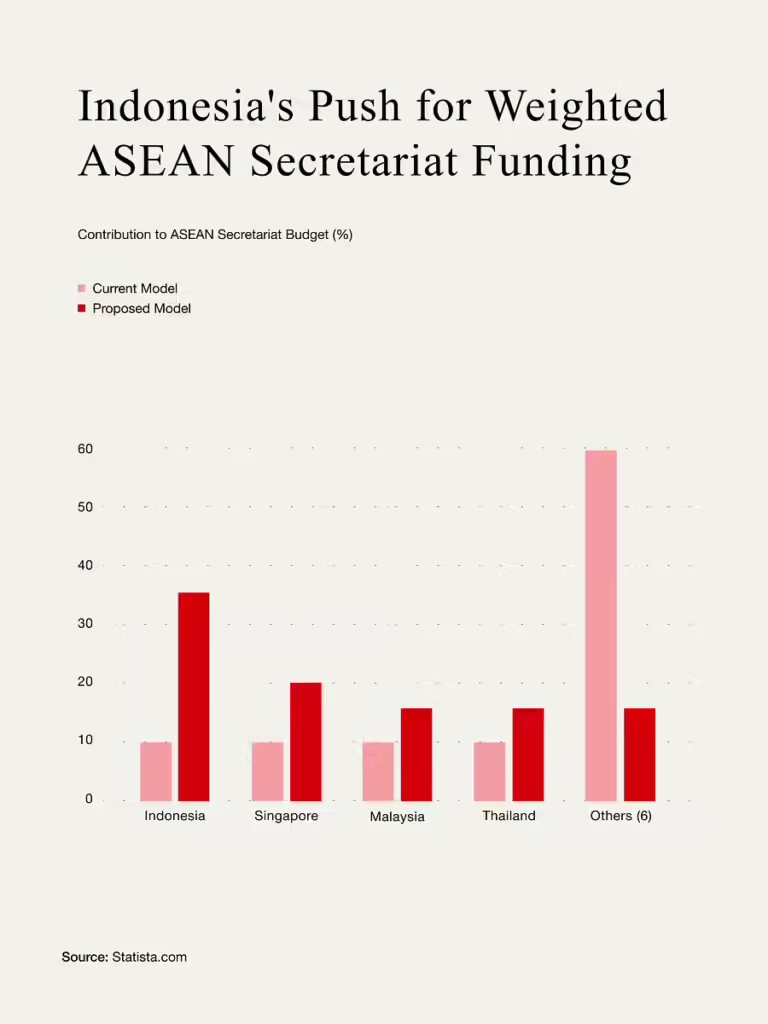
Indonesia's proposal for ASEAN Secretariat's funding reform vs the current arrangement.
Fix the House, then Lead It
Indonesia’s reformist posture begins with the ASEAN Secretariat, long criticised as diplomatically symbolic but operationally impotent. Currently funded equally by all 10 ASEAN members—regardless of GDP—it has little authority, few tools, and virtually no enforcement mechanisms.
Jakarta is pushing to change that. It proposes a new funding model based on GDP share, which would see Indonesia, Singapore, Thailand, and Malaysia shoulder more of the budget—and in return, gain more agenda-setting capacity. Indonesia also wants to empower the Secretariat with binding implementation oversight, particularly in cross-border digital regulation, infrastructure standardisation, and environmental reporting.
If adopted, the changes would amount to ASEAN’s first quasi-executive institution—shifting the bloc from a political roundtable to an administrative engine. For investors, this implies less procedural drag on region-wide projects, and a potential clearing house for corridor-level investment frameworks.
A Currency Bloc in Everything but Name
While China champions the renminbi and the US insists on dollar continuity, Indonesia is building something less hegemonic but more scalable: a decentralised Southeast Asian payments backbone denominated in local currencies.
Since the ASEAN Local Currency Transaction Framework launched in 2023—initially between Indonesia, Malaysia, and Thailand—the volume of non-dollar intra-ASEAN settlement has surged. In the first half of 2025 alone, the framework processed $14.7 billion in trade transactions, a 31% increase year-on-year. New members including Vietnam and the Philippines joined in Q2, with Singapore expected to adopt dual-settlement options by year-end.
Indonesia is now pushing for a regional clearing mechanism, backed by national central banks and bypassing SWIFT. If realised, this would dramatically reduce compliance friction, and exposure to secondary sanctions—a strategic buffer amid growing currency weaponisation in global finance.
Sea Lanes, Sovereign Rules
Indonesia’s maritime activism is also accelerating. Its 2025 proposal for a Joint ASEAN Maritime Safety Framework would establish shared rules of engagement for grey-zone naval behaviour, coordinated patrol protocols, and collective surveillance of major chokepoints like the Malacca and Sunda Straits.
The initiative stops short of formal security alignment but goes further than previous ASEAN maritime documents. Notably, it calls for non-claimant coordination—inviting Singapore, Indonesia, and Brunei into regional security dialogue that had previously been dominated by claimants in the South China Sea.
China has not objected. At a pre-summit forum in Hainan, a senior Chinese envoy described the initiative as ‘constructive and compatible’—Beijing’s way of conceding space without endorsing it outright. The US, meanwhile, continues to press maritime issues via the Quad and AUKUS, limiting its relevance within ASEAN's institutional perimeter.
Investor Takeaway: ASEAN, Rewired
For investors, this signals a structural shift from soft consensus to hard architecture. Trade is being rerouted through local currency corridors, reducing exposure to dollar compliance bottlenecks. If institutionalised, the expanded transaction system which Jakarta helped design will support ASEAN trade finance (now indexed in regional currencies) through sovereign-level infrastructure and risk buffers. Regional banks are already modelling yield spreads and risk-adjustment returns based on this blueprint.
On climate policy, Indonesia has reframed ASEAN energy diplomacy to prioritise ‘resilience through integration’, pushing for joint grid investments and shared carbon market standards. In April 2025, it launched a cross-border carbon pricing pilot with Malaysia and Singapore, soon to be presented to the summit as a scalable ASEAN platform.
At the institutional level, Indonesia’s push to transform the ASEAN Secretariat into an enforcement-capable body could shorten project timelines, strengthen regulatory harmonisation, and offer a more credible framework for cross-border investments. Governance, long ASEAN’s Achilles’ heel, is becoming investable.
The overall message is unmistakable: ASEAN is shifting from a zone of ambiguity to a platform of design. And Indonesia is doing the designing. For capital, that means a region with lower coordination risk, deeper policy coherence, and a clearer strategic floor. The opportunity is not just growth—but governance with traction.
Statement
Indonesia is not asking ASEAN to choose between great powers. It is asking it to grow up. While others oscillate between alignment and ambiguity, Jakarta is drafting rules, empowering institutions, and pushing for a bloc that acts rather than reacts. In a region shaped by outside pressure, Indonesia is working from the inside out. At this summit, power will not be measured by who speaks the loudest, but by who defines what gets done. Indonesia is not balancing ASEAN. It is shaping what ASEAN is becoming.The risk for the region is not in choosing the wrong side, but in failing to build one of its own.
Welcome to the comments section of the Štandard daily. Please take note of our guidelines, comments are moderated by us. You can contact the moderators at support@statement.com.
Participate in the discussion
Comments are available to subscribers only. If you'd like to join the discussion, choose a subscription starting at €6.72 per month.
All comments 0
Register
Comments are available to registered users only. If you'd like to join the discussion, register here.