When Leo XIV sang the Easter 'Regina Caeli' (Queen of Heaven) during his first Sunday appearance as Pope, the moment passed almost unnoticed. The bell-clear voice of the new head of the Catholic Church was perhaps too soft for those expecting political signals or ecclesiastical upheaval. Yet for those attuned to the language of symbol and tradition, the weight of that moment was unmistakable. St Peter’s Square was not merely enveloped in reverent Latin chant; Leo XIV employed quiet song as a symbolic instrument of his mission: Mary, the mother of Jesus, remains a central pillar of Catholic spiritual life, even in the 21st century.
A Quiet Beginning
The importance of the Virgin Mary to Leo XIV was also evident from the very outset—on the loggia of St Peter’s Basilica, immediately after the election of Robert Prevost as the 267th Pope. The American, shaped by pastoral service in Peru, led the recitation of the Hail Mary. Leo pointedly reminded his audience that 8 May, the date of his election, holds not only historical but also heavenly significance: 'Today is the Day of Supplication to Our Lady of Pompeii. Our Mother Mary always wishes to walk with us, to stay close, to assist us with her intercession and her love. That is why I wish to pray with you.'
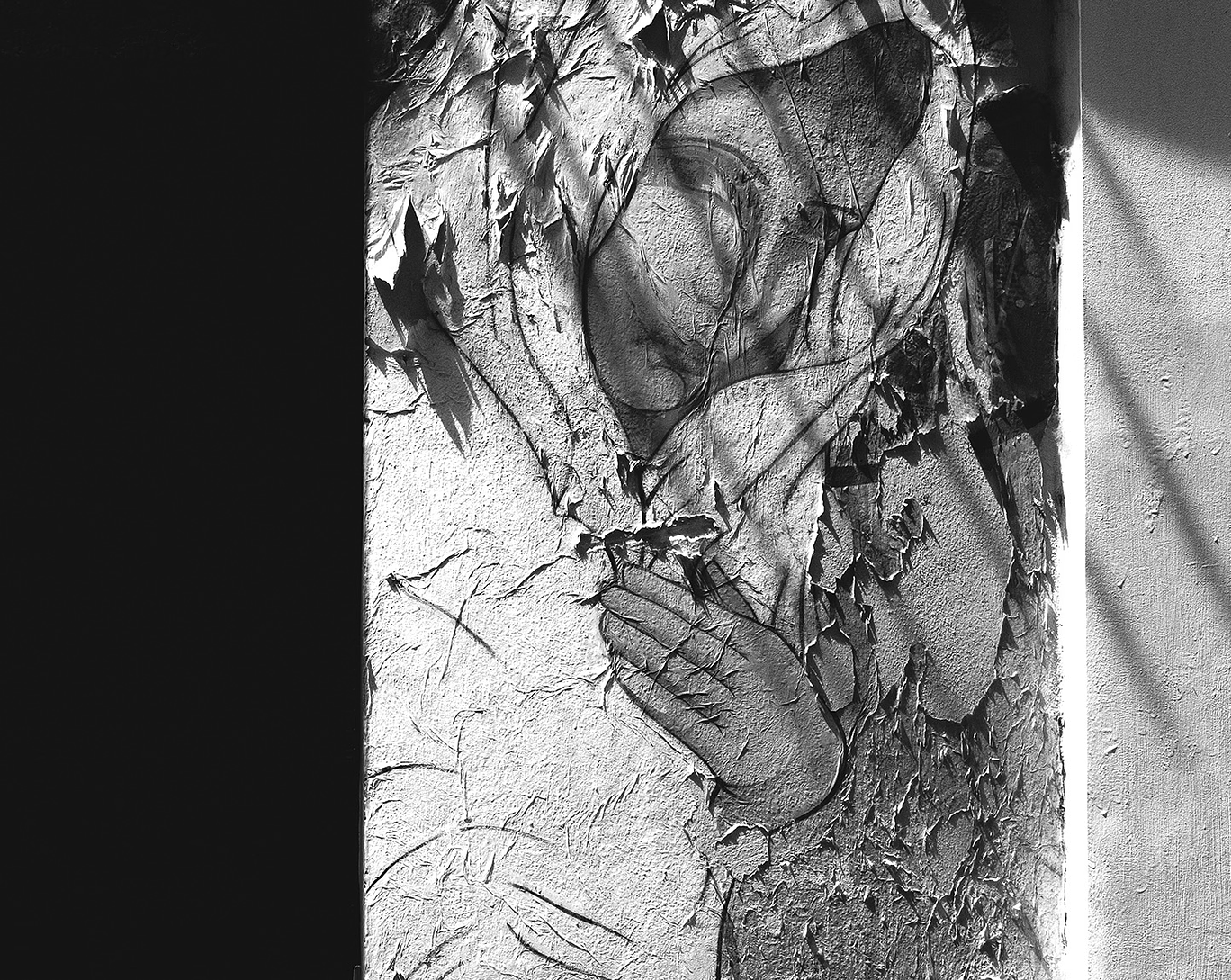
Leo’s Marian devotion—visibly embodied by the silver lily on a blue field that adorned his cardinal's coat of arms and now his papal insignia—is anything but sentimental. Much like Pius XII, whose pontificate was deeply shaped by the visions of Fatima, Leo XIV seems to draw strength from the contemplative tradition of the Church—one in which Mary is seen not only as a gentle intercessor, but also as a spiritual warrior. A dimension that has faded in recent years. Pope Francis, on his part, tended to portray Mary more as a social activist.
Mary as Bastion
In a 2010 lecture Robert Prevost had warned: 'Communism has penetrated even Christian circles disguised as solidarity. It is our pastoral duty to expose it.' Such clarity of speech echoes John Paul II—another Marian pope who regarded Mary as a bastion against evil, including communism and the then-widespread liberation theology in South America. That John Paul II survived an assassination attempt on 13 May 1981, a date coinciding with the first apparition of Mary in Fatima in 1917, he attributed to her protection. The Polish pope then continued, undeterred, with the dismantling of the Soviet Union and the Warsaw Pact.