
For generations, people from other regions of the world came to Europe. The reasons for this were prosaic—the global colonial powers enabled the free populations of Africa, India, and America to emigrate to the so-called mother countries—i.e., France, Great Britain, and Spain.
However, since 1960, when virtually all African states gained independence, there has been no reason for the local population to migrate. The British and French empires left behind an extensive infrastructure in Africa that Africans could rely on, and the West sent a total of around one trillion dollars in humanitarian aid to the continent.
Critics of this aid, particularly among African economists, saw it as a continuation of colonialism, with humanitarian aid undermining efforts to create a free market through price distortions. At the same time, artificially drawn borders tied several ethnic groups to one state, which served as a breeding ground for aggressive wars of mutual annihilation.
Functioning non-European states such as Syria, Egypt, and Libya, in turn, experienced a structural shock in the form of the so-called Arab Spring, which resulted in torn countries controlled by jihadists or the army, with a worse humanitarian situation than before.
The year 2011 is thus one of the main causes of the massive wave of migration in the following years. Officially, 2014 or 2015 are considered the beginning of the migration crisis.
Have we succeeded?
When it comes to migration, critics focus on two issues: increased crime and demographic change. Although statistics from the police authorities of individual countries show that migrants commit fewer crimes than native offenders, these attacks are more violent and have a greater impact—and, above all, they are more widely reported in the media.
At the same time, however, it is true that knife attacks, fights, and sexual assaults are actually more frequently committed by “people with a migrant background,” although this term can also apply to migrants of later generations or naturalized foreigners.
Germany, in particular, entered the migration crisis with a great deal of optimism. The then Chancellor Angela Merkel (CDU) told journalists the now famous phrase: “We can do it.” In doing so, she attempted to calm the allegedly xenophobic sentiments towards refugees from Syria or Afghanistan.
However, it did not take long before economic and climate refugees far outnumbered those fleeing sectarian wars in the aforementioned Middle Eastern countries. At the peak of the migration wave, Syrian refugees accounted for only two percent of all new arrivals.
More than four-fifths of the migrants were men, which once again raised fears of an increase in crime. However, Berlin's generosity made it possible for families to be reunited, which further increased the number of arrivals. For understandable reasons, they do not want to return at present. In most cases, they have secured their livelihoods in Germany and throughout Europe.
After ten years, Germany's population has risen from 82.2 million to 84.1 million, with the local statistics office acknowledging that migration is primarily responsible for this increase. The birth rate among German families last year was 1.62 children per woman.
A basic demographic rule states that the birth rate required to stabilize the population and prevent it from “dying out” is 2.1 children per woman. According to available data, Germany last achieved this rate in 1969.
In 2015, around 2.14 million people immigrated to Germany. However, according to official statistics, 1.5 million migrants also came to the country in 1992.

Find more statistics at Statista
In 2022, up to 2.67 million migrants arrived in Germany. The cumulative migration for the years 2015 to 2023 thus amounts to approximately 15.82 million people. Since the number of emigrants from Germany since 1991 has not exceeded 1.4 million people per year, this result does not correspond to population growth.
The population increase of just under two million people is due to a statistical trick that does not take into account the difference between migrants and naturalized citizens.
Merkel's last successor and party colleague Friedrich Merz admitted last summer that Germany had not managed to integrate such a large population group. “We obviously didn't manage it,” he repeated Merkel's statement.
Poland is succeeding
Critics of migration claim that police statistics are not credible in themselves, as criminals from among the migrants allegedly escape arrest and the police themselves conceal the origin of the criminals. This claim has a shocking background—Pakistani gangs who raped underage British girls at the beginning of this century.
The police had known about the massive sexual assaults on minors since the 1980s and covered them up for decades in order, according to their own statements, “not to fuel racial tensions.” The case only finally came to light last year, prompting calls for the dismissal of the then Crown Prosecution Service chief – Prime Minister Keir Starmer – who, according to critics, had also covered up the case.
Another indication of the activities of criminals from among the ranks of foreigners could also be a recent report broadcast by the German television station ZDF, which uncovered “ethnic clans” of Afghans, Albanians, and other predominantly Muslim ethnic groups who had infiltrated the state's police and investigative authorities in order to trade drugs and weapons undisturbed.
However, demographic change also gives rise to a deeper problem that, while unrelated to crime, does in a sense provide fertile ground for it. This is the problem of social cohesion.
What is simplistically referred to as “good neighborly relations” is in reality a complex network of relationships based on mutual trust between people who, in most cases, do not know each other. Cohesion is therefore promoted when people are similar or share the same values.
Sociologists are reluctant to use Poland as an example, but they do so nonetheless. The country is almost ethnically and religiously homogeneous, with ethnic Poles making up about 96 percent of the population and almost 90 percent professing Roman Catholic Christianity. Even the genetic differentiation between ethnic Poles is surprisingly small.
This is reflected in a kind of “national self-defense” that began in the summer with local Polish border patrols and was later organized into a movement to protect the borders. This arose in response to the intra-European migration of young men of Middle Eastern origin from Germany.
Big cities and the danger of civil war
The metropolises of the West, on the other hand, show how the decline in social cohesion leads to mutual violence. In the last two years alone, incidents have occurred in the UK and Spain – which are also experiencing a massive influx of migrants – that are fueling fears of civil war.
In the town of Southport in northwestern England, supporters of the English Defense League (EDL) protested against a young man of Rwandan origin who had stabbed three girls to death. Although Axel Rudakubana was born in the UK and has British citizenship, his parents are naturalized Rwandans.
The protests were also fueled by misinformation that the perpetrator was allegedly an illegal Muslim migrant. Regardless of these ambiguities, “white” Britons responded with aggressive demonstrations against the “black” perpetrator, which spread across England.
In mid-July, the “beginnings of a race war” also reached Spain, where an attack by Moroccan youths on a pensioner was met with violence by locals. The migrants brought Moroccan flags to the violent clashes, even though they had officially applied for asylum in Spain. They were confronted by citizens, including residents of the town of Torre-Pacheco, where the pensioner had been attacked.
The unrest subsided after six days, but it revealed the dangerous combination of enforced diversity leading to a decline in social cohesion, a lax attitude toward criminal foreigners, and incitement by locals.
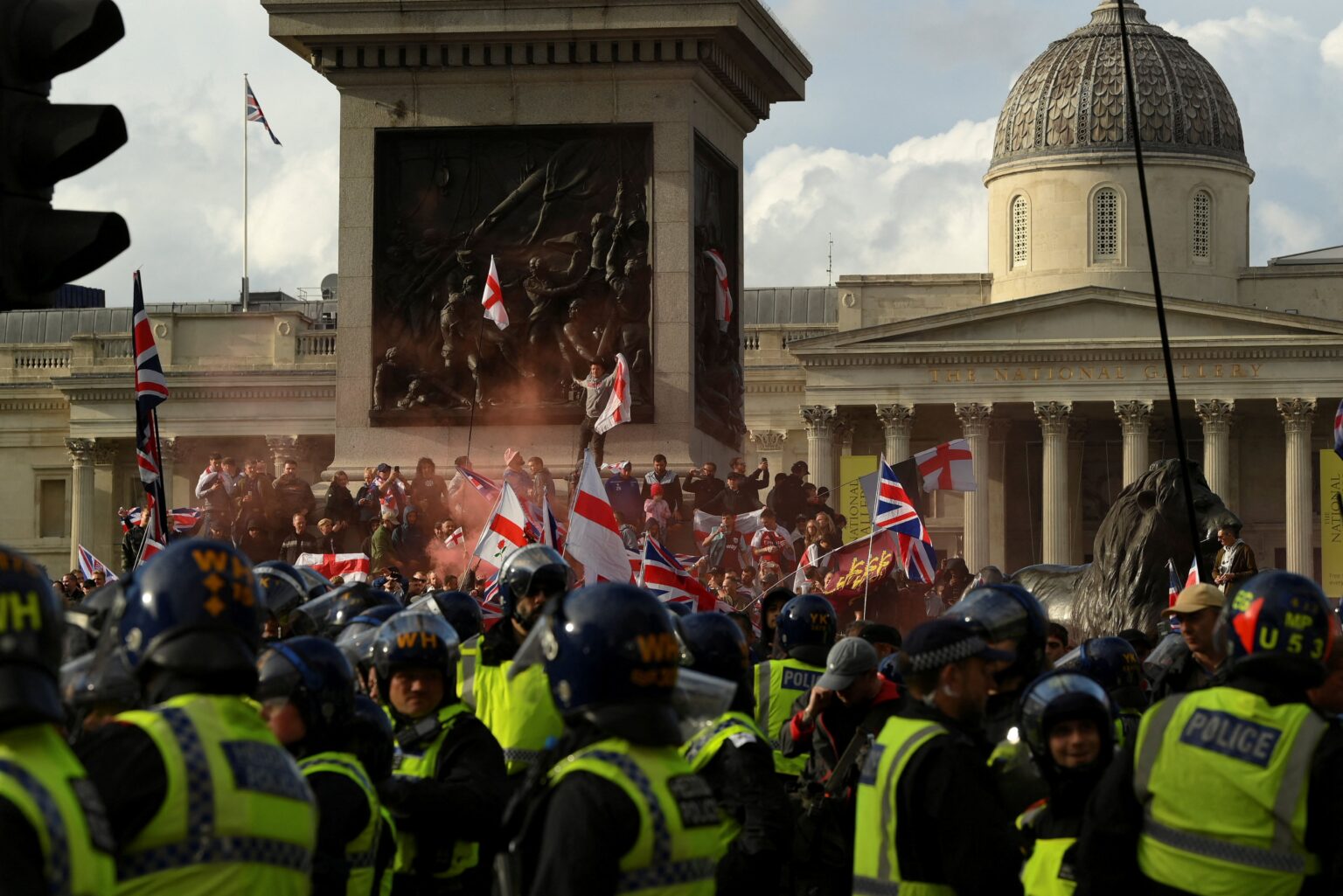
Last weekend, EDL supporters and others protested in several British cities against illegal migration and restrictions on freedom of speech. Hundreds of thousands took part in the demonstrations under the slogan “Unite The Kingdom,” although police had originally estimated 110,000 to 150,000 participants.
It is also noteworthy that the native population in several cities in the collective West is falling below 50 percent. The British Office for National Statistics (ONS) announced in 2022 that the proportion of white people in London and Birmingham had fallen below 50 percent. Three years ago, only 37 percent of the original inhabitants still lived in the capital.
Demographic change is also affecting France in a similar way, where the Muslim population has risen from around 2.4 percent to 10 percent of the population within ten years (2015 to 2025). The south of the country is most affected by this change, with around 40 percent of the population in Marseille already being Muslim in 2014.
Their regions of origin are North Africa, Turkey, and the Comoros archipelago, and it is assumed that Marseille will be the first city with a Muslim majority. Cities such as Paris and Nice also have a growing Muslim population, particularly from North Africa, but they only account for about 15 percent of the population.
It is unlikely that the French will allow themselves to be collectively provoked after a few incidents, as the British or Spanish have been. However, if social sentiment is reflected in support for political parties, similar conflicts could also arise in the suburbs of Paris.
Since 2015, trends that can be described as nationalist, populist, or national conservative have been gaining momentum. These trends were initially reflected in the isolated victories of Donald Trump and Brexit, later joined by Italian Prime Minister Giorgia Meloni, and right-wing parties even achieved a surprise victory in the European elections—although they were unable to capitalize on this victory.
In British politics, the Eurosceptic and anti-immigration MP Nigel Farage is currently gaining influence, and his Reform UK party is likely to displace one of the two traditional camps, the Tories and Labour. After the recent elections in France, the populist National Rally is likely to gain influence, as is the AfD in Germany.
If these victories by nationalist forces do not lead to the formation of governments and concrete government measures, there is a risk that voters will eventually reconsider their participation in elections – and resort to harsher forms of enforcing their social will.