
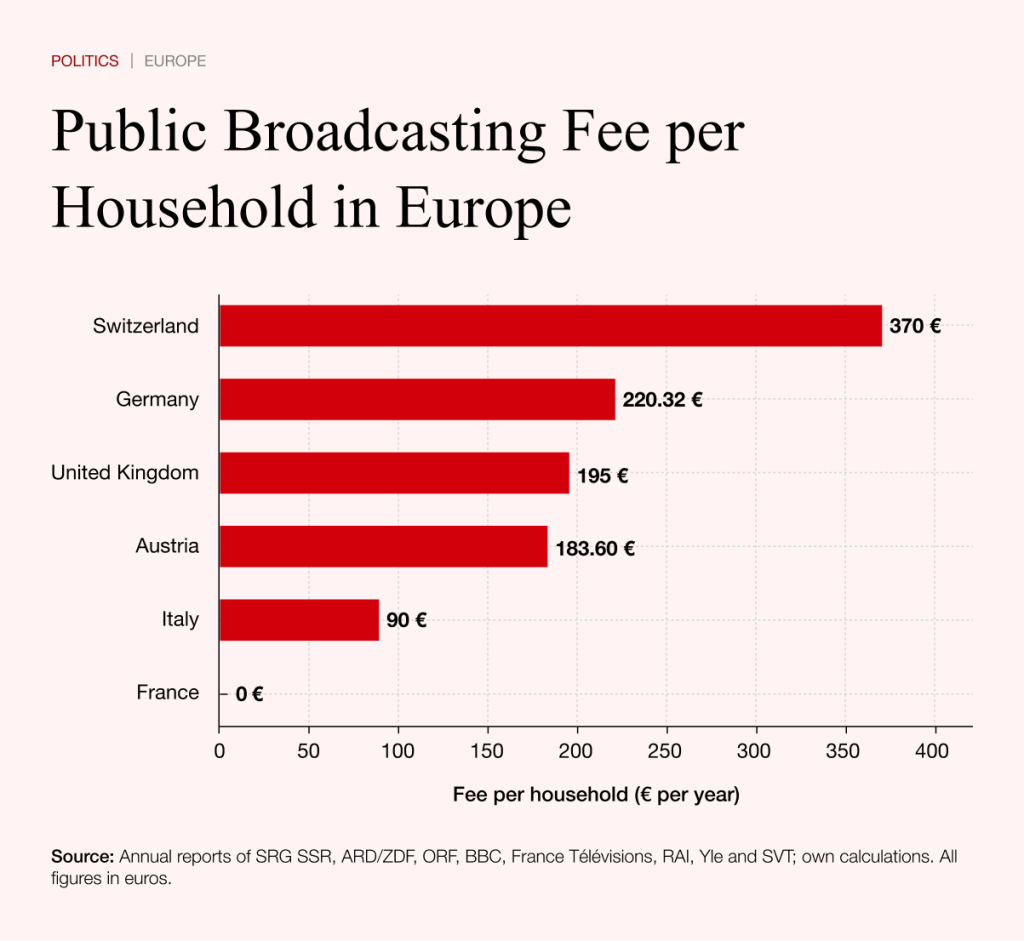
Berlin. A Swiss popular initiative aimed at sharply reducing the country’s broadcasting fee has failed. The referendum challenged the financing of Switzerland’s public broadcasting system, which ranks among the most expensive in Europe. The proposal sought to cut the annual media levy per household from 335 Swiss francs – roughly €370 – to 200 francs. Companies would also have been completely exempted from paying the fee. The initiative aimed to reduce the budget of public broadcasting significantly and curb its role in the media market.
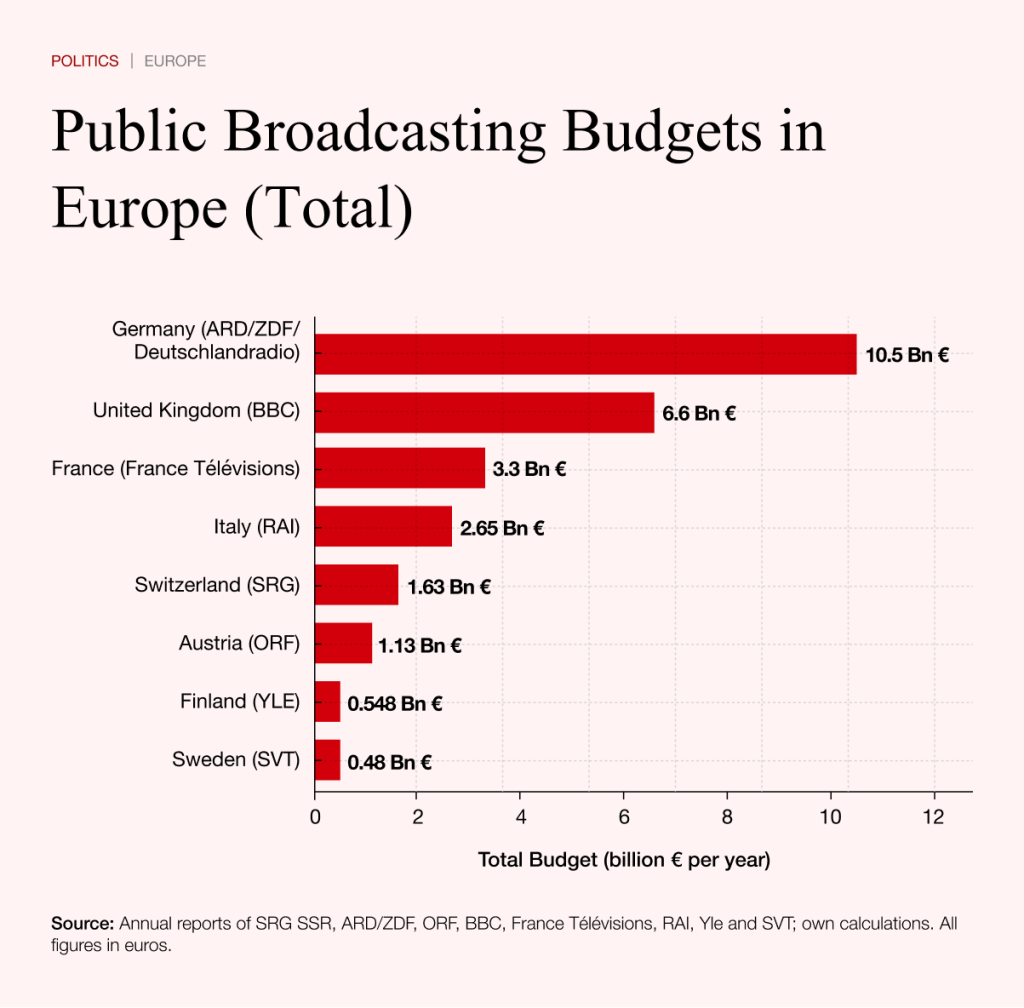
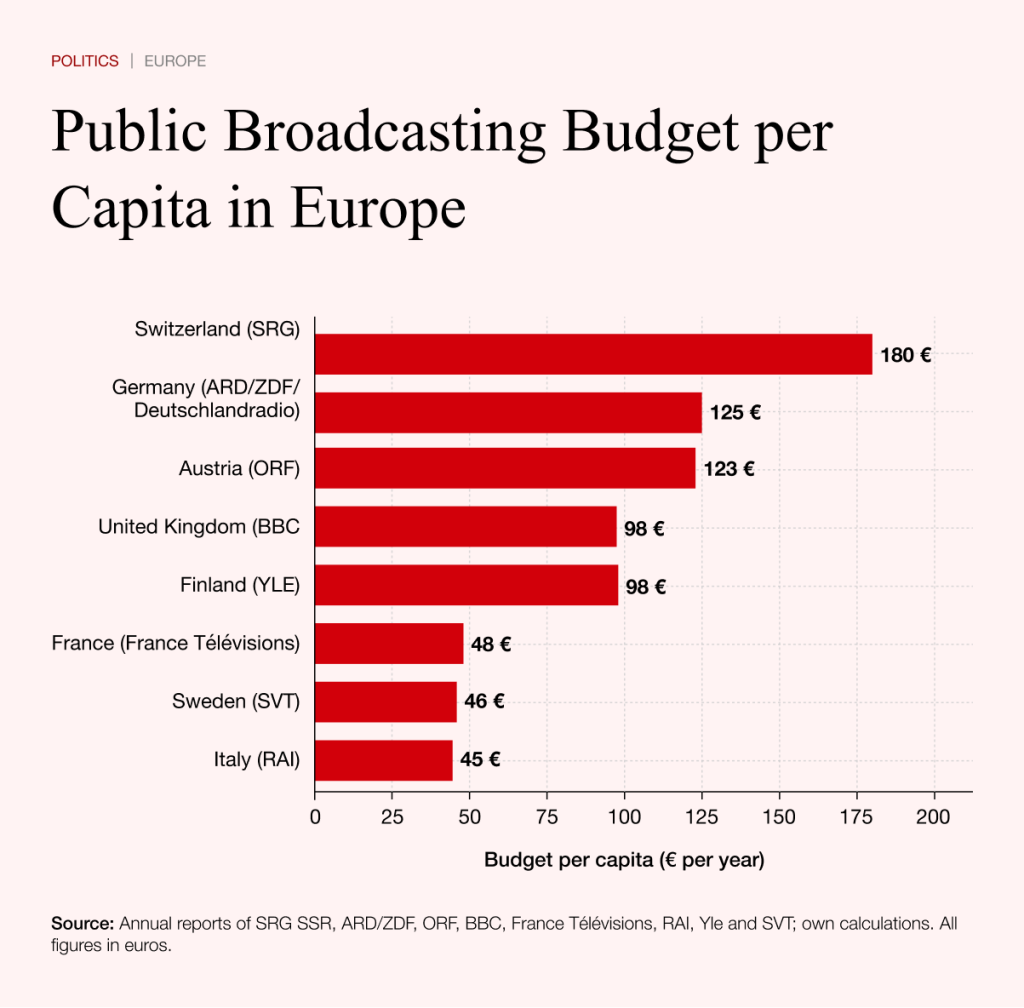
The proposal would have affected above all SRG SSR, Switzerland’s largest media company. SRG operates several television channels, 17 radio stations and extensive online services and employs around 7,000 people. Its annual operating revenue stands at roughly €1.63 billion. With a population of about 9.05 million, that equals around €180 per person – one of the highest per-capita levels of public broadcasting funding in Europe. In Switzerland, the system has been the subject of political debate for years because public broadcasting occupies a dominant position in the media market.
Criticism focuses mainly on the broadcaster’s size and market power. Opponents argue that SRG has evolved from a traditional provider of information into a comprehensive media group competing directly with private companies in many areas. Private media organisations in particular see fee-funded digital services, including news portals and streaming platforms, as a distortion of competition.
SRG also regularly faces political criticism. Conservative parties in particular accuse the broadcaster of a left-liberal orientation and argue that public broadcasting has moved too far away from the country’s political and social majorities. As a result, the issue has repeatedly become a central topic in election campaigns.
Supporters of SRG point to Switzerland’s particular structure. Unlike many European countries, it is a multilingual state. SRG produces programmes in German, French, Italian and Romansh. News, political reporting and cultural programming therefore have to be produced in parallel for several linguistic regions. In smaller language areas especially, a purely private media market would hardly provide comparable coverage.
Another argument is frequently raised. Public broadcasting plays an important democratic role in Switzerland. In a political system shaped strongly by direct democracy, political information is central. Referendums and popular votes take place regularly and many supporters of the system regard SRG as key infrastructure for the country’s political public sphere.
Those arguments ultimately convinced a clear majority of voters. Around 62 per cent voted against the fee reduction. The referendum thus reflects a broader pattern also visible in other European countries. Although criticism of public broadcasters is growing, many citizens remain willing to support their funding as long as they consider their role in the country’s political and cultural life important.
Germany: Europe’s largest broadcasting system
Germany operates the largest public broadcasting system in Europe. Each household currently pays €18.36 per month, or €220.32 per year. The revenue finances mainly the broadcasting groups ARD and ZDF as well as Deutschlandradio. The system’s total annual expenditure amounts to around €10.5 billion. With roughly 84 million inhabitants, that equals about €125 per person and places Germany among the most expensive publicly funded media systems in Europe.
The structure has developed historically and reflects the federal organisation of the country. ARD is not a single broadcaster but a consortium of several regional public broadcasters. These include Bayerischer Rundfunk, Norddeutscher Rundfunk, Westdeutscher Rundfunk, Südwestrundfunk, Mitteldeutscher Rundfunk, Hessischer Rundfunk, Saarländischer Rundfunk, Radio Bremen and Rundfunk Berlin-Brandenburg. Each produces its own programmes while also contributing to a joint national schedule.
Together, ARD and ZDF operate several national television channels, numerous regional programmes and more than 60 radio stations. They also maintain extensive online platforms, media libraries and international correspondent networks. Few European countries possess a public broadcasting network of comparable density.
That very scale is also the main reason for political criticism. Critics argue that a public broadcasting system of such dimensions is no longer necessary in a digital media environment. They point to the wide range of private television channels, streaming platforms and online services that now provide both news and entertainment.
Why ZDF was created
The existence of ZDF has historical roots that are often forgotten today. In the early years of the Federal Republic, there was effectively only one public television programme: ARD’s First German Television. The programme was organised jointly by the regional broadcasters and dominated the German television market.
The federal government under Konrad Adenauer wanted to establish a second national television channel. An attempt to create a state-controlled broadcaster failed in 1961 at the Federal Constitutional Court. The court ruled that broadcasting in Germany was primarily the responsibility of the federal states and could not be directly controlled by the federal government.
The federal states therefore founded ZDF in 1963 as a second public television broadcaster. The original purpose was clearly defined: ZDF was intended to prevent ARD from holding a monopoly in German television and to create a second national perspective within the public broadcasting system.
That logic changed fundamentally in the 1980s. With the introduction of private television, new channels such as RTL and Sat.1 entered the market. The German television landscape developed into a dual system of public and private providers. Since then, there has been recurring debate about whether a second large public broadcaster is still necessary or whether the original historical rationale has long since become outdated.
The ZDF AI scandal
An incident in 2026 illustrated how sensitive the debate over public broadcasting has become. The news programme ‘heute journal’ aired a report about operations carried out by the US immigration authority ICE. The report included a dramatic scene showing officers leading away a woman while a child clung to her.
It later emerged that the footage had been generated using artificial intelligence. The report did not indicate that the video was synthetic. In addition, the editors used archive footage from 2022 that had no connection to the current event. After media journalists drew attention to the error, the broadcaster apologised publicly and announced stricter rules governing the use of AI-generated material.
The episode triggered a wider debate about journalistic standards in the digital age. Critics argued that public broadcasters in particular must handle new technologies with special care, as their claim to credibility and journalistic quality rests on public funding.

Austria: a smaller but still costly system per capita
Austria also operates a public broadcasting system. Since 2024, the ORF has been financed through a mandatory household contribution. The basic fee amounts to €15.30 per month. Depending on the federal state, additional levies apply, so the annual burden for households usually lies between roughly €183 and €240.
ORF most recently generated annual revenue of about €1.13 billion. With a population of around 9.2 million, that corresponds to roughly €123 per person. Austria therefore has a similar per-capita funding level to Germany by European standards.
The broadcaster operates several television channels, numerous radio programmes and a large online portal. At the same time, ORF regularly faces criticism over its political structure. Its foundation council, which exerts significant influence over the broadcaster’s leadership, is partly filled by party representatives, leading to recurring debate about political influence.
United Kingdom: a licence system with an opt-out
The United Kingdom is home to one of the world’s best-known public broadcasting systems: the BBC. It is financed through a television licence. Households currently pay around €195 per year.
The BBC has an annual budget of about €6.6 billion. With roughly 67 million inhabitants, that amounts to around €98 per person. The United Kingdom therefore lies well below the funding levels seen in Germany or Switzerland.
One key difference compared with many other countries lies in the licence system itself. Households can declare that they do not watch live television and do not access BBC content through the BBC iPlayer streaming service. In that case they do not have to pay the licence fee. Some critics regard this as a more liberal model because it allows a more voluntary form of financing.
France: funded from the state budget
France abolished its broadcasting licence entirely in 2022. Public broadcasting has since been financed directly from the state budget. The main channels include France 2, France 3 and France Info.
The system’s budget amounts to roughly €3.30 billion annually. With around 68 million inhabitants, that equals about €48 per person. France therefore operates one of the comparatively less expensive publicly funded broadcasting systems in Europe.
Critics warn, however, that financing through the state budget may facilitate political influence. While licence systems create a certain distance between the state and the broadcaster, the French system depends more directly on political budget decisions.
Italy: fees collected through the electricity bill
Italy has introduced an unusual financing model. The broadcasting fee is collected automatically through electricity bills. Households pay around €90 per year for the state broadcaster RAI.
RAI’s annual budget amounts to about €2.65 billion. With roughly 59 million inhabitants, that corresponds to around €45 per person. Italy therefore belongs to the less expensive public broadcasting systems in Europe.
The model was introduced because many citizens previously avoided paying the licence fee. Linking the payment to electricity bills significantly increased the number of paying households.
Scandinavia: high funding, high trust
Public broadcasting systems in Scandinavia are among the most stable in Europe. In Finland, the broadcaster Yle is financed through a special broadcasting tax. Its budget amounts to roughly €548 million annually. With a population of about 5.6 million, that equals around €98 per person.
In Sweden, public broadcasting is likewise financed through a tax. The television broadcaster SVT has a budget of around €480 million. With roughly 10.5 million inhabitants, that corresponds to about €46 per person.
What distinguishes these countries, however, is not only their funding model but also public trust. In international studies, Scandinavia’s public broadcasters regularly rank among the most trusted news sources.

Trust: the decisive factor
Beyond costs and institutional structures, the future of public broadcasting depends above all on public trust. International comparative studies show significant differences across Europe. In Scandinavia, public broadcasters enjoy particularly high credibility. In Finland, for example, roughly two-thirds of the population say they trust news media overall. The public broadcaster Yle ranks among the country’s most trusted media brands. Norway and Sweden also score well above the European average in measures of public trust.
In Central Europe, the picture is more mixed. In Germany, about 45 per cent of respondents say they trust most news in general. Public broadcasters such as ARD and ZDF still rank among the country’s most trusted news brands, yet perceptions of the media are more politically polarised than in Scandinavia. In France and Italy, confidence in news media is significantly lower overall. Many citizens increasingly see the media as part of political conflicts.
The central issue
The European comparison shows that public broadcasting can take very different forms. In Switzerland and Germany, the systems are large and financed through licence fees with substantial budgets. France funds broadcasting through taxation, while the United Kingdom maintains a traditional licence system with an opt-out. Italy, meanwhile, has linked its licence fee to electricity bills.
The key question, however, is not only the level of fees but the degree of public trust. In countries such as Finland and Norway, public broadcasters enjoy particularly high credibility. In others, trust is far more polarised, and political debates about reform or cuts are becoming increasingly intense.
The dispute over licence fees therefore reflects a broader media-policy question: what role publicly funded journalism should play in a digital media environment and how large such broadcasting systems ought to be in the future.