
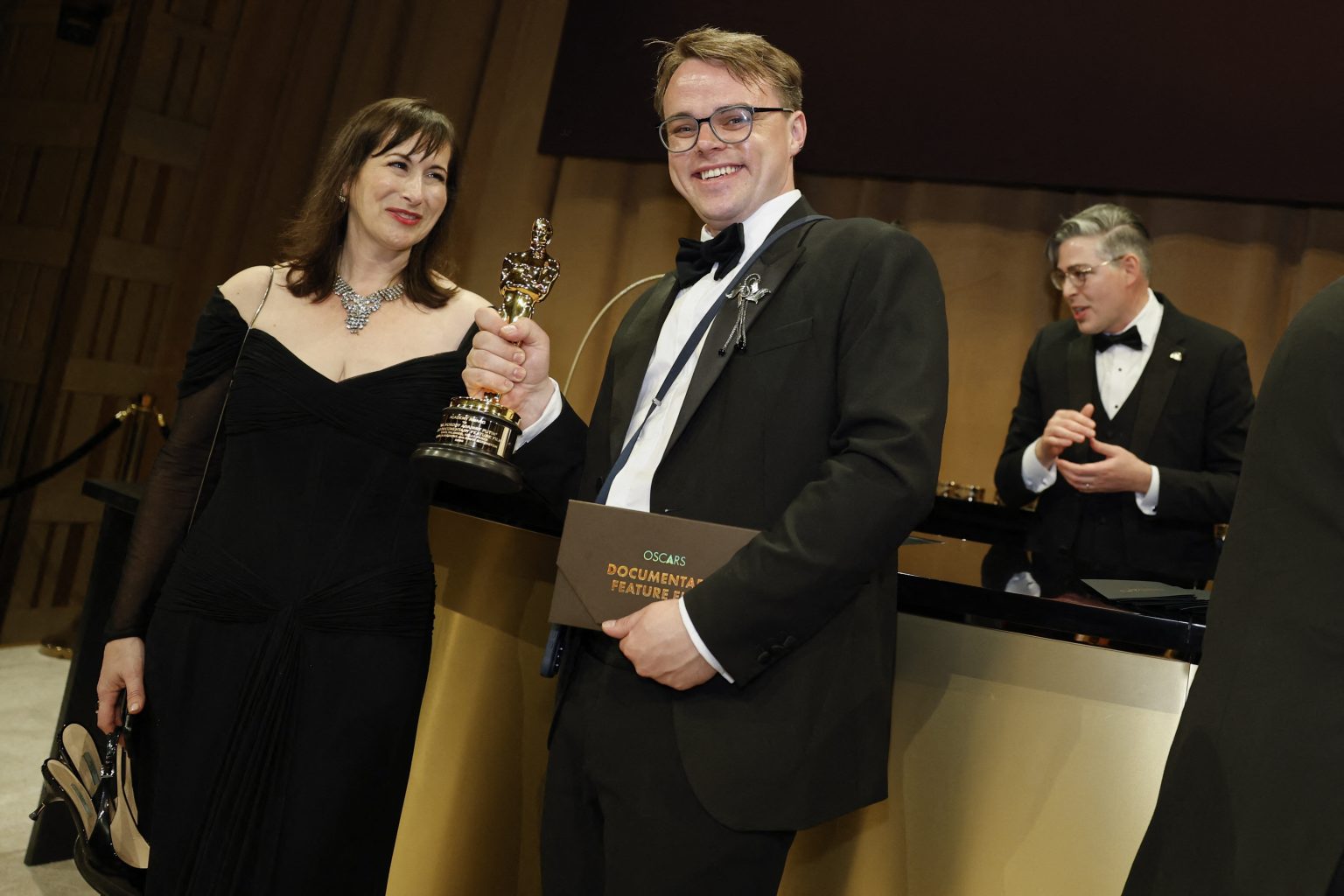
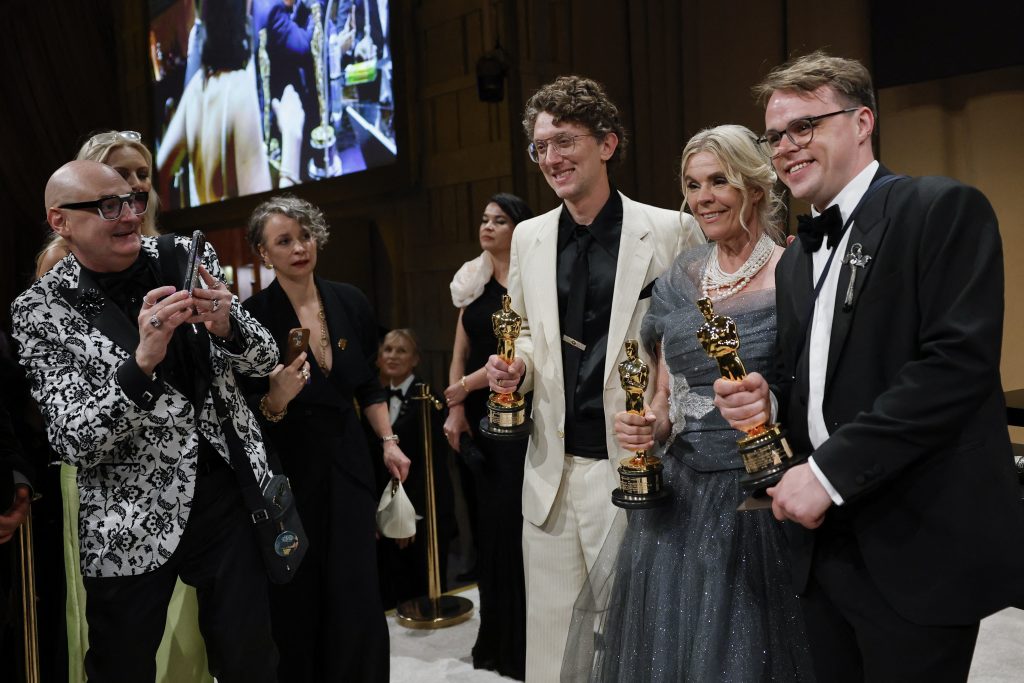
The 98th Academy Awards ceremony took place in Los Angeles on the night of 15–16 March 2026. Mr. Nobody Against Putin was named best documentary. The Danish–Czech co-production was directed by the American filmmaker David Borenstein and the Russian teacher Pavel Talankin, who filmed much of the material himself. As a result, he cannot return to Russia for the time being.
Talankin, an elementary school teacher from Karabash in the Chelyabinsk region, previously spoke to Statement about his work and propaganda in Russian schools.
Filming the System From Within
When Talankin was tasked in 2022 with filming ‘patriotic education’ at his school, he approached the assignment in his own way – recording events without embellishment. He smuggled the footage out of Russia in the summer of 2024 and, together with a professional director, turned it into a 90-minute documentary that has already been screened in several European countries.
Talankin remains the only person known to have smuggled such material out of Russia on such a scale. As he told Statement, the film runs for only 90 minutes, although he recorded roughly another ten hours of footage.
‘I started filming two weeks after the war began,’ Talankin said. The idea of releasing part of the footage as a film did not occur to him at first. At that stage, he only knew that he had no intention of deleting the recordings after submitting them to the Ministry of Education, as required by regulations.
In a February interview with the Russian émigré outlet Novaya Gazeta, Borenstein said that he had originally planned to shoot the film himself, with Talankin appearing only as the central character. Neither Talankin nor Borenstein realised at the outset what risks they were taking.
‘Anti-war protests were still taking place in the streets, the new law on treason had not yet been enacted, and the revised version of the law on foreign agents had not been adopted,’ Borenstein explained the reasoning behind the original plan. After some initial haste, however, they concluded that only Talankin himself could film the material.
Tensions Inside the School
Talankin told Statement that he did not have a single ideologically like-minded colleague. Quite a few students, especially older ones, also criticised him for his openly anti-regime stance.
‘A new wave of repression has now hit Russia. Children are reporting teachers, and teachers, in turn, are reporting children and their parents,’ Talankin said.
This atmosphere was reflected in school campaigns designed to demonstrate loyalty to the war effort. One such campaign, known as ‘A Letter to a Soldier’, encouraged pupils to write messages of support to Russian troops at the front. At the Karabash school, however, one student wrote to a soldier, ‘I won’t wish you anything – I don’t care what happens to you.’ Talankin quietly removed the postcard from the staff room so that the incident would simply fade away.

Honoured Abroad
‘For four years, we have been looking at the starry sky and making the most important wish. There are countries where, instead of shooting stars, bombs fall from the sky and drones fly,’ Pavel Talankin said on stage during the Oscar ceremony.
‘Mr. Nobody Against Putin is a film about how one can lose one’s country,’ added David Borenstein. ‘While working on these scenes, we realised that it can be lost through countless small acts of complicity.’
Talankin and Borenstein’s film had already won the documentary category at the 79th BAFTA Film Awards on 22 February.