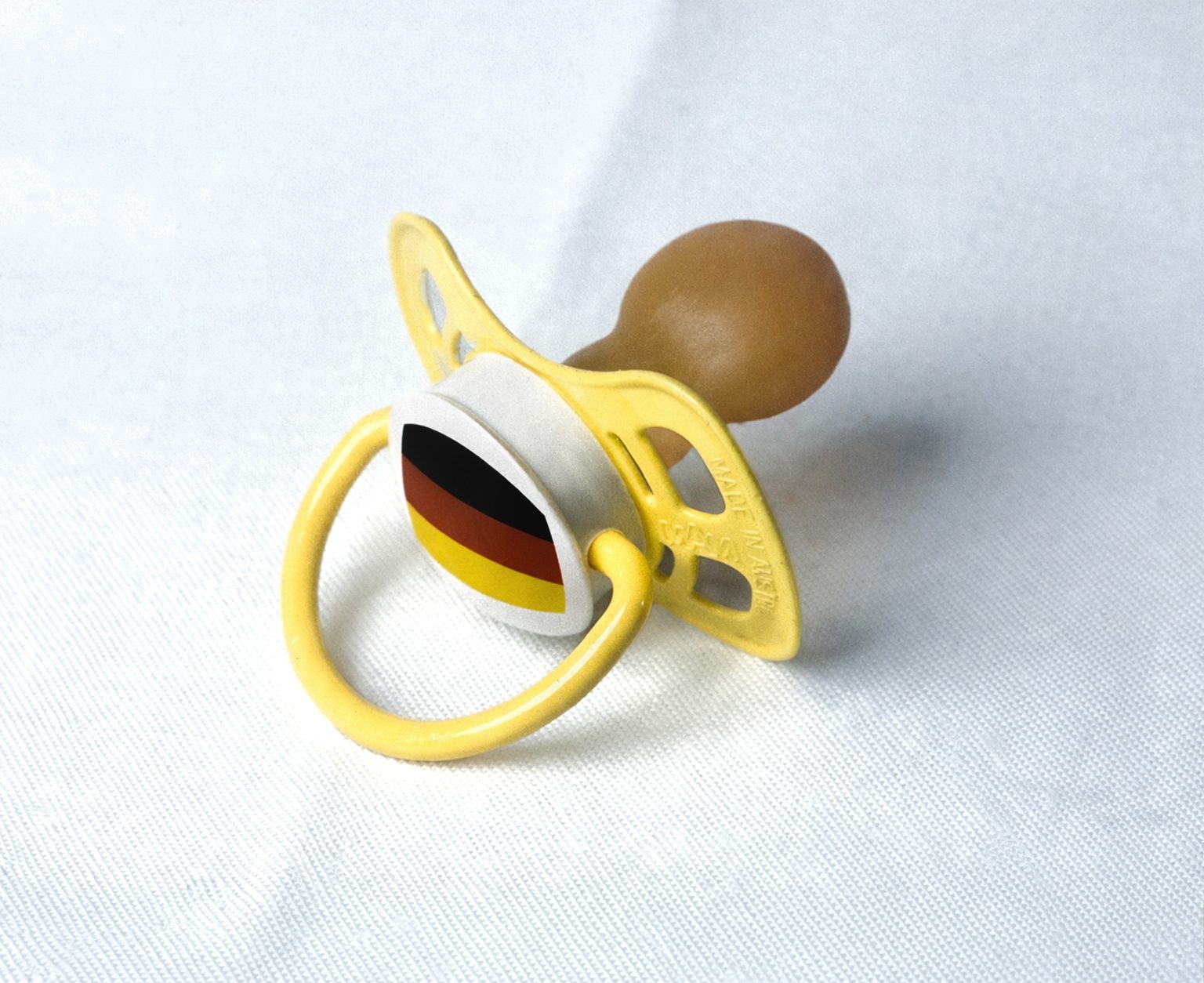
Surrogacy is banned in Germany, yet parents can legally obtain children abroad as agencies openly promote the practice. Photo: Illustré/RDB/ullstein bild via Getty Images/AI
Baby Shopping Abroad
Surrogacy is banned in Germany. Yet would-be parents can still obtain a child abroad – and bring it home legally. Agencies openly promote the business even at fairs in German cities.
Given the legal framework, an article about surrogacy in Germany ought to be rather brief, since the practice of assisted reproduction is explicitly prohibited in the country. In reality, however, many Germans still make perfectly legal use of the option of obtaining a child on a foreign market and then bringing it home. The German justice system does not punish them for doing so. On the contrary, it usually helps them subsequently regularise and optimise the child’s legal status. Meanwhile, agencies from around the world offer the very services abroad that are banned in Germany, openly advertising them at so-called ‘baby wish fairs’ without interference from the authorities.
The result is a paradoxical situation. Although Germany formally bans surrogacy, it does not prevent its citizens from engaging in reproductive tourism, as Italy did only last year through a legislative amendment. Instead, the circumvention of German law is ultimately rewarded with a German passport for the child.
The Legal Framework
In Germany, as in most European countries, surrogacy is prohibited in all forms. The relevant provisions are set out in the Embryo Protection Act (Embryonenschutzgesetz, ESchG). The law is primarily framed from the perspective of child protection. It seeks to defend the dignity of the child against potential abuse by adults as well as against scientific ambitions and research interests that require human eggs or embryos. The child, whether a two-cell embryo or a newborn, is not to be treated as an object. Germany therefore attempts to uphold the principle mater semper certa est – the mother is always certain. Accordingly, Section 1591 of the Civil Code (Bürgerliches Gesetzbuch, BGB) states: ‘The mother of a child is the woman who gave birth to it.’
Arranging surrogacy is likewise a criminal offence. The relevant provision appears in Section 13 of the Adoption Placement Act (Adoptionsvermittlungsgesetz, AdVermiG) under the heading ‘Prohibition of surrogate-mother mediation’. The law therefore forbids not only attempts to bring together the parties involved but also actively ‘seeking or offering surrogate mothers or commissioning parents through public declarations, particularly through newspaper advertisements or reports’. In effect, there is also a ban on advertising.
A Schizophrenic Grey Zone
Not all participants in this business commit a criminal offence when attempting to realise surrogacy in Germany or from Germany. Only the doctors who provide the necessary medical procedures and the intermediaries who establish contact between women and commissioning parents are liable to prosecution, regardless of whether they receive payment.
The women who agree to carry such pregnancies and the clients who hire them, by contrast, are explicitly exempt from punishment. The law guarantees that they operate within the legal sphere. What they cannot find in Germany, however, are doctors or clinics willing to perform the medical procedures. Nor could the handover of the child from the birth mother to the commissioning parents take place legally in Germany, although that restriction applies only if the process occurs on German soil.
That is why the legal situation appears somewhat schizophrenic. The medical procedure required for surrogacy is prohibited, yet carrying a child as a surrogate is not. Nor is it illegal for intended parents to seek the services banned in Germany abroad. Only the medical providers and the intermediaries are criminally liable, and in practice even they are not always prosecuted. Welcome to Germany’s grey zone.
Sales Fairs in the Middle of Germany
The fact that something is illegal does not mean it does not happen. Although surrogacy itself is banned in Germany, the arrangement of surrogacy is punishable and advertising for it is prohibited, surrogacy fairs are nevertheless held regularly in the country. They do precisely what the law forbids: advertise such services and facilitate contacts between agencies, surrogate mothers and potential clients. Prosecutors have so far turned a blind eye. And wherever an offer exists, customers will follow.
Once human beings are no longer regarded as individuals but as the optimised result of a production process – a product traded on the global market and transferred as a commodity – all the usual mechanisms of a market economy inevitably follow. Supply-chain disruptions, ‘production defects’ such as children born with disabilities, complicated trade regulations, dubious providers, profit-driven agencies and enterprising lawyers appear. And like any market, it also requires sales venues. Germany provides them.
What Does a Child Cost?
What, then, does a child cost? It is tragic and shameful that the question can once again be expressed in figures today – not in some rogue state on the other side of the world, but in the middle of Germany.
In spring 2024 a Ukrainian agency personally offered me a child in Germany at a legal baby fair called ‘Wish for a Baby’ in Berlin for only €52,000. Online, the child would have cost €36,000. The embryo would be conceived in Ukraine, the surrogate mother would come from Bulgaria or Kazakhstan and could be selected from an online catalogue. She would give birth in Cyprus, where the authorities cooperate, and I would receive sole parental rights as a single mother in Germany.
Even the war, now in its fourth year, has not ruined Ukraine’s lucrative business. The country remains the low-cost El Dorado of the global surrogacy industry. Business continues without interruption. For customers reluctant to travel to Kyiv to sign contracts or transfer genetic material or newborns, offices and apartments have long been established across the border in countries such as the Czech Republic, Georgia and Bulgaria. In some cases, agencies have even opened their own branches.
‘Wish for a Baby’ has meanwhile become an institution across Europe. The fair is held not only in Berlin and Cologne but also in Milan, Paris and Brussels. A second event has now emerged as well, though with stricter access rules intended to keep journalists away: ‘Men Having Babies’ in Berlin, which focuses specifically on single or homosexual male clients. Here women are reduced to nothing more than ‘gestational machines’, serving merely as instruments of reproduction.
"Yes, Everything Is Legal"
It is more than a bad joke that the Ukrainian agency Feskov was able to appear as an exhibitor at the Wish for a Baby fair in Germany without interference, even while investigations for human trafficking were under way against its operators in several European countries and charges had been filed in Ukraine itself. Despite multiple criminal complaints against the organisers, the German justice system has shown little interest in the fact that surrogacy, egg donation and anonymous sperm donation were advertised in Cologne and Berlin like goods on a marketplace – practices that are illegal in Germany.
Only when an LGBTQ online portal openly advertised a ‘10 per cent discount’ on ordering a child in 2025, complete with a promotional image of a stork, did the public prosecutor in Düsseldorf open an investigation following a criminal complaint.
Another regular exhibitor at these fairs is the low-cost agency Success, based in Cyprus. On its website a chat function operates around the clock. Within an hour one can receive an offer for a comprehensive IVF programme with unlimited embryo transfers for €35,550. The friendly woman in the chat assures prospective clients: ‘Yes, everything is legal’. The brochure even promises that clients may spend the final three months of pregnancy with the surrogate mother before the birth and enjoy the period before delivery in the country of the commissioning parents. In other words, the pregnant woman would be brought to the customer. The precise location of the birth remains vague, though the agency guarantees legal documents.
"We Can Guarantee You a Baby"
American providers are particularly dominant at these fairs. The Fertility Institute in San Diego acts as sponsor. ‘We can guarantee you a baby’, boasts one of the doctors, adding that there is also a money-back guarantee. The Utah Fertility Center offers a programme with an unlimited number of embryo transfers for $45,000, though agency fees and the surrogate mother must be added, bringing the total to around $95,000. The $1,000 sperm donation is the smallest item in the calculation. Another Californian firm, Building Families Inc., advertises with the slogan ‘Their bun, my oven’ – suggesting that anyone can have their desired child baked in a borrowed oven. The agency apparently considers such slogans amusing.
At Vittoriavita, headquartered in Kyiv, the baby-guarantee programme costs €54,000 in Ukraine and €62,000 in Georgia.
‘We do everything’, assured a representative of IVMED Family Agency in Kyiv when asked at the Baby Fair about the services on offer. The company operates branches in Georgia, Armenia, Cyprus and Greece. Clients can book not only the guaranteed birth of a live child but also a 100 per cent money-back guarantee.
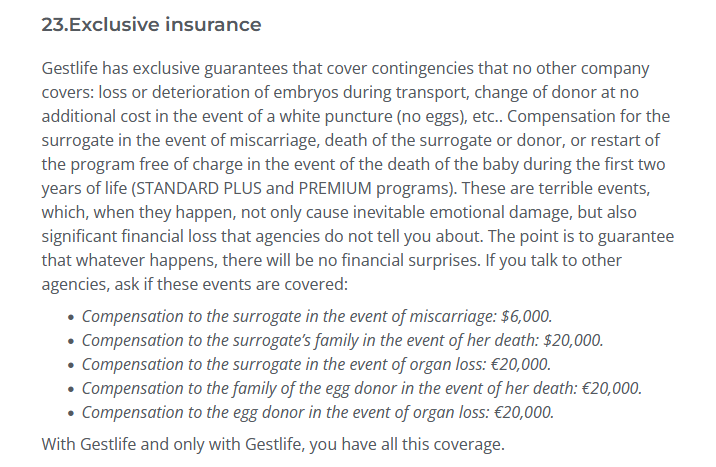
Particularly striking offers come from the agency Gestlife, which seriously advertises a two-year warranty on a child and a replacement should the baby die. The clause is described as a ‘free restart of the programme in the event of the death of the baby during the first two years of life (STANDARD PLUS and PREMIUM programmes)’. It is difficult to imagine a clearer example of children being reduced to objects – traded and replaced like defective toys.
Gestlife Warranty gives you a second child, if the first one dies within two years. Source: Gestlife Homepage
Italy has already shown how the circumvention of national law can be prevented. A universal ban penalises Italian citizens not only at home but also if they make use of surrogacy abroad. Anyone returning with such a child, or presenting themselves at an Italian consulate overseas, does not receive a passport for the new citizen but a criminal complaint. They risk substantial fines and may even lose custody of the child.
Germany and many other countries, by contrast, tolerate the business and its intermediaries even on their own territory, while simultaneously debating possible legalisation.
Prohibit What Cannot Be Regulated
In Germany, liberal voices are also calling for a relaxation of the rules and at least the possibility of ‘altruistic’ surrogacy, arguing that no money would be involved and therefore no child would be sold. Yet do the lawyers, doctors, agencies, clinics and laboratories involved really work without payment? Or would the woman be the only participant whose service – the use of her body – is expected to remain unpaid?
However one looks at it, the idea that a ‘clean’ or ‘altruistic’ form of surrogacy could be legalised within national borders is an illusion. There is no ethically defensible way deliberately to take children away from their mothers and attach price tags to them. The very proposal is absurd. Instead, those who enable it become accomplices in a global trade in children. Anyone who legalises the practice nationally inevitably becomes complicit in the exploitation that characterises the international market.
Welcome to the comments section of the Štandard daily. Please take note of our guidelines, comments are moderated by us. You can contact the moderators at support@statement.com.
Participate in the discussion
Comments are available to subscribers only. If you'd like to join the discussion, choose a subscription starting at €6.72 per month.
All comments 0
Register
Comments are available to registered users only. If you'd like to join the discussion, register here.