

Oxford. This year’s World Happiness Report once again shows how differently people around the world assess their quality of life. The study is published annually to coincide with the International Day of Happiness by an international team of researchers led by the Wellbeing Research Centre at the University of Oxford, in collaboration with the UN Sustainable Development Solutions Network.
The analysis draws on global data from the Gallup World Poll, in which respondents assess their own life satisfaction. At its core is the so-called ‘Cantril ladder’, where individuals place their lives on a scale from 0 to 10. Additional factors include economic performance, social support, life expectancy, personal freedom, generosity and perceptions of corruption.

The stable top – and a quiet shift in Europe
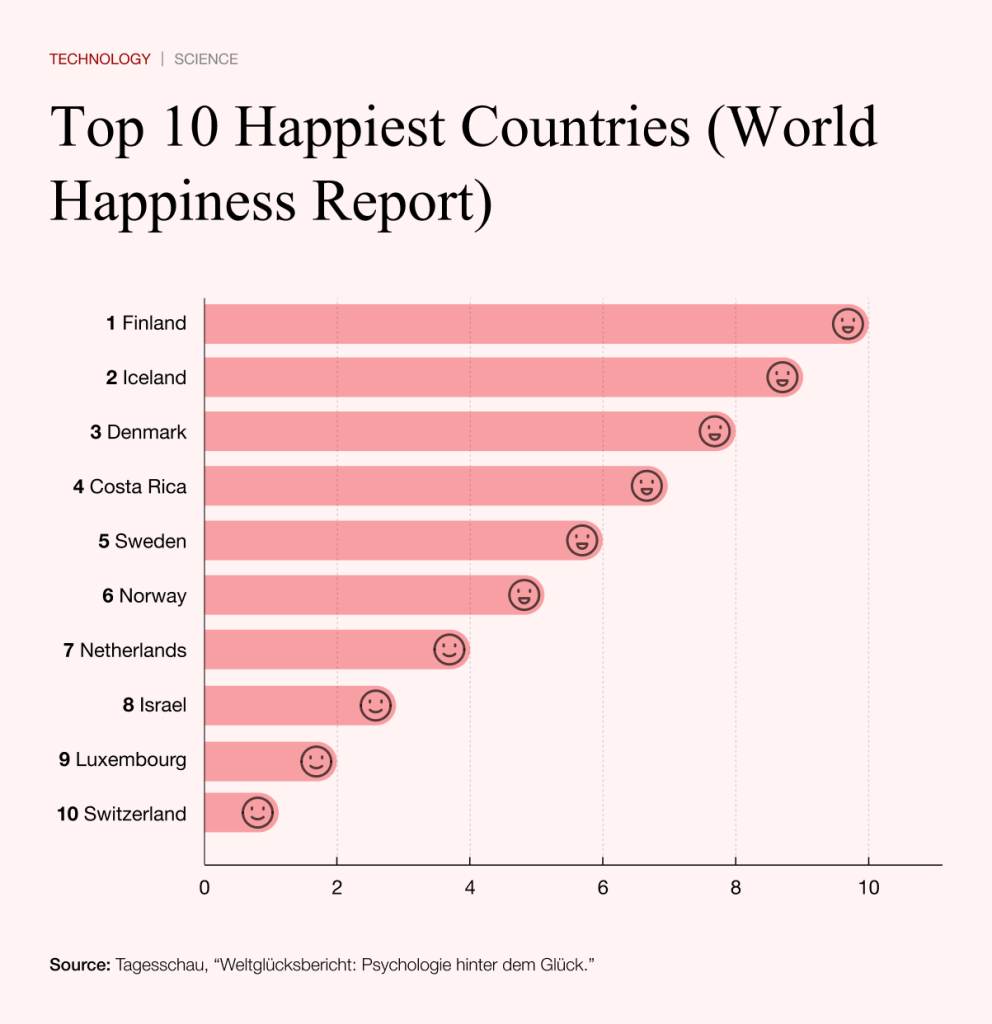
Finland retains its position at the top for the ninth consecutive year. Behind it, a familiar picture emerges: Iceland, Denmark and Sweden follow closely, joined by Norway and the Netherlands. This is no one-off but a structural pattern. The Nordic countries have built a model based on trust, effective institutions and high social stability. Happiness there is not a matter of chance but the product of political and social arrangements.
What stands out, however, is who has entered the top tier: Costa Rica ranks fourth, the best result ever achieved by a Latin American country. It underlines that material wealth alone is not decisive. Social ties and a sense of well-being can partly offset deficits in income or infrastructure. Europe as a whole also shows a longer-term shift: a gradual convergence between East and West. Countries in Central and Eastern Europe in particular are catching up. States such as Serbia, Bulgaria and Latvia have significantly raised life satisfaction over the past two decades. This is no coincidence. It reflects economic convergence, political stabilisation and gradual integration into European structures. The gap within Europe is narrowing – a rare and tangible success of European development policy.
Slovakia fits into this pattern, albeit less dramatically. The country has not seen sudden leaps in recent years, but it has moved steadily upwards. Life satisfaction has risen consistently, supported by economic convergence, higher employment and gradual alignment with Western living standards. Unlike in many Western European countries, there has been no drop in subjective well-being. Slovakia thus exemplifies those countries in Central and Eastern Europe where satisfaction grows not through isolated reforms but through long-term stability.
Against this backdrop, developments in the German-speaking countries may seem marginal, yet they are politically telling. Germany improves from 22nd to 17th place, while Austria slips to 19th. The shift is small but symbolic: two closely intertwined economies are diverging in how people perceive their lives. The reasons lie less in short-term policy than in deeper structural factors.
According to the report, six variables are key: economic performance, life expectancy, social support, personal freedom, generosity and perceptions of corruption. Together, they account for more than three quarters of the differences between countries. Yet they do not explain everything. Germany in particular shows that even in highly developed economies, small shifts in perception can have a noticeable impact on rankings. The gaps in the middle of the table are narrow, a marginal improvement is enough to climb several places. The United States, by contrast, remains stuck at a comparatively low level, well behind Europe’s top performers. That, too, reflects a deeper trend.
The West grows less content – despite prosperity
The most important finding of the report is not the ranking itself but the longer-term trend. Western industrialised countries are, on average, less satisfied today than they were 15 years ago. 15 of them have recorded significant declines, while only four have improved. That is striking. Objectively, many living conditions have not worsened. Incomes have risen, healthcare and security remain stable at a high level. Yet satisfaction is falling.
The reason lies in changing expectations and social structures. While traditional factors such as income remain relevant, intangible aspects are gaining weight: trust, social connection and a sense of control over one’s own life. It is precisely here that many Western societies show signs of erosion. Trust in institutions is declining, social bonds are weakening and the sense of control over one’s own life is diminishing. The result is a paradox: rising prosperity alongside falling satisfaction.
This shift is most visible among the young. In North America and Western Europe, life satisfaction among those under 25 has fallen sharply, in some countries dramatically. The United States, Canada, Australia and New Zealand rank among the lowest globally in terms of youth satisfaction trends. This runs counter to the long-held assumption that younger generations automatically benefit from progress. While in most parts of the world young people are more satisfied today than they were two decades ago, the opposite is true in the West. The causes are complex, but one factor stands out: the digital environment.
Social media – a global experiment with an uncertain outcome
For the first time, the report examines the role of social media in depth. The findings are nuanced but clear in direction. Moderate use of digital tools – for communication, learning or information exchange – is associated with higher satisfaction. Heavy use, particularly of social networks, shows the opposite effect. Adolescents who spend more than seven hours a day on social media report markedly lower levels of satisfaction. The effect is especially pronounced among girls in Western Europe.
Crucially, it depends on how social media are used. Platforms that encourage genuine interaction can have positive effects, while those driven by algorithmically curated content and constant comparison tend to have negative ones. The mechanism is well known: perpetual comparison, social competition and a shift from real to digital relationships.
Another finding is particularly revealing: many users are aware of the negative effects. Studies show that numerous young people say they would prefer not to use social media but do so because everyone else does. It is a classic network effect, stabilising behaviour even when it is perceived as harmful.

The World Happiness Report thus offers more than a ranking. It provides a diagnosis of Western societies. Happiness is not primarily a question of income or growth. It is the result of functioning social structures, stable institutions and resilient communities. Where these foundations erode, satisfaction declines, even in conditions of high prosperity.
The political implication is clear, even if it is rarely stated openly: economic policy alone is no longer sufficient to secure social stability. The decisive questions lie deeper – in trust, social cohesion and cultural continuity. It is here that it will be decided whether Western societies can reverse the current trend or continue to lose satisfaction despite their wealth.