Speculation over VAT rise in Germany – government denies plans
A possible rise in value-added tax is unsettling consumers in Germany. It would hit low and middle incomes – the very groups the government says should be relieved as petrol prices rise. The Finance Ministry denies the plans. For now.
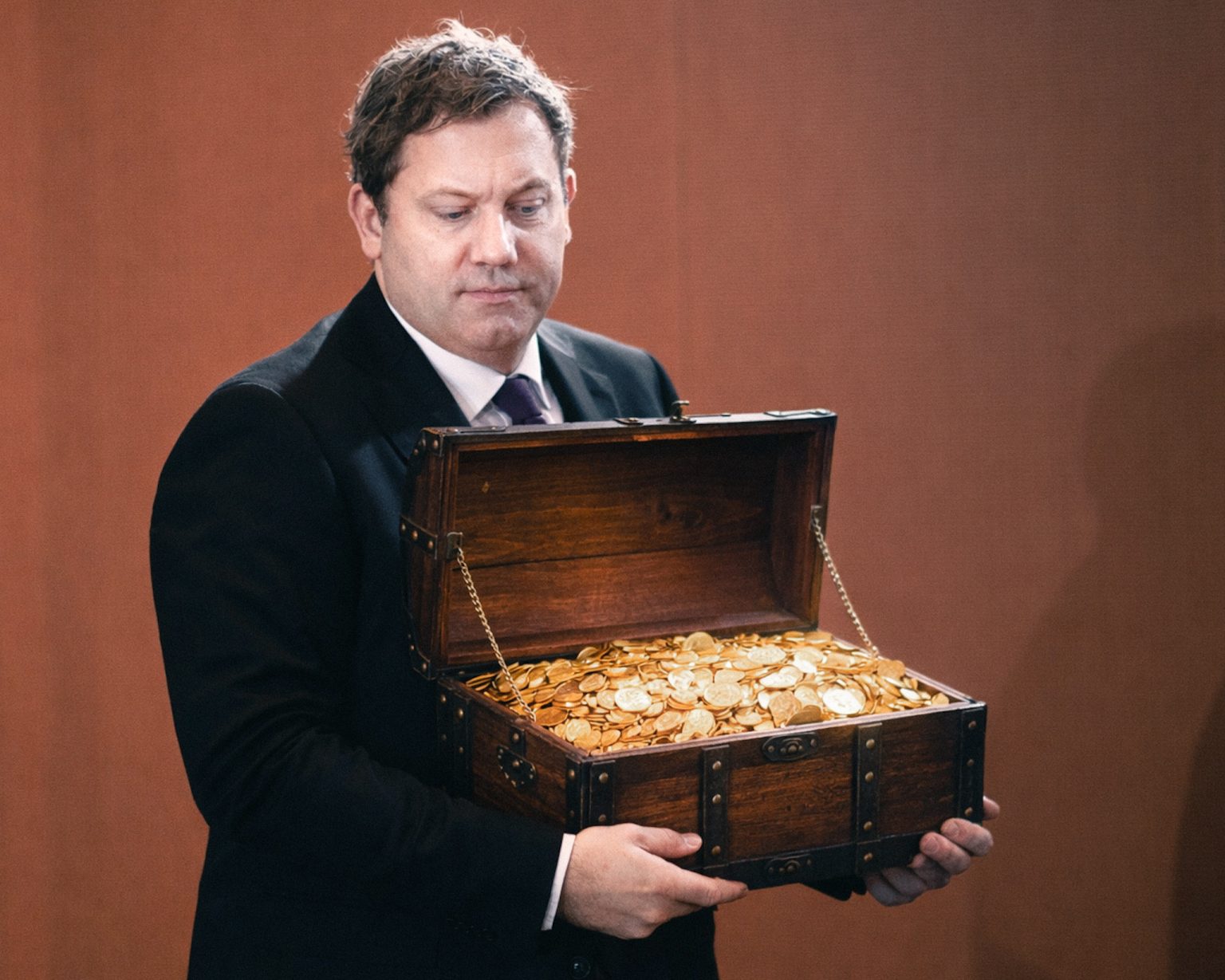
Lars Klingbeil and the dream of a full state treasury. Photo: Carsten Koall/Getty Images/ChatGPT
|
Berlin. Several media outlets report that the German government is considering raising VAT from the current 19 per cent to 20 or 21 per cent. VAT is an indirect tax paid by all end consumers on goods and services. For items deemed essential, including food and books, a reduced rate of seven per cent currently applies in Germany.
To cushion the impact on lower earners, discussions are said to include cutting that reduced rate from seven to four per cent, according to Handelsblatt. For food, a reduction to zero per cent is even under consideration. No decision has yet been taken, the newspaper reports.
Relief here – increases there
Germany is among the countries with the highest tax burdens worldwide. The debate reflects the government’s efforts to ease the burden on low and middle incomes, which would have to be financed elsewhere. One option, raising the top rate of income tax from 42 to 49 per cent, has been rejected by the larger of the two governing parties, the CDU.
The media speculation was followed by a denial. The Finance Ministry, led by Finance Minister Lars Klingbeil (SPD), will not propose an increase in VAT in the government’s reform talks, the German Press Agency (dpa) reports. According to information from Berlin, such a measure is not part of the ministry’s plans.
Handelsblatt had earlier reported that the government was internally examining a two-percentage-point rise in VAT, from 19 to 21 per cent. According to the paper, such scenarios have been calculated within the Finance Ministry. The considerations are said to form part of a broader package that would, in return, lower income tax or social security contributions. Estimates suggest that a one-point increase would generate more than €15 billion in additional revenue for the state, while a two-point rise would bring in around €31 billion.
Risk to consumer sentiment
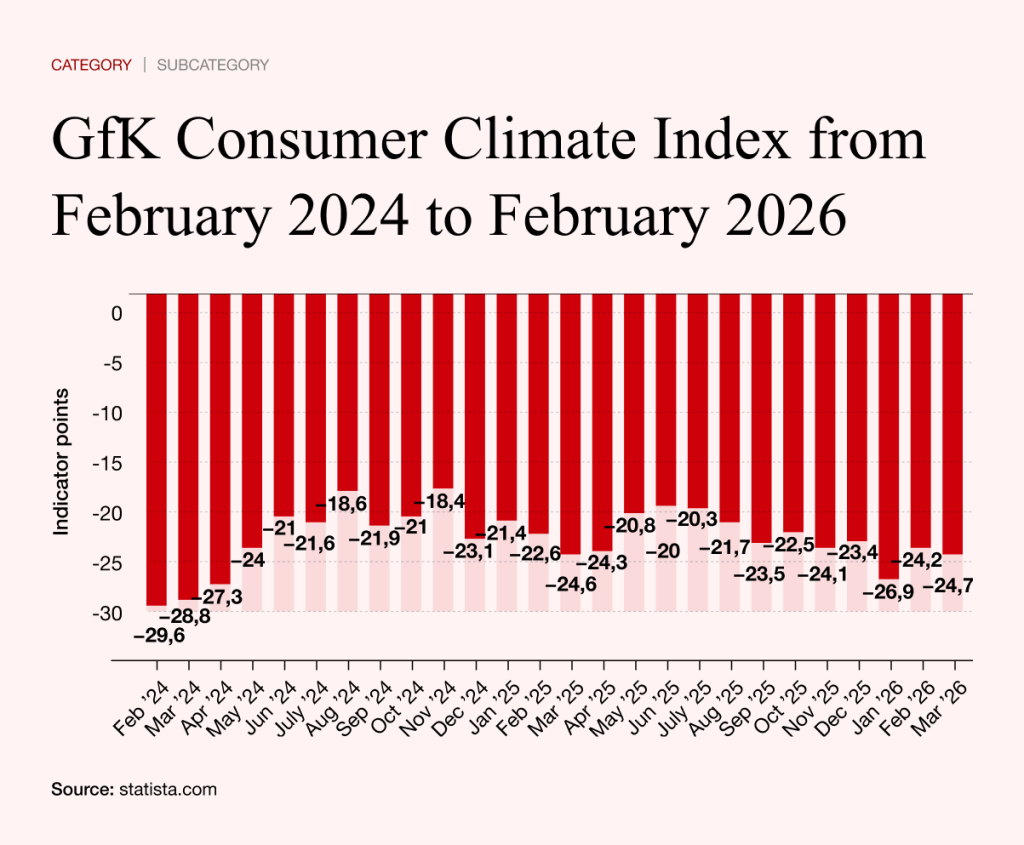
In the past, increases in VAT have been passed on in full to consumers. In an already fragile climate, a rise in indirect taxes would send the wrong signal. According to the Federal Statistical Office (Destatis), the consumer climate index compiled by the market research institute GfK (Gesellschaft für Konsumforschung) fell again in March. The indicator is Germany’s key gauge of household willingness to spend.
GfK Consumer Climate Index from February 2024 to February 2026. Grafic: Statement.com
Consumer sentiment has deteriorated again. Improved income expectations have not translated into a greater willingness to make purchases. On the contrary, Germans are saving. The propensity to save rose in February to its highest level since the financial crisis of 2008. Any further increase in consumer prices through higher VAT would weigh further on spending.
Criticism of the reported considerations, said to have been floated by the CDU and CSU, has come from the CDU’s social wing, which represents employees within the party. It reacted sceptically to the alleged plans of the conservative–social democratic coalition to raise VAT.
Dennis Radtke, chairman of the Christian Democratic Employees’ Association of Germany (CDA), described such a move as ‘a hard nut to crack’. He called for any reform package to deliver a clear reduction in non-wage labour costs so that, in the end, workers would benefit.
After a chorus of speculation and denials, one thing is certain for now: nothing is certain.
Placeholder For Topreaded Placeholder For Topreaded
Placeholder
Placeholder
Placeholder For Topreaded Placeholder For Topreaded
Placeholder
Placeholder
Placeholder For Topreaded Placeholder For Topreaded
Placeholder
Placeholder
Placeholder For Topreaded Placeholder For Topreaded
Placeholder
Placeholder
Placeholder For Topreaded Placeholder For Topreaded
Here is placeholder for Article excerpt Here is placeholder for Article excerpt Here is placeholder for Article excerpt Here is placeholder for Article excerpt
Here is placeholder for Article excerpt Here is placeholder for Article excerpt Here is placeholder for Article excerpt Here is placeholder for Article excerpt
Here is placeholder for Article excerpt Here is placeholder for Article excerpt Here is placeholder for Article excerpt Here is placeholder for Article excerpt
Welcome to the comments section of the Štandard daily. Please take note of our guidelines, comments are moderated by us. You can contact the moderators at [email protected].
Participate in the discussion
Comments are available to subscribers only. If you'd like to join the discussion, choose a subscription starting at €6.72 per month.
All comments 0
Register
Comments are available to registered users only. If you'd like to join the discussion, register here.