War has reduced Christians in Syria to a vanishing minority. The fall of Assad has brought no relief. Economic hardship and hostility are tightening their grip, while the new government moves to further restrict their freedoms.
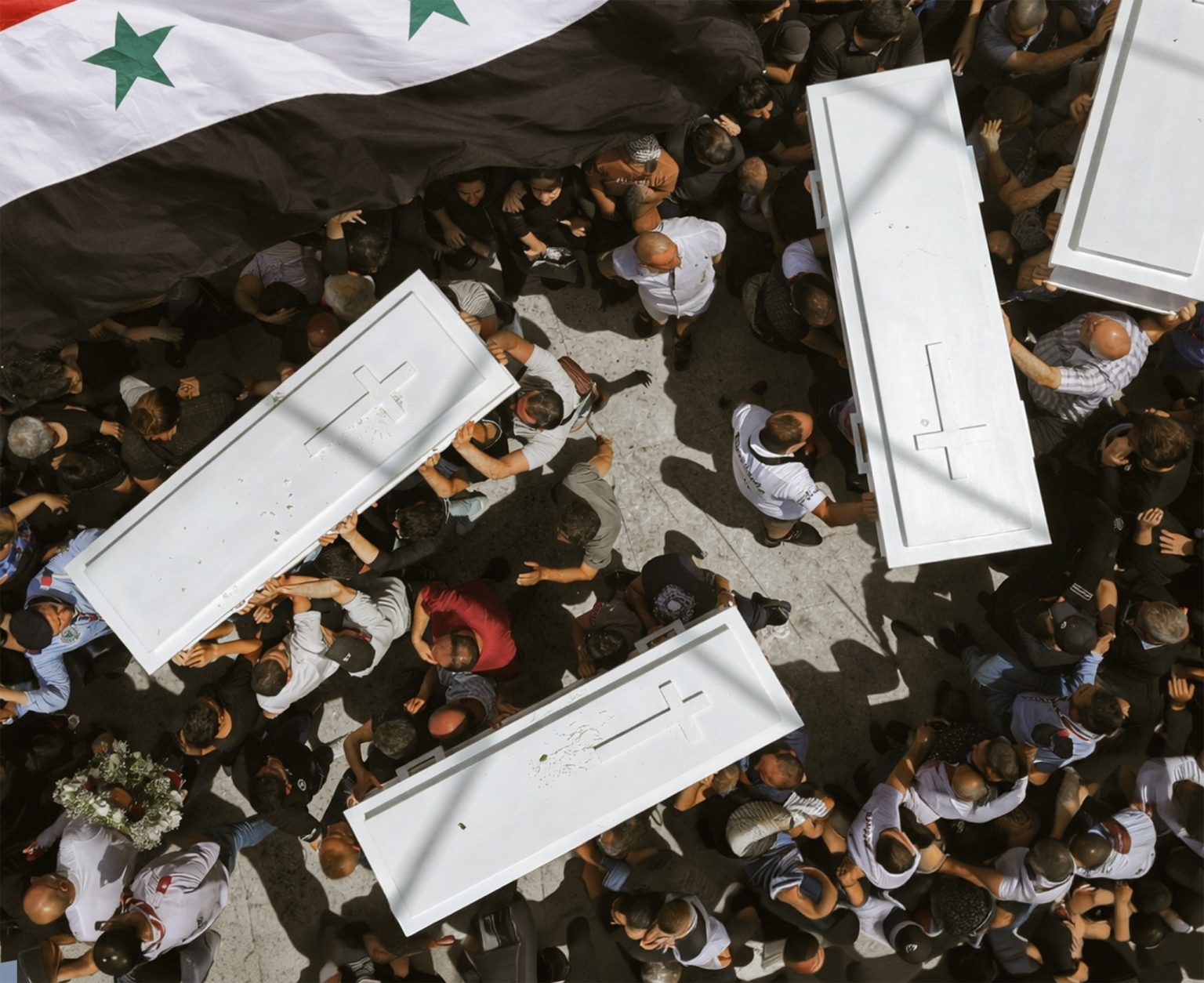
A mass funeral in Damascus after the Mar Elijah Church attack underscores the growing vulnerability of Syria’s Christian communities. Photo: Izettin Kasim/Anadolu via Getty Images
|
The situation of Christians in Syria has been among the most troubling developments in the Middle East since the outbreak of the civil war in 2011. Fresh unrest has once again drawn attention to their plight.
Christians previously made up around eight to ten per cent of the population. Today, only a few hundred thousand remain. According to Aid to the Church in Need, an international Catholic charity, they now account for roughly five per cent. The organisation highlights the persecution of Christians worldwide through annual initiatives, including confessional campaigns and the ‘Red Wednesday’ day of action.
Just days before Easter, reports emerged that Palm Sunday services had been restricted. The dramatic decline in the Christian population is largely the result of flight and displacement during the war. For those who remain, life is marked by fear and pressure. Aid organisations such as Open Doors and Aid to the Church in Need describe a minority struggling to survive amid persecution, violence, political uncertainty and economic hardship.
Decline in Numbers and Structural Weakness
Christians in Syria now form a small and politically weak minority. Across the Middle East, the broader trend is one of Christian exodus. During the civil war, many Christian towns were destroyed or abandoned. A spokesman for Open Doors stresses that Christians have ‘suffered disproportionately from the fighting and displacement’. One reason lies in their position: Christians are often viewed with suspicion both by Islamist groups and by other actors in the conflict.
Perceived ties to the West or to the former Assad regime have deepened that mistrust. Open Doors is an international organisation dedicated to supporting persecuted Christians. Its representatives are closely familiar with local conditions, with staff also present on the ground. They provide assistance while documenting the situation. Its annual World Watch List offers a detailed picture of global Christian persecution. Syria currently ranks sixth in the World Watch List 2026.
A report by Open Doors, published yesterday and available to Statement, offers a vivid example of daily life in Syria: ‘Fear swept through the village of As Suqaylabiyah in the past days after violent clashes on Friday evening, 27 March. Earlier that afternoon, two boys from the nearby village of Al-Qala came and stood outside a café, harassing a Christian girl. This quickly led to a fight between some Christian boys and the two men. The Christian boys wanted to help the girl. What began as a small incident earlier in the day quickly turned into violence. By night, a large group of at least a hundred men returned, attacking the village, destroying shops, damaging cars and shouting hateful insults against Christians.’
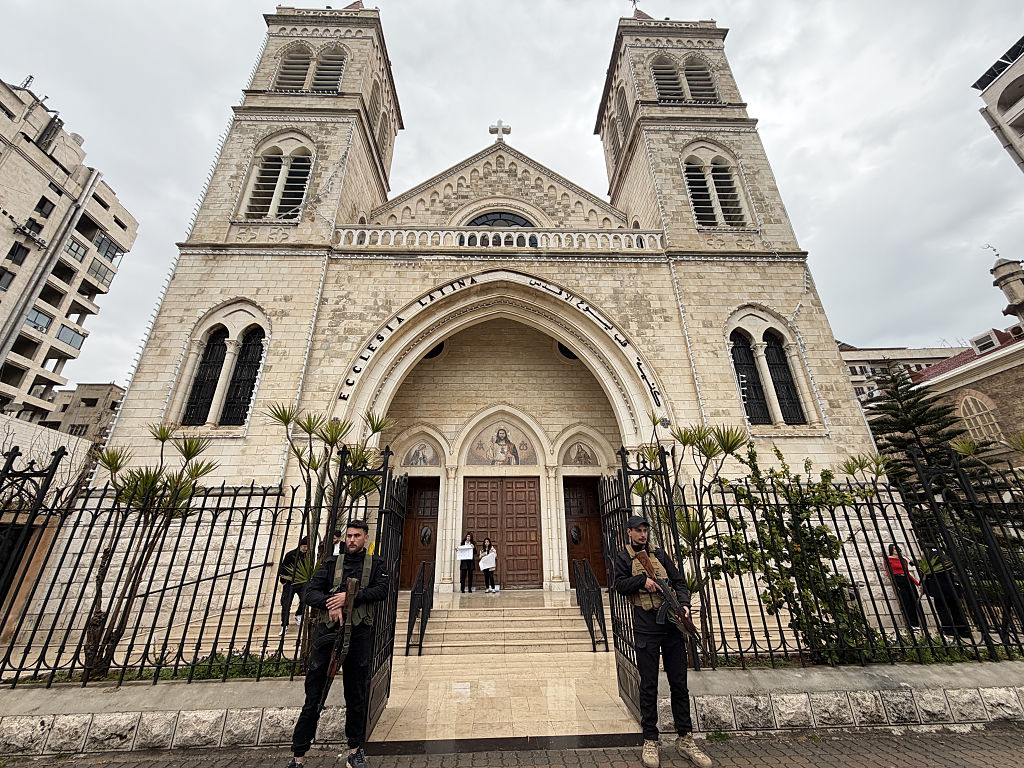
Syrian security forces take precautions in front of the Holy Jesus Church as worshippers attend a Palm Sunday service in Latakia, Syria, on March 29, 2026. Photo: Sevket Akca/Anadolu via Getty Images)
The incident did not end there. It escalated further in the following days, prompting churches to scale back Palm Sunday observances. Open Doors reports: ‘With all of this happening just before Palm Sunday, fear has taken over. Many people asked to cancel the celebrations, worried they could be targeted. The churches only held Mass on Palm Sunday, canceling all outdoor festivities in solidarity with As Suqaylabiyah.’ It is a world of fear in which Christians, like the apostles after Easter in Jerusalem, remain behind closed doors.
Leading representatives of the Catholic, Greek Orthodox and Syriac Orthodox Churches condemned the violence, as reported by the news agency IDEA. Public Easter services will not take place this year. The civil society organisation Syrian Christians for Peace called for unity among Syrian Christians.
Fear Remains Ever-Present
Despite the formal end of large-scale hostilities, the security situation for Christians remains highly fragile. Ongoing threats, attacks and growing uncertainty define everyday life. Incidents such as those described above have a profound psychological impact. Many Christians live in constant fear of renewed violence. The broader instability of the country compounds that anxiety. Violence between different groups, including against Alawites and Druze, reinforces concerns that minorities are not adequately protected.
‘People report a growing sense of fear in everyday life,’ said an observer familiar with the situation, speaking to Statement on condition of anonymity so as not to endanger work on the ground in Aleppo. He is in contact with numerous communities and describes alarming conditions in the country. ‘It is no longer only about political uncertainty, but about concrete experiences: murder, persecution, rape, economic isolation, intimidation, verbal and physical attacks, and the feeling of no longer being safe in one’s own country.’ At the same time, he notes a gradual but tangible form of pressure. Many are losing their jobs or being economically marginalised. Others feel compelled to adapt their way of life in order to avoid drawing attention or becoming targets.
Religious Pressure and Social Tensions
Alongside direct violence and open discrimination, social pressure is increasing. Particularly alarming is the growing legal uncertainty. The same source explains: ‘Experienced bureaucrats have been removed from their posts. Among them are judges, heads of authorities and administrations, as well as university professors.’ They are being replaced by loyal, radical Islamists with little or no experience, in order to enforce the ruling ideology. Such decisions appear arbitrary, and existing laws are losing their meaning. For many, there is no longer any reliable protection.
An often overlooked factor is the economic situation. Many Christians live in extreme poverty. Unemployment, inflation and destroyed infrastructure affect the minority especially severely. Open Doors and Aid to the Church in Need therefore provide not only spiritual but also practical support, including food, medical care, trauma counselling and microloans. Without such assistance, the survival of many communities would be unlikely. As the same observer notes: ‘The humanitarian situation is worsening matters further. Prices for food and medicine continue to rise, while incomes collapse. Families are facing existential decisions that are difficult to imagine.’
The Exodus Continues
Reports from the country point to very real problems: violence, discrimination and existential hardship. This week, Christian graves were damaged in the village of Al-Rawda, according to the Syrian Observatory for Human Rights (SOHR). The reality remains complex. Many challenges, including poverty and insecurity, affect all parts of the population. Even so, Christians are particularly vulnerable because of their minority status.
The observer adds: ‘One development that concerns me greatly is the growing religious and ideological shaping of public life.’ An alcohol ban has recently been introduced. That is not a minor detail but a clear signal of the direction in which the system is moving, he says. For minorities, it means further restrictions on freedom and identity. The quiet but persistent exodus of Christians from Syria is perhaps the clearest indication of how serious the situation has become.
Taken together, the accounts from aid organisations and sources within the country paint a picture of deep distress. Yet Christian communities in Syria are still preparing for Easter, the spiritual high point of the year. The days commemorating the suffering and death of Jesus on Maundy Thursday and Good Friday reflect their own reality. Even so, amid hardship and persecution, the resurrection of Christ will be celebrated on the third day, behind closed doors. That, too, is a truth that no persecution can erase. The ultimate hope of Christians does not lie in this world. Syria, more than most places, shows that the world cannot offer a final or lasting hope.
Welcome to the comments section of the Štandard daily. Please take note of our guidelines, comments are moderated by us. You can contact the moderators at support@statement.com.
Participate in the discussion
Comments are available to subscribers only. If you'd like to join the discussion, choose a subscription starting at €6.72 per month.
All comments 0
Register
Comments are available to registered users only. If you'd like to join the discussion, register here.