Friedrich Merz floated sending back 80 per cent of Syrians in Germany, later attributing the figure to Syria’s president Ahmed al-Sharaa, who does not wish to claim it either. The numbers show how unrealistic it is.
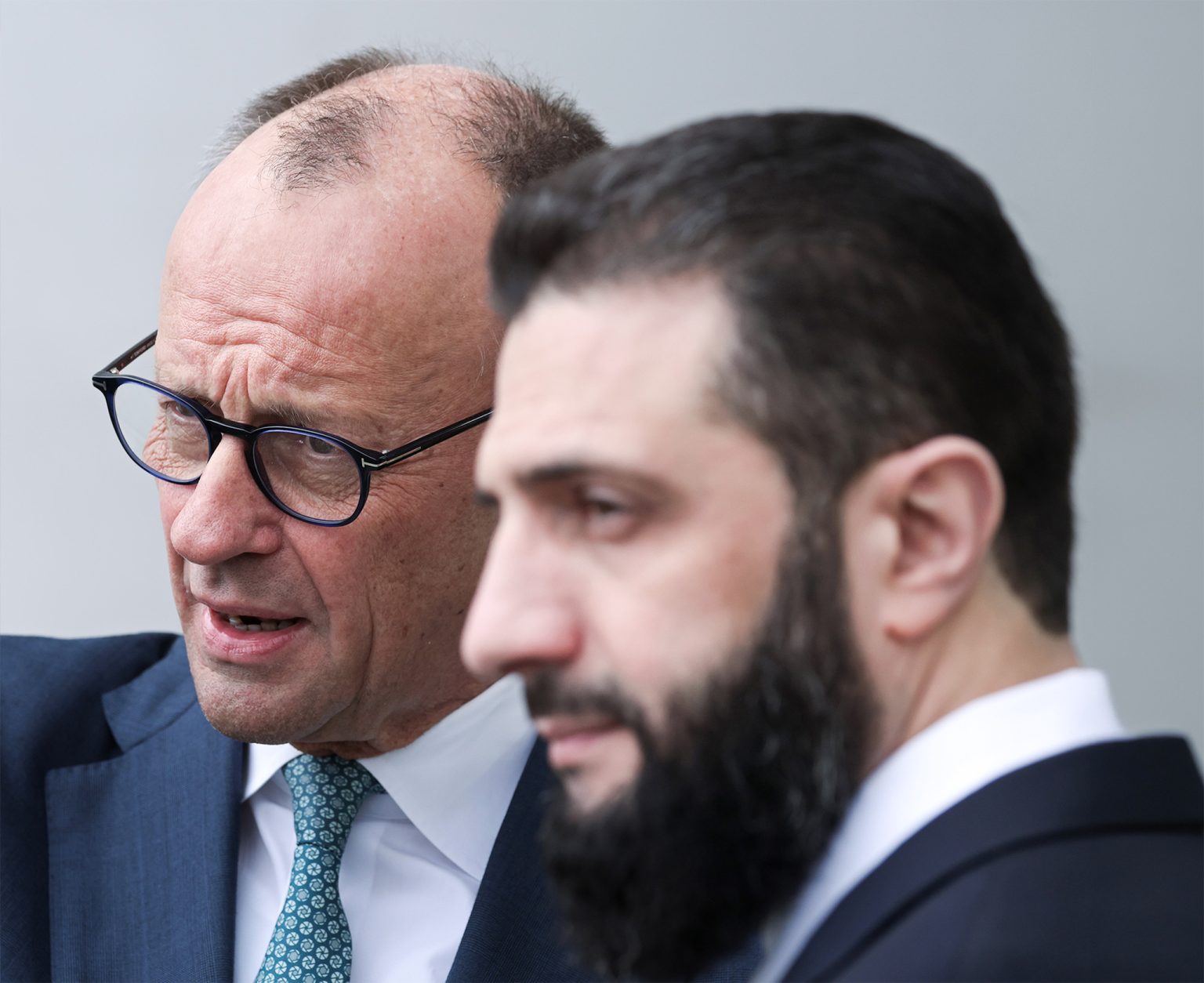
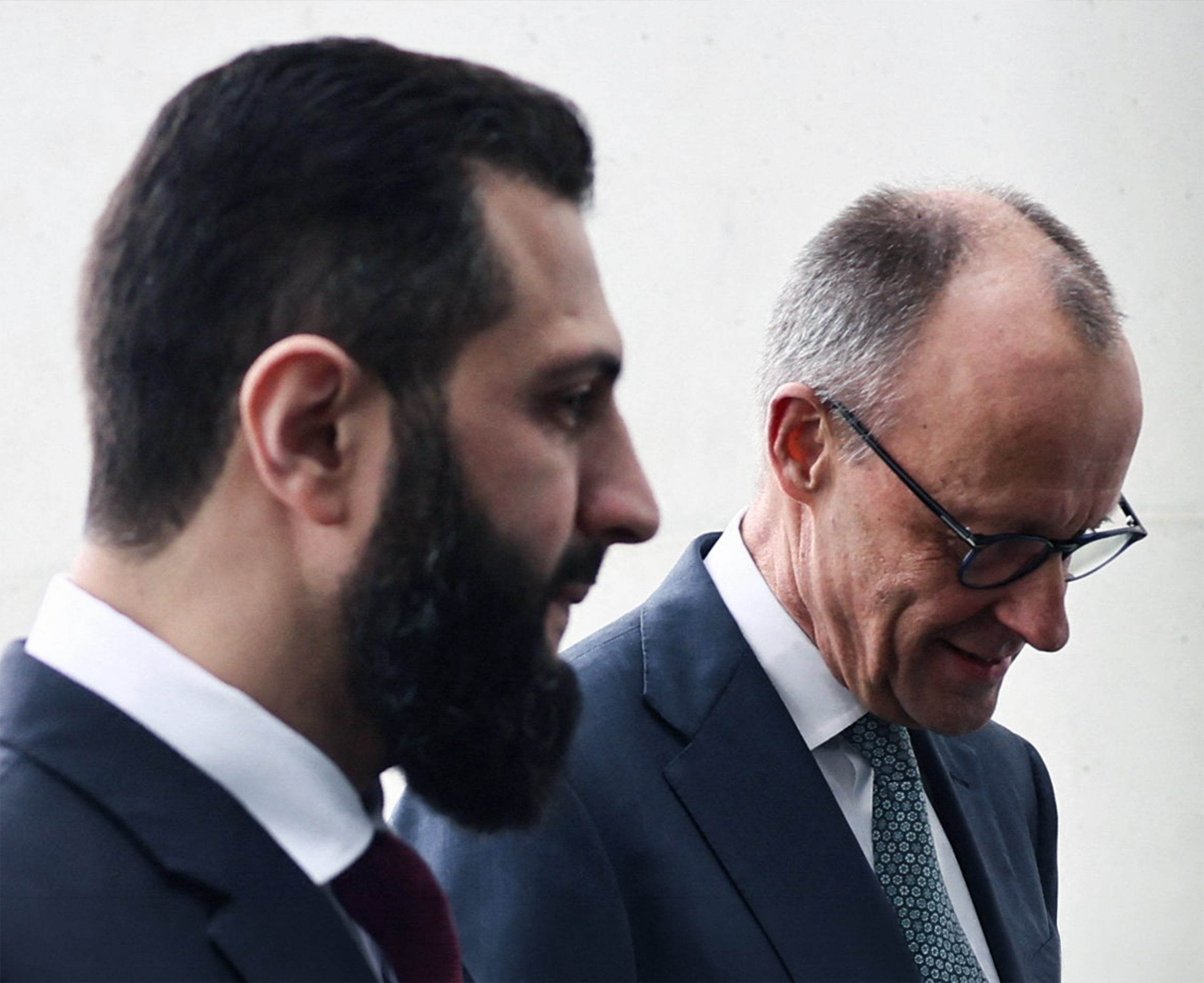
As the 80 per cent figure circulates, neither Friedrich Merz nor Ahmed al-Sharaa appears eager to claim it. Photo: Sean Gallup/Getty Images
|
The renewed debate over Syrian refugees in Germany has a familiar ring. There is talk of return, yet no clarity over who exactly should return, when this might happen, on what legal basis or at what scale. The discussion was triggered by a remark followed by two political reversals. Chancellor Friedrich Merz suggested that within three years, 80 per cent of Syrians living in Germany should return to their country of origin.
The first reversal followed swiftly. After travelling on to London, Syria’s transitional president Ahmed al-Sharaa rejected the suggestion that the figure had come from him. Merz later stated that he had merely repeated the number, which meant it had not originated with him either. It remains unclear where the figure came from.
A day later, Syria’s foreign minister Asaad Hassan al-Shaibani addressed the issue on X. ‘Syrians in the diaspora are a strategic national asset, not a burden. We firmly reject any attempts at forced resettlement and are working closely with our partners.’
That raises an obvious question. What strategic interest does Syria have in keeping its citizens in Germany? The German government is now attempting to play down the political confusion. The fact remains that a politically charged figure is circulating without anyone able to explain how it could realistically be achieved.
The intensity of the current media reaction also reflects memories of the refugee crisis of 2015 and 2016. At the time, then chancellor Angela Merkel publicly stated that Syrians were expected to return home once peace had been restored. That formed part of a calming political narrative. Protection was presented as temporary rather than a pathway to permanent immigration.
Ten years on, the country has arrived at a different reality. A substantial share of those who fled has long since settled. Many are in employment, some have children born in Germany, and a large number have already been naturalised. The latter cannot be compelled to leave under any circumstances.
Syrians in Absolute Numbers
Any serious political discussion requires clarity about the figures involved, even if each number represents an individual story. Three different reference groups must be distinguished.
First, there are people of Syrian migration background in Germany. According to the Federal Statistical Office (Destatis), around 1.22 million lived in the country in 2024.
Second, there are Syrian nationals recorded in the Central Register of Foreign Nationals. As of 31 October 2025, their number stood at 944,060.
Third, there are Syrian asylum seekers, totalling around 713,000 at the end of 2024.
Depending on which group is meant, the political implications differ considerably. In public debate, the categories are often blurred.
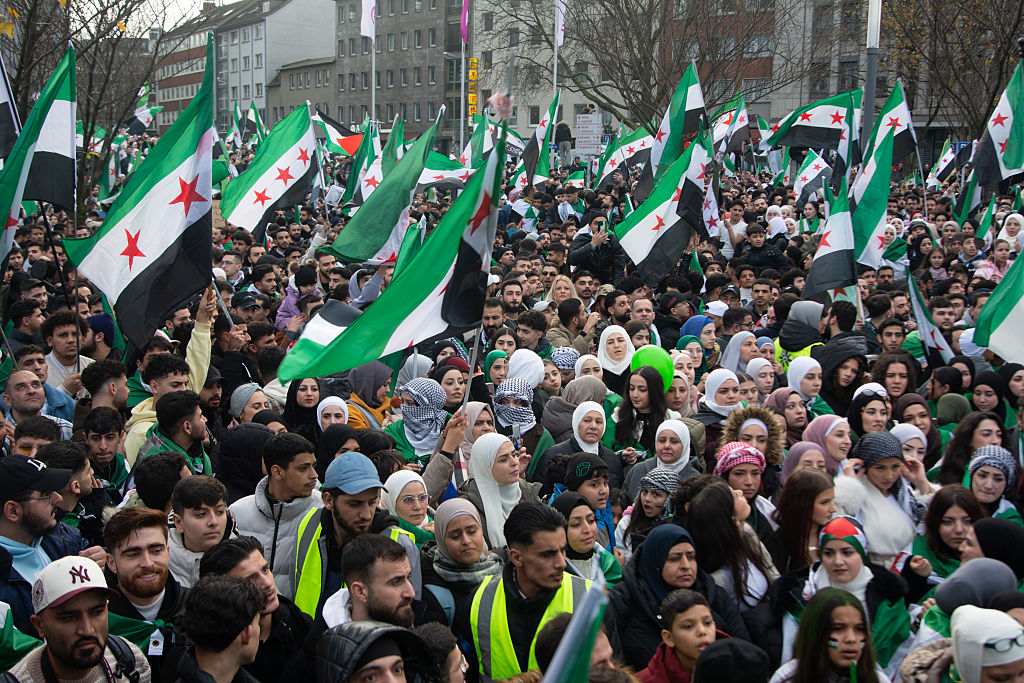
Relief after the fall of the Assad regime is visible on the streets, but not in the number of people returning to Syria. Photo: Ying Tang/NurPhoto via Getty Images
The broadest and most reliable figure is the 1.22 million people with a Syrian migration background. Of these, 81 per cent immigrated, while 19 per cent were born in Germany. That equates to roughly 988,000 who came to the country themselves and about 232,000 born there. At the same time, migration data show that inflows have slowed markedly. Between January and September 2025, around 40,000 Syrian nationals arrived, compared with more than 74,600 in the same period the previous year.
Many Have Already Been Naturalised
According to Destatis, 83,150 Syrians were naturalised in 2024, following 75,500 in 2023. That amounts to 158,650 over just two years. Even more significant is the overall stock. In 2024, 24 per cent of the 1.22 million people of Syrian migration background already held German citizenship, or roughly 292,800 individuals.
Legally, these people are no longer ‘Syrians’ in the sense of immigration law. They are German citizens and cannot be expelled. On that basis alone, any blanket demand for an 80 per cent return is fundamentally misleading. If percentages are used, the reference group must be clearly defined.
If the 80% Target Were Taken Seriously
Using the politically cited figure of around 944,060 Syrian nationals in Germany, 80 per cent would amount to 755,248 people. That is the simple arithmetic behind the chancellor’s proposal. Applying the percentage to the broader group of 1.22 million would be both methodologically and legally unsound.
To return 755,248 people within three years would require an average of roughly 251,749 departures per year. That is more than one and a half times the number of passengers departing from Frankfurt Airport, Germany’s largest hub, on a typical day. Broken down further, it would mean about 20,979 per month, 4,841 per week and 690 per day. In practical terms, around four Airbus A320 aircraft would have to transport people to Syria every single day. That would amount to more than 1,400 flights a year.
Attempting to carry out such an operation would place extreme strain on infrastructure. The scale alone illustrates why the debate has become so charged. What is being proposed is not a marginal adjustment to migration policy, but a repatriation effort of a magnitude without precedent in the history of the Federal Republic.
In Reality, It Is Not Feasible
Recent return figures tell a very different story. According to consistent media reports, only 1,867 Syrians left Germany for Syria by the end of August 2025 following the fall of Bashar al-Assad. The number of state-supported voluntary returns was only in the low four-digit range. The gap between a political target of 755,248 and fewer than 2,000 actual departures over seven months is vast.
These figures must also be seen in their legal and social context. At the end of 2024, around 713,000 Syrian refugees were registered in Germany. Of these, 90 per cent held recognised humanitarian protection status, typically as war refugees. In total, 642,200 Syrians had been granted protection, 92 per cent of them on a temporary basis.
The debate over returning 80 per cent of Syrians is therefore largely theoretical. In practical political terms, it would amount to a mission destined to fail.
Welcome to the comments section of the Štandard daily. Please take note of our guidelines, comments are moderated by us. You can contact the moderators at support@statement.com.
Participate in the discussion
Comments are available to subscribers only. If you'd like to join the discussion, choose a subscription starting at €6.72 per month.
All comments 0
Register
Comments are available to registered users only. If you'd like to join the discussion, register here.