The Loss of Wonder
The indifference seems almost symptomatic. The capacity to perceive the sublime appears to have faded. Public attention has narrowed to the trivial. There is outrage over late trains, crumbling bridges and allegedly decaying city centers, but little sense for anything larger. This can be read as mature realism, an ability to focus on what matters. Yet the inability to become excited by achievements beyond one’s own immediate world is above all a sign of an almost pathological narcissism. Attention turns inward, toward preferences and resentments, rather than outward toward Earth or the Moon. The wider horizon no longer commands interest. A few spectators took a selfie with the departing rocket. That was all.
It almost seems as if the mission’s name anticipated this ambivalence. Artemis is the twin sister of Apollo. Apollo, the namesake of the 1960s space program, stood for progress, reason, departure and light. Artemis is a figure of contradictions: hunter and protector, guardian of the wilderness and goddess of death. Opposites meet in her without resolution.
That she became the patron of the new lunar program is more than mythological ornament. It reflects the spirit of the age. Where Apollo once embodied optimism and faith in perpetual progress, Artemis represents uncertainty, hesitation and doubt in an era that has lost confidence in itself.
At the Limits of the Possible
When John F. Kennedy addressed Congress on 25 May 1961 and set the goal of landing a man on the Moon before the end of the decade, the declaration was more than political rhetoric. It was a challenge to the limits of the possible. When he declared in Houston on 12 September 1962 that the United States had chosen the Moon “not because it is easy, but because it is hard”, he formulated an imperative that today sounds almost foreign. At the time, spaceflight was a symbol of courage.
Today, that courage appears to have faded. The dominant tone is complaint: about climate change, about discrimination, about migration, about perceived injustices. Such a society knows neither determination nor fearlessness. Caution prevails. The comfort zone that has been created is clung to anxiously. Looking beyond its edge has become unfamiliar. Flying to the Moon? The first reaction is often that the money could be spent more sensibly elsewhere. What a poor showing. Pioneering spirit looks different.
Even during the planning phase of the Apollo missions in the 1960s, opposition emerged. Yet it came from a very different direction. The philosopher Hannah Arendt warned in her 1963 essay Man’s Conquest of Space about the consequences of spaceflight. She feared that humanity might become alienated from Earth, that technology could reach dimensions beyond human experience and that the cosmic perspective might foster dangerous hubris. Her argument was shaped by concern that humanity might forget itself if it moved too far from its natural conditions and environment.
The New Engines of Alienation
Rarely has a major thinker been more mistaken. The opposite has occurred. Humanity did not rise above the small problems of the world but became lost in them. The worries of the planet were not forgotten. They dominate attention. The real machines of alienation are already carried in pockets. No rocket launch has shifted human scale as profoundly as the permanent digital presence of smartphones. No Moon flight has altered perception as radically as constant connectivity.
Against the sterile world of digitization, spaceflight with its robust technology, its rockets, its fuel and its capsules appears almost tangible, physical and human.
Perhaps this explains the subdued enthusiasm and underlying reservations surrounding new space missions. Digitization and artificial intelligence create an impression of omnipotence. Everything seems possible. Some imagine a transhumanist age in which the last flaws of being human are overcome physically, intellectually and morally. The new lunar program acts as an antidote to such fantasies. It reminds observers how small and insignificant the blue home planet is within the vastness of space and how unimportant humanity remains, even with smartphones in their pockets.
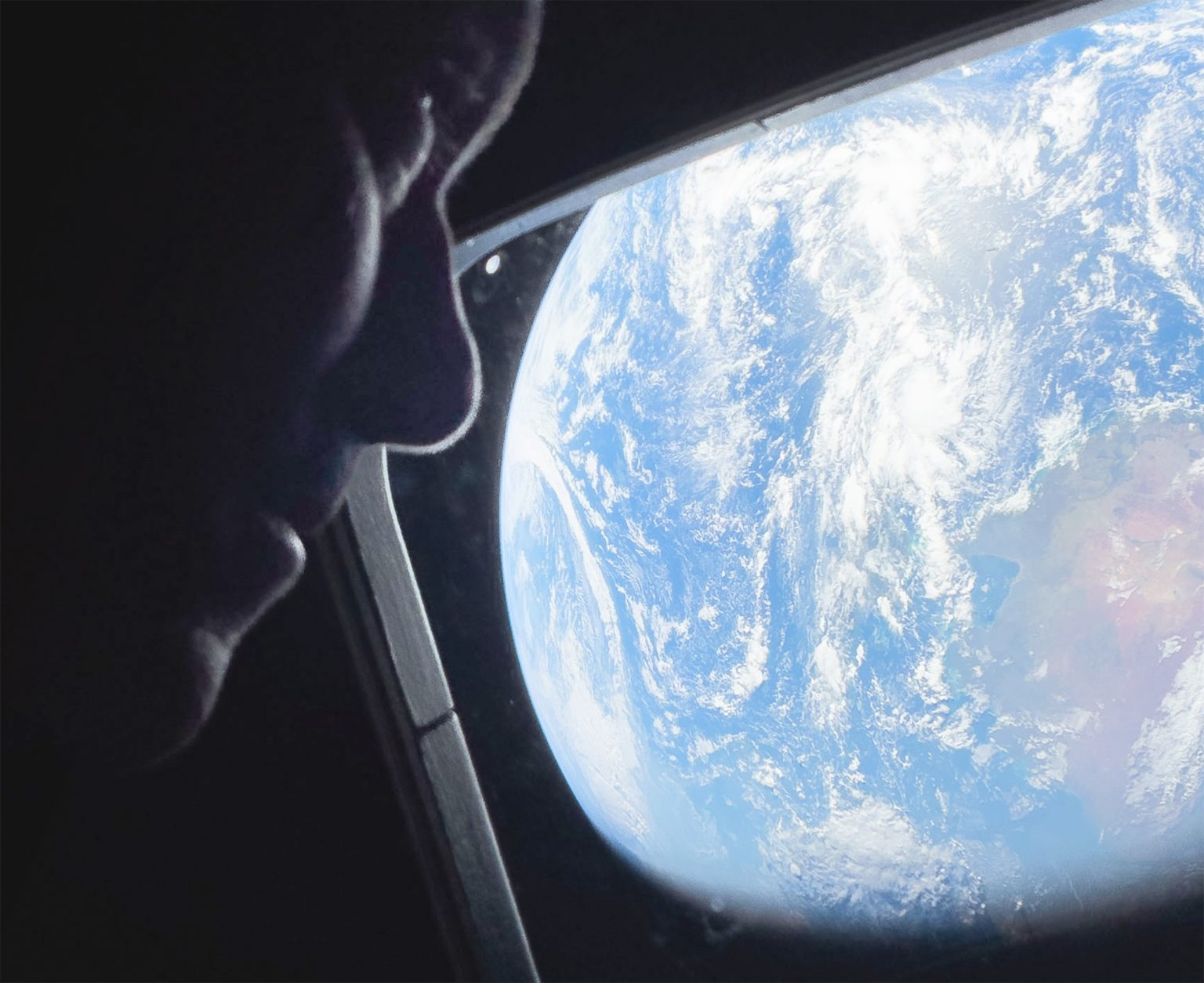
The Artemis mission forces a relativization of human self-importance. That is its provocation. After decades, it again confronts humanity with the realization that conflicts, vanities and certainties fade on the scale of the cosmos. Environmental destruction? Climate hysteria? National vanity? Political trench warfare? Religious wars? Seen from the Moon, all of it appears rather ridiculous.
A Humbling of Human Narcissism
Nature itself cannot be destroyed, only the human habitat. National greatness looks like grotesque childishness from space. Political ideologies and religious quarrels appear equally petty. In an age in which people unsettled by globalization and technological change cling to ideologies of all kinds, the new space program is perceived as a threat to those certainties, and those who dream of settling or utilizing the Moon or Mars are dismissed as cranks. That is precisely where the mission’s Enlightenment potential lies.
The vastness of space cuts personal importance down to size. A view of Earth from the Moon should make even the most stubborn narcissist understand how insignificant individual existence is. Neither the most perfect selfie nor a few thousand likes on social media will change that. It is an uncomfortable message and a humiliation, but one that is urgently needed. In that sense, the Artemis program arrives at the right time.