
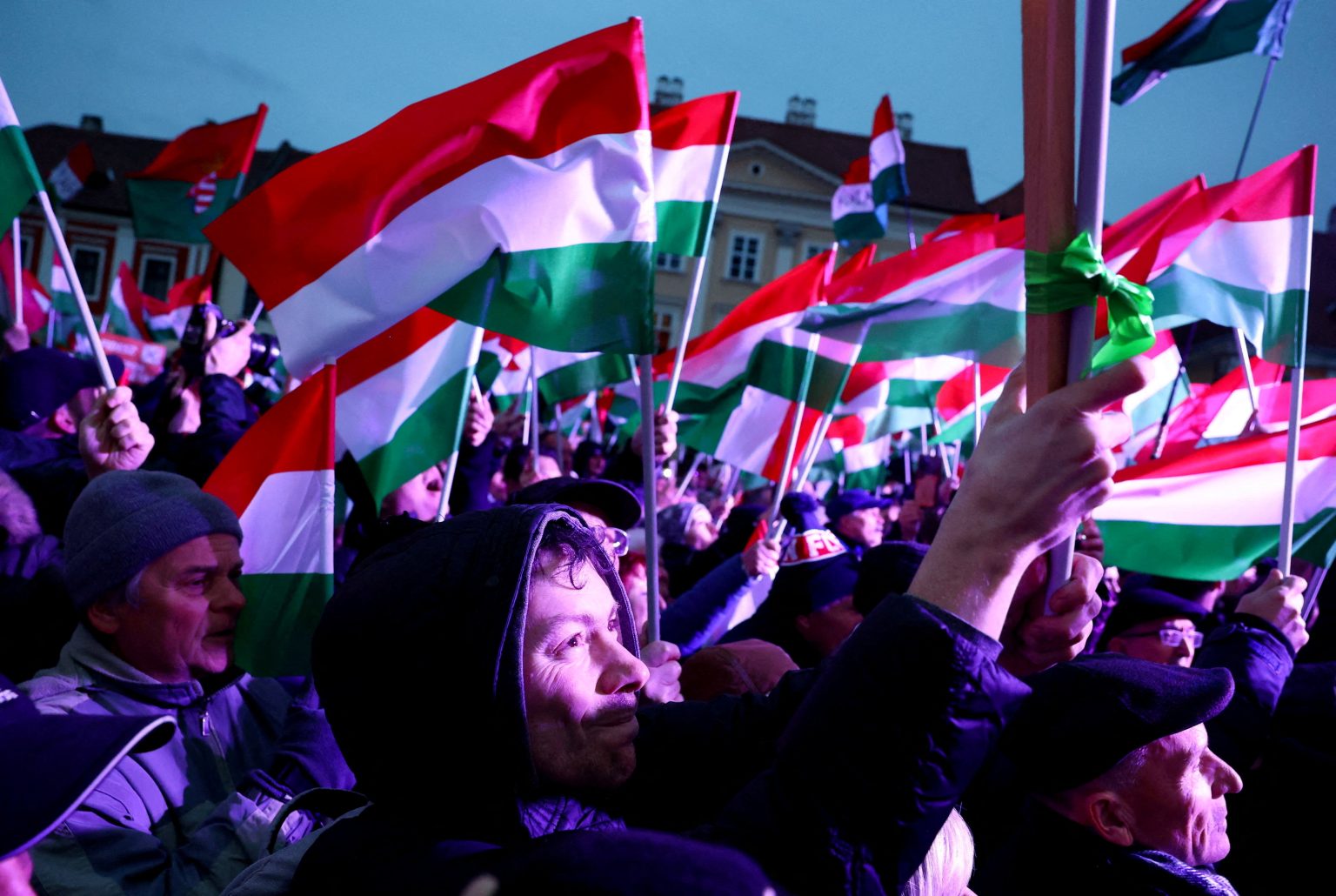
The latest polls at the turn of March and April showed that the parties of Prime Minister Viktor Orban’s ruling coalition, Fidesz – the Hungarian Civic Union and the Christian Democratic People’s Party (KDNP), neither significantly improved nor deteriorated compared with previous surveys. However, the opposition Tisza party of Peter Magyar has slightly expanded its electoral base.
The latest polls by the Hungarian Medián Institute suggest that Tisza could win between 138 and 143 seats in the 199-seat parliament, which would give it a constitutional two-thirds majority. The remaining parties, with the exception of the Our Fatherland Movement, fall short of the five per cent threshold. The pro-government Nezopont Institute released its own poll, measuring 46% support for Fidesz and 40% for Tisza.
Support From the East and the West
The Kremlin is openly backing Orban in the upcoming elections. In the event of his defeat, Moscow would lose an important partner in central Europe, as Magyar’s record so far shows no sympathy for Russia’s domestic or foreign policy.
US President Donald Trump, Czech Prime Minister Andrej Babis and Israeli Prime Minister Benjamin Netanyahu also endorsed Orban in March at the fifth Budapest International Conservative Political Action Conference (CPAC). Polish Prime Minister Donald Tusk has indirectly expressed support for Magyar.
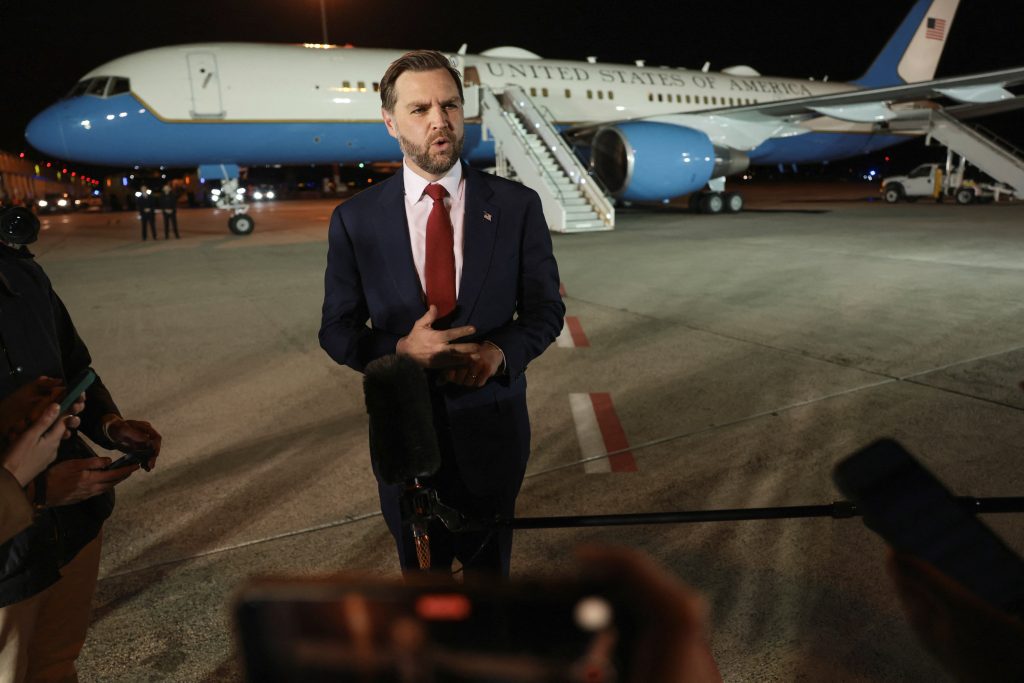
On 7 April, US Vice President JD Vance flew to Budapest to openly support the incumbent prime minister ahead of the elections. At the same time, trade relations have deepened. MOL is to buy 510,000 tonnes of oil from the US in the coming weeks, worth around $500m.
The Budapest-based 4iG technology group will also be involved in military projects. The Hungarian government is planning to purchase $700m worth of HIMARS missile systems, with 4iG to ensure their integration into the armed forces.
Pre-Election Scandals
At the end of March, a consortium of investigative media outlets comprising VSquare, FrontStory, Delfi Estonia, Insider and the Investigative Center of Jan Kuciak (ICJK) released recordings of phone calls between Russian Foreign Minister Sergei Lavrov and his Hungarian counterpart Peter Szijjarto.
The recordings, dating from 2023 to 2025, were used in extensive reporting that described close cooperation between Moscow and Budapest. At Russia’s request, Hungary sought to remove specific individuals from EU sanctions lists and informed the Russian side in detail about the content of negotiations in Brussels.
Szijjarto initially denied the authenticity of the recordings but later acknowledged them, describing his actions as diplomacy. According to part of the material published on 8 April, the Hungarian foreign minister provided the Kremlin with internal EU documents via the Hungarian embassy in Russia.
The day before, Bloomberg reported on a nearly quarter-hour phone call between Orban and Russian President Vladimir Putin on 17 October 2025. Among other things, Orban expressed readiness to help “in any matter”.
The Hungarian prime minister compared his relationship with Putin to that between the mouse and the lion in Aesop’s fable. On the evening of 9 April, Orban commented on the publication of his telephone conversation with Putin to the Telex portal with one Hungarian word: “bűncselekmény”, meaning “criminal act”.
Scandals linked to figures from the extra-parliamentary Tisza movement are far fewer. The only scandal that resonated widely in Hungarian society was a reportedly secretly recorded intimate video involving the then-divorced Magyar and his former girlfriend. Although Magyar claims Orban was behind the hidden camera recording, there is no evidence supporting that assertion.
Mutual accusations were also triggered by the scandal surrounding the TurkStream pipeline, through which a considerable amount of gas flows into the country. On 5 April, Serbian President Aleksandar Vucic announced that the army and police had found two backpacks containing explosives in the town of Kanjiza in northern Serbia, “a few hundred metres” from the pipeline running from Russia to Hungary.
Szijjarto described the discovery as “an attempted serious attack on Hungary’s sovereignty”, adding that he would “provide military protection for the pipeline” because of a possible Ukrainian attack. In response, Ukrainian Foreign Ministry spokesman Heorhiy Tykhyi wrote on X that Kyiv “categorically rejects attempts to falsely link Ukraine to the incident”.
“Ukraine has nothing to do with it. Most likely this is a Russian false flag operation, part of Moscow’s massive interference in the Hungarian elections,” he wrote. Magyar reacted in similar terms.
A Soldier, a Policeman and a Mafioso
A trio of seemingly unrelated men contributed in their own way to shifting electoral preferences.
At the end of March, Captain Bence Szabo, a cybercrime investigator at the National Bureau of Investigation, was interviewed by Telex. He claimed to know details of an operation which, according to the Direkt36 investigative centre, was aimed at discrediting the strongest opposition party. Szabo was later accused of abuse of power after the interview, in which he alleged secret service involvement.
In early April, Szabo received verbal support from army captain Szilveszter Palinkas, who declared that the Hungarian army was in a deep moral and systemic crisis caused by unprofessional leadership at the defence ministry.
He also criticised participation in foreign missions. His statements resonated because he was involved in recruitment activities and public communication for the armed forces.
The third figure was Laszlo Kovacs, a former courier for Budapest underworld figure Igor Korol. In an interview with Insider on 7 April, he claimed that in the 1990s he personally carried money from Russian mafia boss Semion Mogilevich to senior Hungarian police officials, and that large sums allegedly also went to Orban.
Neither the Hungarian government nor Orban has responded to the statements by Szabo, Palinkas and Kovacs. Magyar, however, described Palinkas as a hero who was not afraid to speak out and called Szabo’s claims about an alleged government operation against Tisza a heroic act.
It Is in the Stars
With scandals emerging and rhetoric intensifying, both camps appear to have timed disclosures to maximise their electoral impact. Hungarian political scientist Gabor Torok does not downplay the significance of the scandals or Magyar’s intensive travel schedule, visiting five to seven cities a day.
He notes, however, that during the campaign neither camp has managed to win over prominent figures from the opposing side. The focus has instead been on persuading undecided voters and mobilising existing supporters.
“Thus, at the end of the campaign, what will be decisive will not be new developments, but the ability of each party to convince its own supporters to actually turn out to vote on Sunday,” the analyst said.
Compared with Magyar, Orban enjoys stronger support in smaller municipalities and among pensioners. The pattern is similar among Hungarians in Slovakia, where nearly 50% of Slovak Hungarians would vote for Orban and less than 30% for Magyar, while Magyar leads in regional towns in southern Slovakia.
In 17.5% of cases, support is linked not directly to Orban’s personality but to cross-border initiatives supporting Hungarian minority life. Both Orban and Magyar’s positions on Slovakia show elements of irredentism.
Magyar has proposed that Hungarians from neighbouring countries should also be able to participate in Hungarian elections, which could paradoxically strengthen Orban’s voter base in the future.
Although the number of Slovak Hungarians has been declining, the last census recorded a community of nearly half a million people: 462,000 with Hungarian as their mother tongue, of whom 422,000 identified as Hungarian nationality.
Key for Europe
The outcome of the Hungarian elections will shape Budapest’s domestic and foreign policy for several years. The contest is therefore being closely watched abroad, with Ukraine becoming a prominent issue in the Hungarian campaign.
“I think probably the EU in some ways welcomes the fact that Ukraine is such a major issue in that it sets up this election as a referendum on Hungary’s stance toward Ukraine. If Orban’s opponent Peter Magyar were to win, it would give presumably greater unity and cohesion to the EU position,” said American political science professor Alexander Cooley.
Although Orban has long taken action against the country’s nationalist far right, part of the international press, along with Trump, Netanyahu, Fico, Vucic and Putin, describes him as representing the “far right”, whose global camp would be weakened by an electoral defeat.
“However, ending Fidesz’s entrenched control of most public institutions would take years and require a supermajority in the Assembly, which Tisza is unlikely to get at this point,” the Center for Strategic and International Studies (CSIS) said.
As CSIS analyst Libby Berry notes, it is also possible that Orban’s rival could win the vote overall, but due to single-member constituencies concentrated in rural pro-Orban areas, Fidesz could still secure more seats and parliamentary representation.
A serious political dispute could then arise over who actually won the elections in Hungary.