Two studies from northern Europe are putting the immigration debate to an uncomfortable test. Their conclusion is clear: the fiscal balance of immigration depends heavily on immigrants' country of origin, qualifications and level of integration.
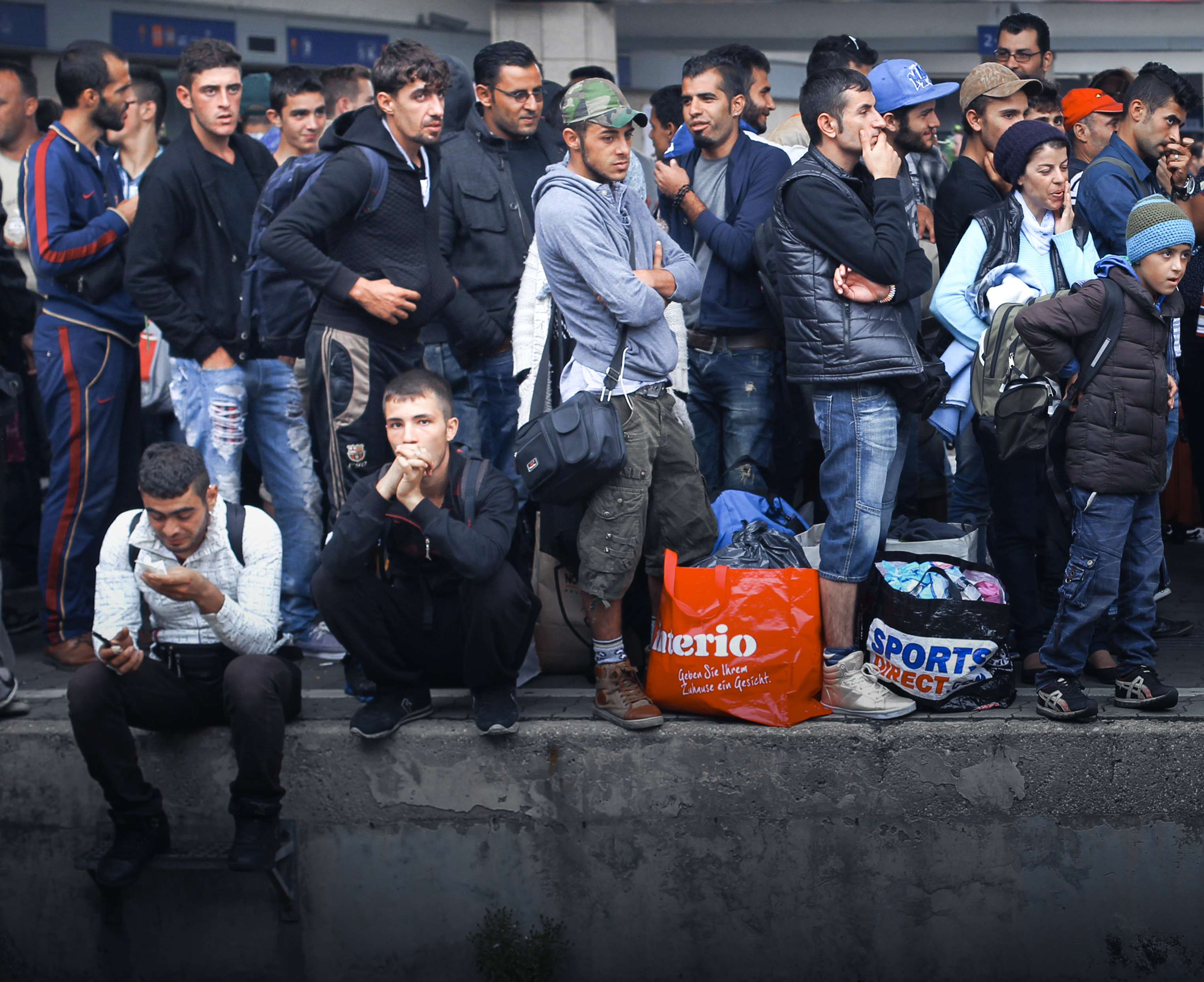
Migration and welfare: Europe’s immigration debate is increasingly shaped by questions of fiscal sustainability. Photo: Patrik Stollarz/AFP/Profimedia/AI
|
Two major studies from northern Europe are prompting a sober reassessment of the immigration issue. With great methodological precision, they highlight what Germany does not want to admit: for a welfare state, immigration is not primarily a moral question, but a fiscal one. Who arrives, how quickly they enter the labour market, how much they earn, how long they depend on social welfare and the long-term costs they generate ultimately determine whether a welfare system remains fit for purpose or becomes overwhelmed.
For years, Europe has based its attitude to immigration largely on moral values and humanitarian gestures. The central question, by contrast, is consistently avoided: what does sustained mass immigration mean for a highly developed redistribution system whose stability rests on contributions, productivity and trust? This is no longer an abstract question about the future. It has already become a real test for Europe’s welfare states.
In Germany, more than a quarter of the population now has a migration background, a demographic shift that is already reshaping schools, cities, public finances, housing markets and national security. And yet, what would be considered essential in any other policy area is missing: an honest cost-benefit analysis.
Borderless Welfare State, a large, long-term study from the Netherlands, provides precisely this kind of sober analysis. Written by economists Jan van de Beek, Joop Hartog, Hans Roodenburg and Gerrit Kreffer, it does not rely on rough estimates. Rather, the authors use detailed microdata covering the entire Dutch population. They examine how immigrants affect public finances over the course of their lives in terms of taxes, social security contributions, education spending, healthcare costs, transfers, housing, administration, security and pensions.
The methodological approach explains why the study has become so politically sensitive. The study is not about political moods or moral posturing, but about the underlying mechanics of a welfare state. Such a system can function only if, over decades, enough people contribute more than they receive. And the Dutch researchers focus on precisely those factors that are integral to keeping the welfare state running, keeping in mind that immigrants who earn little over the long term, remain weakly integrated into the labour market or are permanently dependent on state benefits place a structural burden on the system.
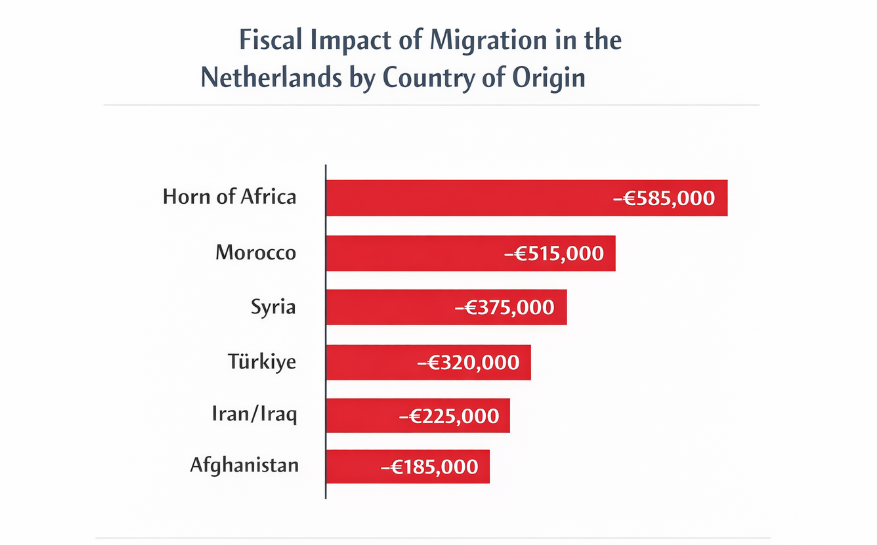
The results of the study are politically explosive. The authors write: “Only 20% of all immigrants make a positive lifetime net contribution to the public budget.” In other words, four out of five immigrants do not pay more into the system over their lifetime than they receive. Comparing immigrants’ country of origin reveals stark differences. Highly skilled migrants from economically strong countries, such as North America, Scandinavia or Japan, often make a positive net contribution. By contrast, many groups from Africa, the Middle East or parts of Asia show a long-term negative balance, in some cases substantial.
Crucially, the burden does not arise from one-off expenses, but from structural underperformance. Lower employment rates, low incomes, low tax contributions, higher dependence on state benefits and increased spending on integration, education, administration and law enforcement accumulate over decades. Political debates often ignore and even hide this point. The real strain lies not at the point of arrival, but in the long-term financing of a system built on solidarity.
A second finding of the Dutch study makes for particularly uncomfortable reading. It challenges one of the central assumptions of German immigration policy: the idea that problems will resolve themselves by the second generation. The authors reject this notion outright: “The adage ‘it will all work out with the second generation’ does not hold true.”
There are, of course, differences between immigrant groups, but the overall pattern is clear. For many, difficulties persist into the second generation. Children grow up in the country, attend school and speak the language. Yet the decisive factor is not cultural adaptation alone, but economic performance. And here, the data consistently shows lasting gaps in income, labour market integration and tax contributions.
The study even suggests that these problems emerge not so much in schools as later in the labour market. The researchers found no significant differences in early educational outcomes for many immigrant groups, but large disparities in later economic productivity. Put simply, structural problems do not just disappear with time. The belief that integration issues will resolve on their own has proved to be a political illusion.
Estimated lifetime net fiscal cost per immigrant in the Netherlands by place of origin. Source: Borderless Welfare State (2023)
An Alarming Study from Denmark
We only need to look to Denmark to find that other countries have already drawn conclusions from such findings. There, the question of how much strain the welfare state can bear has long been the subject of sober fiscal debate. Unlike in Germany, immigration is assessed in financial terms, not only in moral ones. Over many years, the Rockwool Foundation Research Unit and the Danish Ministry of Finance have been compiling clear and indicative data.
Researchers led by Torben Tranaes and Claus Vastrup have found that the fiscal balance of immigration depends strongly on place of origin, qualifications and labour market integration. Their central finding is that migrants from western countries are far more likely to make a positive net contribution, while those from non-western countries tend to place a greater long-term burden on the welfare state. This reflects a broader pattern of lower employment, weaker incomes, higher reliance on state benefits and increased public expenditure.
Particularly revealing are the official calculations of the Danish Ministry of Finance. In several budget and sustainability reports, it has found that non-western immigrants and their descendants impose a net annual cost of several billion euros on the Danish state. In some years, this burden has exceeded €4bn ($4.3bn). By contrast, migrants from western countries and Danish citizens make a positive contribution to the system.
Crucially, the case of Denmark also shows that fiscal imbalances do not simply disappear over time. While language skills, education and labour market access improve across generations, the data contradicts the assumption that integration is merely a matter of time. Structural differences persist for many years, especially among low-skilled migrants from culturally distant regions, and the welfare state has to absorb these differences over the long term.
These findings have reshaped Danish politics, with the Social Democrats drawing the most reasonable conclusions. Prime Minister Mette Frederiksen stated in 2018: “For me, it is becoming more and more clear that the price of uncontrolled globalization, mass immigration and free movement of labour is paid by the lower classes.” This was not a rhetorical flourish, but a political conclusion drawn from years of experience.
Danish Prime Minister Mette Frederiksen tightened migration policy after years of mounting pressure on the welfare state. Photo: Leonhard Foeger/Reuters
Former Social Democratic finance minister Bjarne Corydon faces the issue with the same directness: “You cannot have both a generous welfare state and open borders.” This captures the core of the Danish debate. A welfare state is not an abstract moral project, but a system built on mutual reliability. Those who consistently receive more than they contribute affect not only public finances, but the overall trust in the system itself.
Denmark has therefore adopted a more restrictive approach. Stricter asylum rules, less benefits for new arrivals and tougher requirements for family reunification and integration: changes that did not arise suddenly, but reflect a political conclusion that is now widely accepted. The welfare state has limits. Ignoring them risks undermining the very system it is meant to protect.
Germany’s Grand Delusion
In Germany, such debate is still largely avoided. Discussions about asylum costs, housing, overwhelmed schools, crime and employment do take place, but they remain few and far between. A comprehensive fiscal assessment is being systematically avoided. But why?
The answer in an unpleasant one. A transparent balance sheet would be politically risky. It could make known what many already suspect: that Germany’s immigration policy in recent years has created not only humanitarian outcomes, but also long-term financial commitments on an unprecedented scale. These commitments will not be borne by politicians, but by taxpayers, workers, families and future generations.
Such an assessment is particularly important in Germany. The population is ageing rapidly. Pension systems are under pressure. Healthcare services are overwhelmed. Housing markets are tight. Schools and childcare facilities are being pushed to their limits. At the same time, immigration has been consistently presented as the solution to labour shortages, pension gaps and demographic change.
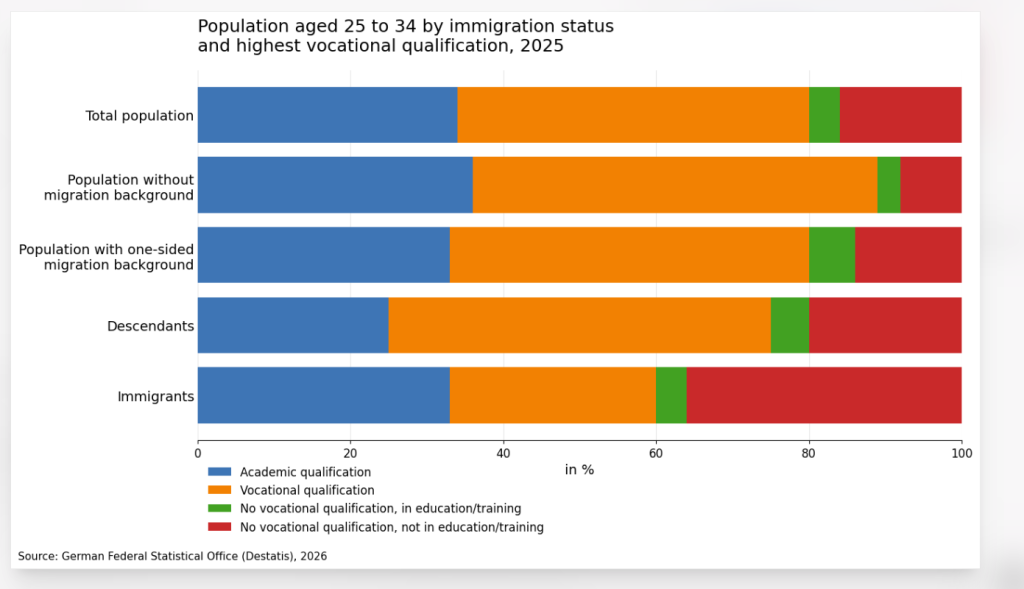
Young immigrants are far less likely to have vocational qualifications than their peers in Germany. Source: Destatis, 2026
That argument holds only under specific conditions. Immigration supports a welfare state only when immigrants are skilled, economically productive and pay their taxes. Those who enter the labour market quickly, earn well and rely little on public support strengthen the system. Those who do not intensify existing pressures. This is not ideology, but fiscal reality.
For that reason, the German debate increasingly resembles a form of collective delusion. Symptoms are discussed, but causes remain unexamined. Budget gaps are criticized, but structural burdens are rarely addressed. Integration is expected, yet it is seldom acknowledged that integration is not only a cultural issue, but above all an economic one.
What would happen if the German government undertook a transparent life-cycle analysis? If it were to make known which groups contribute net benefits, which ones impose net costs and which policy incentives shape the outcomes? The result would likely be shocking. It might, however, mark a first step back towards a politics that treats the state not as a moral stage, but as a community bound by shared responsibility.
The Dutch authors conclude their report with a simple observation: “It would certainly give the immigration debate in the EU a stronger factual basis.” That is precisely the point. Less sentiment, less rhetoric, fewer distractions. Instead, a focus on data, reality and political clarity. Because those who refuse to look at the bill will, in the end, still have to pay it.
Placeholder For Topreaded Placeholder For Topreaded
Placeholder
Placeholder
Placeholder For Topreaded Placeholder For Topreaded
Placeholder
Placeholder
Placeholder For Topreaded Placeholder For Topreaded
Placeholder
Placeholder
Placeholder For Topreaded Placeholder For Topreaded
Placeholder
Placeholder
Placeholder For Topreaded Placeholder For Topreaded
Here is placeholder for Article excerpt Here is placeholder for Article excerpt Here is placeholder for Article excerpt Here is placeholder for Article excerpt
Here is placeholder for Article excerpt Here is placeholder for Article excerpt Here is placeholder for Article excerpt Here is placeholder for Article excerpt
Here is placeholder for Article excerpt Here is placeholder for Article excerpt Here is placeholder for Article excerpt Here is placeholder for Article excerpt
Welcome to the comments section of the Štandard daily. Please take note of our guidelines, comments are moderated by us. You can contact the moderators at [email protected].
Participate in the discussion
Comments are available to subscribers only. If you'd like to join the discussion, choose a subscription starting at €6.72 per month.
All comments 0
Register
Comments are available to registered users only. If you'd like to join the discussion, register here.