Majority Finds No Constitutional Violation
According to the majority opinion, the Texas law does not violate either the First Amendment’s prohibition on establishing a state religion or its guarantee of religious freedom. The ruling states: “It does not tell churches or synagogues or mosques what to believe or how to worship or whom to employ as priests, rabbis, or imams.”
It also emphasizes: “No child is made to recite the Commandments, believe them, or affirm their divine origin.” Because the plaintiffs could not show that their religious freedom had been substantially burdened, their claims were dismissed.
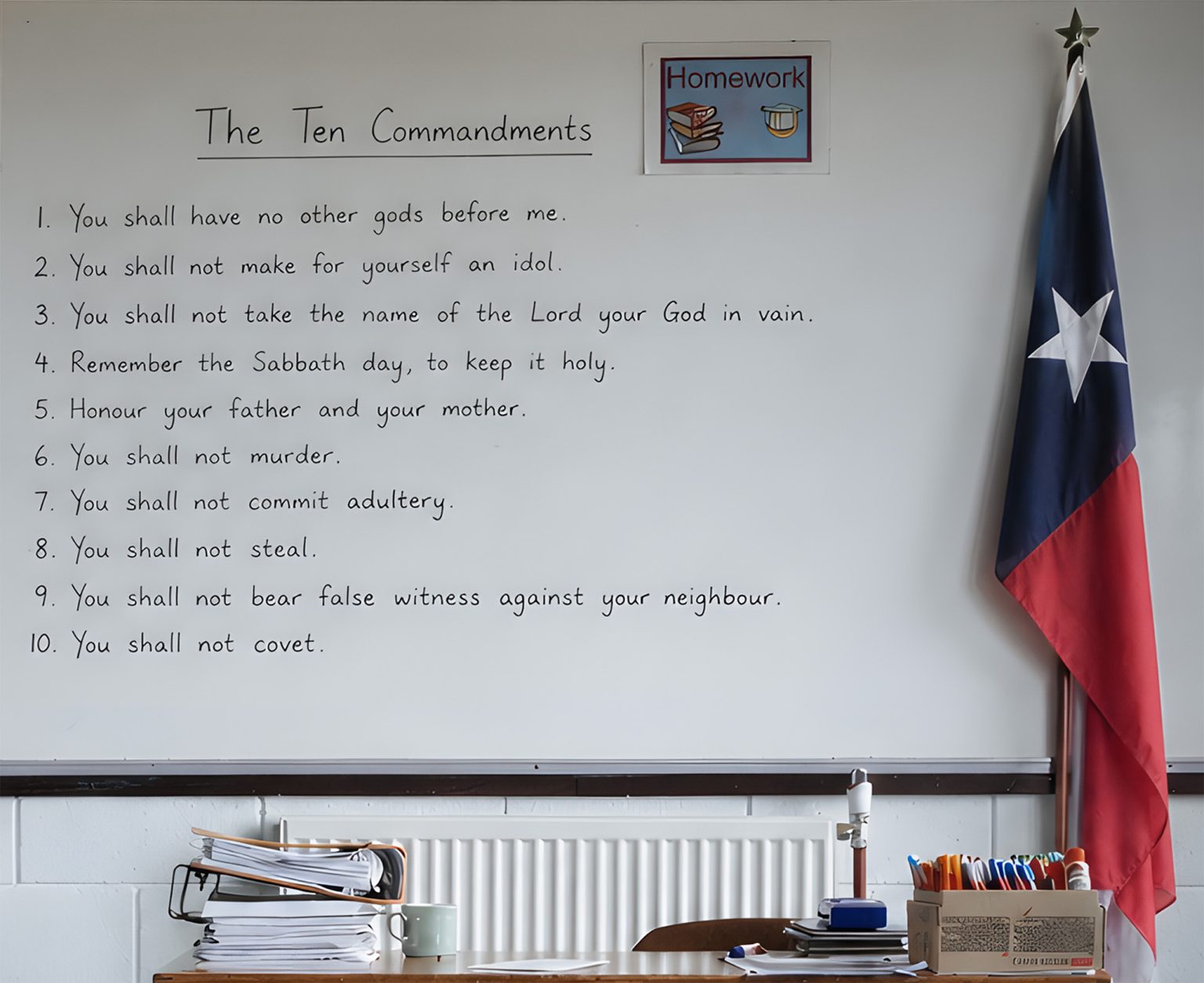
The Texas law requires a “prominent” display of the Ten Commandments in every public school classroom. It took effect on 1 September 2025 and immediately triggered controversy and legal challenges. According to a report by CNN, around two dozen school districts were at one point temporarily blocked by court orders from enforcing the requirement. Even so, the commandments had already been posted in many other classrooms at the start of the school year.
Republicans Call It a Victory
Texas Governor Greg Abbott, a Republican, described the decision on X as a “huge victory”. He said the Ten Commandments form the foundation of Western law and morality and therefore belong in schools. Texas stands “for faith, freedom, and the values our great state was founded upon”.
Attorney General Ken Paxton, also a Republican, called the ruling a “major victory for Texas and our moral values”. He said the commandments had a “profound impact” on the United States and that it was important for students to encounter them every day.
Dissenting Opinions Warn of Religious Pressure
Eight of the court’s 17 judges disagreed with the majority decision in separate dissenting opinions. Among them was Leslie H. Southwick, who had been appointed by former President George W. Bush. He stressed that religion was “a matter of the mind and the heart”. Faith, he argued, “cannot flourish when it is forced”.
Another dissent by Judge Stephen A. Higginson emphasized that the Founding Fathers had sought to prevent larger religious groups from imposing their beliefs on others. Responsibility for religious education, he wrote, belongs to parents, not the state.
Similar Developments in Other States
Other US states have passed comparable laws. Similar measures have already been adopted in Louisiana and Arkansas. In early April, Alabama Governor Kay Ivey, a Republican, signed a similar bill into law.
While the appeals court in New Orleans lifted a block on Louisiana’s law in February, implementation in Arkansas was halted by a federal judge in March.