
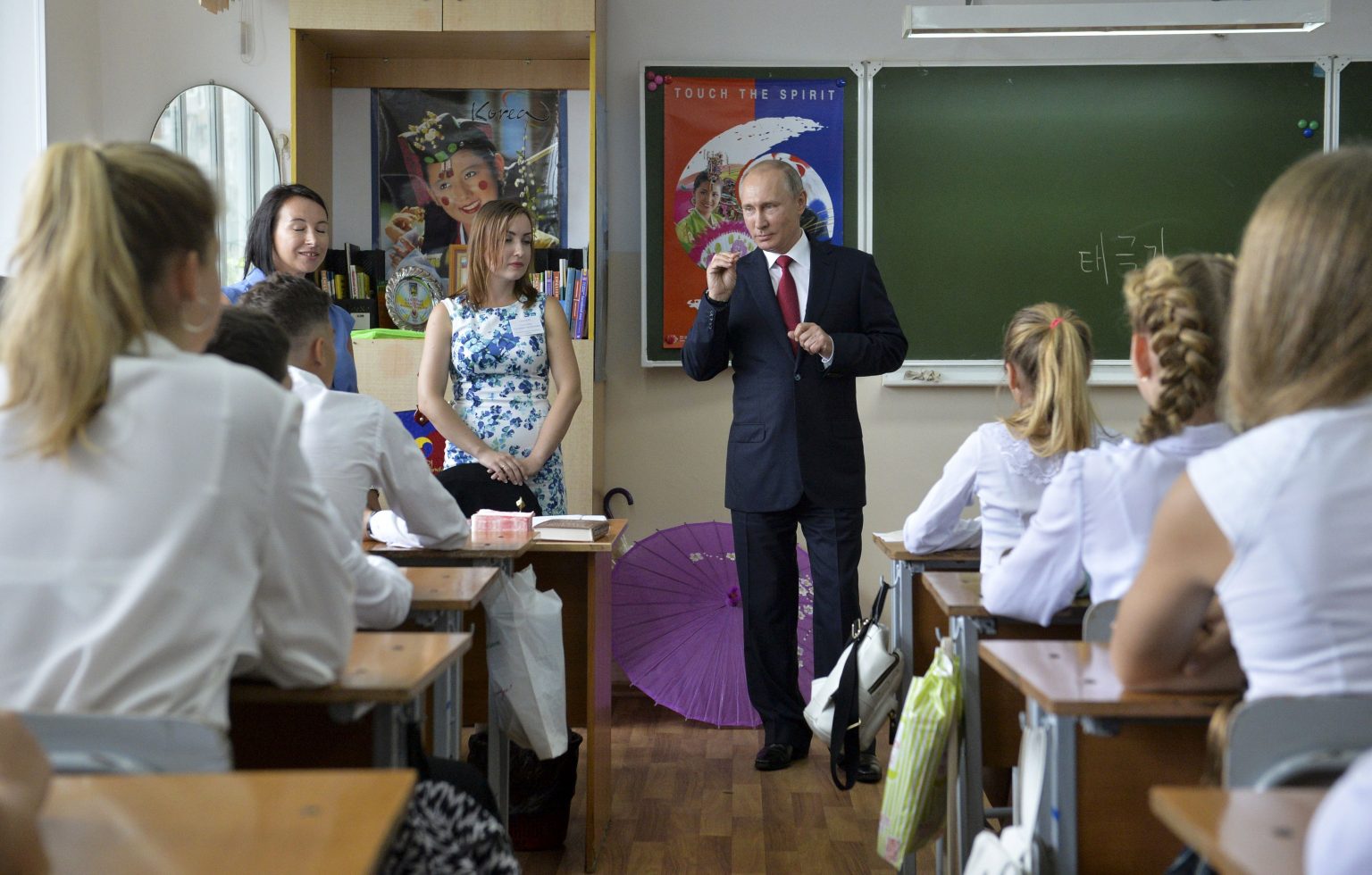
In September 2026, all Russian schools will switch to new history textbooks that the state has been phasing in since 2023. Although concerns about their content have been raised since their introduction, a lengthy interview published in March by the Russian outlet Kommersant has prompted renewed scrutiny.
Vladislav Kononov, an official in the Presidential Administration responsible for state policy in the humanitarian sphere and secretary overseeing the project, said that “the state is not only entitled, it is directly obliged to convey its point of view to pupils”.
Ideologizing History
Statement interviewed Russian historian Alexei Uvarov, an independent scholar in the Department of East European History at Ruhr University Bochum. He has been based in Germany since summer 2022, after emigrating from Russia and leaving Moscow State University.
In April, he presented a detailed analysis of historical inaccuracies and distortions in textbooks intended for grades 10 and 11, the final years of secondary education. Among the issues he identified are a one-sided, pro-Bolshevik interpretation of the Russian Civil War, justifications of Stalin’s repressions and a sympathetic framing of the Soviet suppression of the Hungarian uprising in 1956.
The ongoing war between Russia and Ukraine, which cannot yet be assessed as a historical event from an academic perspective due to its duration, is also addressed in the textbooks.
“This new series was not created out of thin air. It partly builds on earlier editions. In that sense, it does not offer any new scholarly insight. Instead, it reinforces simplified patriotic and pro-repressive elements that were already present in previous versions”, Uvarov said.
However, their scale in the current set exceeds what is acceptable. He recalled a controversy in 2007 over schoolbooks that rehabilitated Stalin.
“Even without the inaccuracies, errors and falsifications, the 2023 volumes are mediocre. They were written by a range of authors, which is noticeable. The narrative style varies significantly in places, and that clearly affects how the text is perceived”, he said, adding that more valuable teaching materials are available.
According to Uvarov, some sections, such as those covering Soviet culture or science, are handled competently. However, comparable Russian publications present those topics more effectively. “The series does not add any meaningful new knowledge”, he said.
A separate concern, he added, is their impact on pupils. The Year 10 volume explicitly states that interpretations of the Soviet-German war that deviate from the official line may be considered a “rehabilitation of Nazism”, which may carry criminal liability.
“And that is spelled out immediately after the section on the Second World War, with the explicit warning that it constitutes a criminal offence. That is quite striking”, Uvarov said.
The volumes also contain numerous quotations from Russian President Vladimir Putin. They consistently present positive assessments of the Soviet Union, its wartime role and the heroism of soldiers in the First World War. Earlier statements from the beginning of his presidency, including remarks on Stalin’s responsibility for the Katyn massacre, are absent.
Uvarov said references to Putin could be justified when discussing his period in office. However, their use in sections on the World Wars, the collapse of the Soviet Union or the Brezhnev era is excessive and misplaced.
“I genuinely tried to identify positive aspects. The problem is that the new material offers almost no fresh insights while including elements such as references to criminal law for ‘denying the role of the Soviet people in the war’ and extensive quotations from Putin. These elements shape an ideological interpretation of history and define the narrow framework within which pupils are expected to understand it, reinforced by reminders of criminal liability”, he said.
Unhappy Educators
Critics in Russia also point to practical shortcomings. The new state-approved materials do not align with the official curriculum, and pupils cannot find answers to several exam questions in them.
A Moscow-based teacher, who asked not to be named for security reasons, described significant problems in the classroom. She teaches pupils aged 11 to 17.
“According to the curriculum, Year 9 pupils first study general history, including the 19th century, the Industrial Revolution and Queen Victoria. We are supposed to examine the causes of the First World War, before returning to the 19th century from a Russian perspective, covering the reign of Alexander I and the Napoleonic Wars”, she said.
The teacher identified a major flaw in the Year 9 volume in its treatment of the early 20th century. After a brief overview of Russia’s entry into the new century, pupils are abruptly presented with the 1917 revolution, without any explanation of its causes or context.
“Immediately after the revolution comes the Great Patriotic War. There is no Lenin, no Stalin, no New Economic Policy, no forced collectivization. The war is followed straight away by the collapse of the Soviet Union”, she said.
Instead of addressing the difficult economic and social transition of the 1990s, it moves directly to the “reannexation of Crimea” and then to the invasion of Ukraine, described as a Special Military Operation, where the narrative ends.
“It feels as though Year 9 pupils are being given a disjointed introduction focused only on what are seen as key events of the 20th century, while vast parts of history are omitted. And yet pupils have two to three history lessons a week. It makes no sense”, she said, adding that even colleagues who support the government have criticized the material.
The series consists of 13 volumes. It includes General History for Years 5 to 11 and History of Russia for Years 6 to 11, the final year of secondary education. The Moscow teacher expressed hope that the rollout might still be reconsidered before September.