
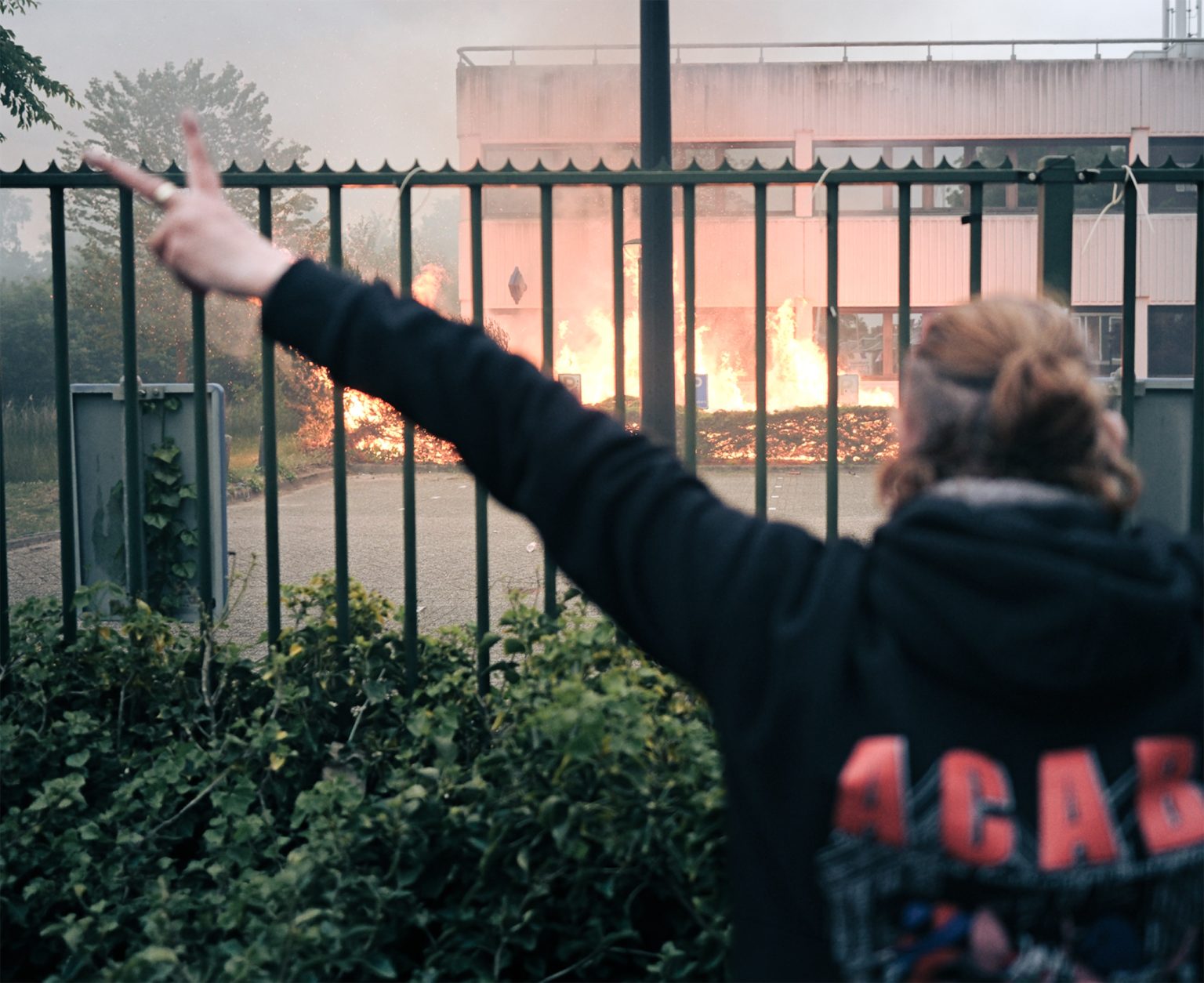
The plan was to house 110 migrants in the Dutch municipality of Wijdemeren. The municipality agreed to a request from the Central Agency for the Reception of Asylum Seekers and decided to use part of the municipal offices in Loosdrecht, a local district with about 8,600 residents, to accommodate them until 1 November 2026. A girls’ hockey club is located next to the building, which has also raised concerns among residents.
After a series of protests, some of which escalated into riots, the planned number was reduced to 70 men. Fifteen have already moved into the new asylum center, while the rest are due to arrive by the end of this week.
Fire on the Roof
On the evening of 12 May, a fire broke out near the municipal offices, with flames rising several meters high. Fifteen asylum seekers had been staying in part of the building since that morning. Police arrested three Dutch men in connection with the unrest later that evening.
Alongside a 28-year-old man suspected of arson, two juveniles were arrested. One was detained on suspicion of violence against a journalist and police officers, while the other is suspected of throwing flares and stones during the riots. Neither is from the village.
“It is not known whether the 15 asylum seekers who moved into the building on Tuesday morning (12 May) remained in place after the riots. The municipal authority did not provide a statement. The plan is for a total of 70 people to be accommodated in the municipal authority building by 1 November”, the Dutch AD portal reported.
At the end of April, a group damaged the municipal office building. A 34-year-old Dutch man named Brian was later sentenced to six weeks in prison, part of it suspended. A sign reading “Free Brian” remained on the fence outside the municipal offices for a long time.
Flowers and banners were also placed there, carrying messages such as “No refugees, go home” and “Loosdrecht is ours and will always remain. We will defend it with pride and determination”.
Tensions Had Been Building
In April, Dutch Deputy Prime Minister and Minister of Asylum and Migration Bart van den Brink, of the Christian Democratic Appeal (CDA), warned that the country lacked about 4,500 places to accommodate migrants. He called on local authorities to help. The mayor of Wijdemeren, Mark Verheijen, of the opposition People’s Party for Freedom and Democracy (VVD), accepted the request.
After the protests began, Verheijen accused demonstrators of undermining a free society. He stressed that many of those taking part were not local residents, but nationalists and supporters of the far right. He also said he had decided on his own initiative, not under pressure from protesters, to reduce the number of migrants in the village from 110 to 70.
“I think we all have to set an example”, Van den Brink said in early May, referring to the government’s announcement. “That’s why I expect everyone – politicians and society – to calm the situation down and not add fuel to the fire”, he added, stressing that society should condemn those who violently oppose the arrival of asylum seekers.

Protests Elsewhere
Events in Loosdrecht have pushed immigration back onto the national agenda after a long lull. But the village is not the only place in the Netherlands where opponents of immigration have clashed with the government’s current course in recent weeks.
On 6 May, protesters blocked the A59 motorway for half an hour near the site of a planned center for young refugees on an industrial estate close to Den Bosch. About 100 demonstrators gathered at the Waalwijk exit with banners and lit torches. Police eventually intervened and arrested two people at the scene.
Smaller anti-immigration protests have taken place in IJsselstein, Apeldoorn, Aalsmeer, ’s-Hertogenbosch and Nieuw-Lekkerland, affecting most of the country’s provinces.
The well-known Dutch singer and presenter Gerard Joling, referring to the growing revolt against migrant centers across the Netherlands, declared: “Next year we will basically have a kind of civil war.” The country, he said, was being taken over by foreigners because of the left.
Although Joling has long criticized migration policy, he is not seen in the Netherlands as a representative of the far right. He has not taken part in any protests himself, peaceful or violent, although in late April he said he would join a demonstration if a migrant detention center were planned in his home village.
The Tables Have Turned
Geert Wilders, founder and chairman of the Party for Freedom (PVV), is regarded as the most anti-immigration politician in the Netherlands. He has been a member of the lower house of the Dutch parliament since 1998.
His party won the November 2023 parliamentary elections, taking 37 of the 150 seats. Wilders needed coalition partners to form a government, but they refused to accept him as prime minister. The PVV instead formed a coalition with three other parties, including the VVD, which counts Wijdemeren Mayor Mark Verheijen among its members, as well as NATO Secretary General Mark Rutte.
The prime minister of that right-wing cabinet was Dick Schoof, an independent politician and former head of the intelligence service. At its launch, his government intended to introduce “the toughest asylum policy in the history of the Netherlands”. It pledged, for example, to sharply limit the number of asylum seekers, impose stricter rules on migrant family reunification and tighten border controls.
But not all of the PVV’s coalition partners, especially the VVD, supported Wilders’ plans to curb immigration. That was one reason his party left the government in the summer of 2025 after disputes over how to handle the issue.
In the early elections in autumn 2025, the PVV won 26 seats, the same number as Democrats 66 (D66). D66, which finished narrowly ahead in the popular vote, eventually formed a minority government.
Rob Jetten, the head of the liberal party, became prime minister with a much more moderate stance on migration than the previous right-wing government. The new prime minister supports controlled migration rather than “zero” migration, emphasizes migrant integration and labor migration for the economy, and rejects Geert Wilders’ most radical anti-immigration proposals.