Germany’s churches speak with one voice against the AfD. Yet more and more Christians can imagine voting for the party. The flock is no longer following its shepherds, because church leaders are speaking past the concerns of ordinary believers.
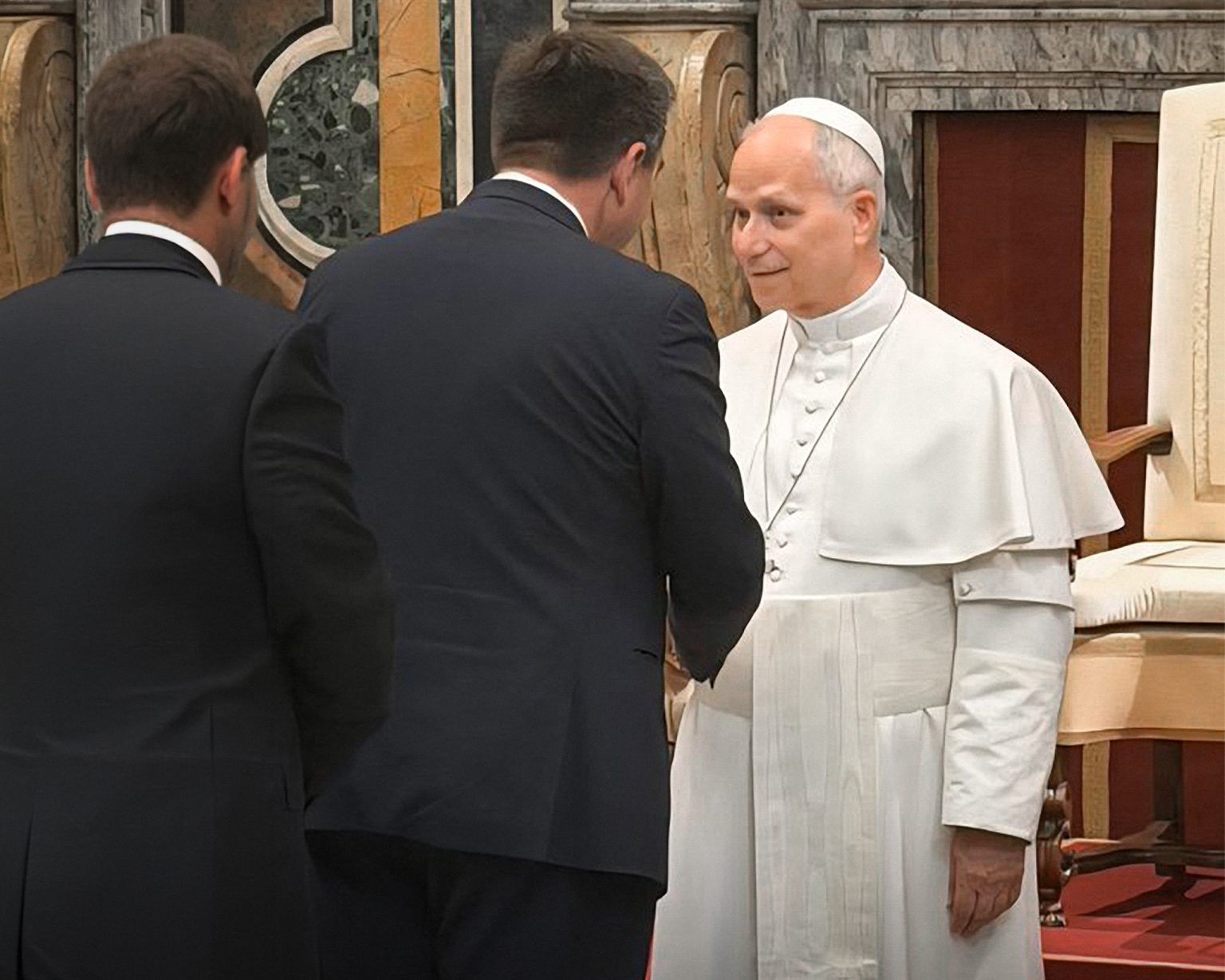
Pope Leo XIV speaks with AfD politician Malte Kaufmann during an audience at the Vatican. Photo: Catholic Arena/X
|
At the recent German Catholic Congress in Würzburg, politicians from almost all parties were invited to panels and events. The Alternative for Germany (AfD) was explicitly excluded. The churches have set themselves against the party. Few organizations in Germany campaign as energetically against the AfD as the Catholic dioceses and Protestant regional churches.
The German Catholic Congress has indeed refrained for years from inviting AfD representatives. There was one exception in 2018 in Münster, where Volker Münz, the religious policy spokesman for the AfD parliamentary group in the Bundestag, was allowed to take part in a panel discussion. The decision triggered fierce controversy and was not repeated. “Anyone who tramples on human dignity in the way the AfD does is not a party Christians can vote for”, said Ernst-Wilhelm Gohl, the regional bishop of the Evangelical Church in Württemberg.
Church Leaders Draw a Line
Bishop Georg Bätzing, the former chairman of the German Bishops’ Conference, put it this way: “Anyone who spreads right-wing extremist slogans cannot be a party Christians can vote for.” Ethno-nationalism, he said, was completely incompatible with the Christian understanding of God and humanity.
Kirsten Fehrs, chair of the Council of the Evangelical Church in Germany (EKD), warned: “Right-wing extremist parties and those that thrive on the fringes of this ideology can be no place for Christians to be politically active and are therefore not a party Christians can vote for.” The Bishops’ Conference of the United Evangelical Lutheran Church of Germany (VELKD) also took a position in a joint statement: “We say clearly and unequivocally: anyone who votes for the AfD supports a party that tramples on the Christian view of humanity.”
Yet believers quite clearly no longer follow their shepherds on this question. A recent survey by the polling institute INSA-Consulere for Bild, Germany’s best-selling tabloid, put the AfD at 26% among Catholics and 27% among Protestants.
Nor does the contradiction end there. At the very moment the German Katholikentag was taking place with the AfD deliberately kept outside, a photo of AfD Bundestag member Malte Kaufmann with Pope Leo XIV in the Vatican went viral on X. He had attended an audience for OSCE parliamentarians.
Kaufmann is a member of Germany’s delegation to the OSCE Parliamentary Assembly. The meeting with the Holy Father focused on combating drug trafficking, drug addiction and organized crime. Pope Leo XIV spoke about the rule of law, crime prevention, criminal justice, human dignity, help for addicts, education, prevention and the reintegration of offenders. Kaufmann later presented the meeting as an opportunity to explain to the Pope that the AfD was fighting for family and Christian values, which he said the pontiff had been pleased to hear.
An Apparent Contradiction
The apparent contradiction is less striking than it first seems, because the meeting was not a private audience with an AfD politician carrying any significance in church affairs. It was a working meeting in an entirely different context. There is no evidence to support the assumption that the Pope was giving the party political legitimacy. It should nevertheless be noted that, in a German context, one might have expected the AfD representative to be excluded if the practice of the German Katholikentag were taken as the standard.
Germany’s Catholic dioceses set out their position in a declaration issued by the German Bishops’ Conference on 22 February 2024. Its title was Ethno-Nationalism and Christianity Are Incompatible. In it, the bishops described right-wing extremism as “currently the most pressing threat to the free democratic order”. They called for parties of that orientation to be rejected.
The AfD was explicitly named in the text. The accusation was that, after several waves of radicalization, an “ethno-nationalist attitude” had come to dominate the party. For Christians, the bishops said, the AfD was neither a party they could vote for nor a place for political activity. They justified their rejection by pointing to the equal dignity of every human being, which is central both to the Christian understanding of humanity and to Germany’s Basic Law.
Praying Against the AfD?
The churches’ greatest concern is the prospect of AfD victories at state level. Because of the so-called firewall, however, only an absolute AfD majority could allow the party to take over a state government. There is a distinct possibility that this could happen in Saxony-Anhalt in September, where the AfD has moved to within one percentage point of an absolute majority in polls.
In the event of an election victory, the AfD has announced a restrictive policy toward the churches. The state collection of church tax is to be reviewed, as are state payments by Saxony-Anhalt to the churches. In Germany, the federal states pay the churches compensation for lost income from expropriated historical property. This is regulated in the constitution and in international treaties. The AfD justifies its position by arguing that both the Catholic Diocese of Magdeburg and the regional Protestant church no longer proclaim the authentic Christian faith.
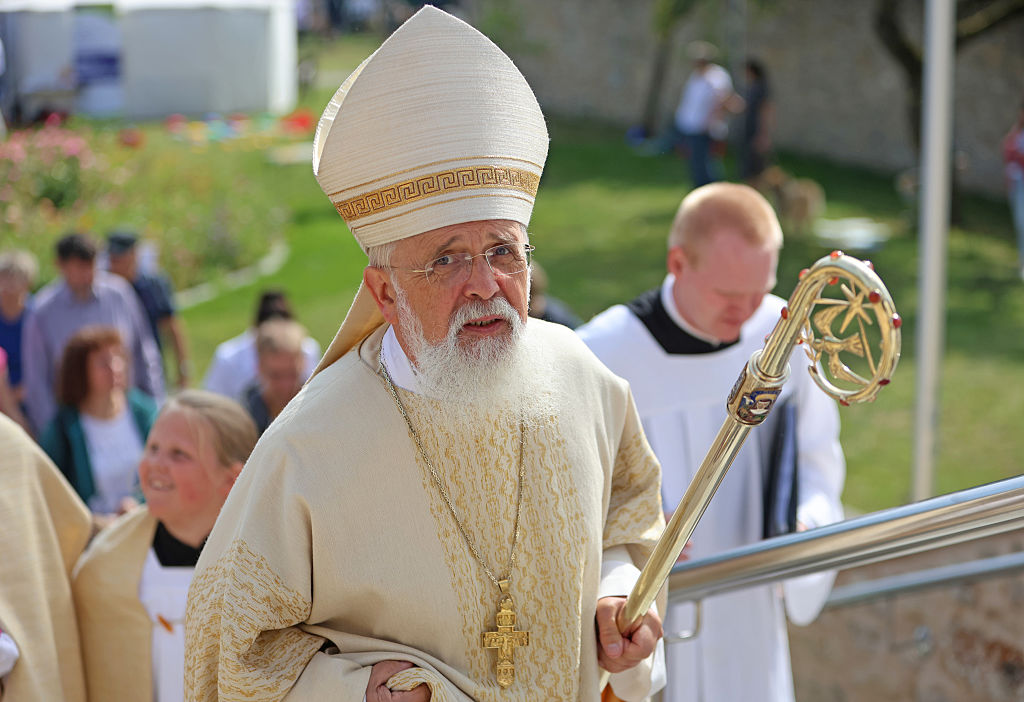
Gerhard Feige, the Bishop of Magdeburg, pictured here at a diocesan pilgrimage, never tires of warning against the AfD. Photo: Matthias Bein/picture alliance via Getty Images
The bishop of the Diocese of Magdeburg has repeatedly warned against an absolute AfD majority and said that the party is not one Christians can vote for. In a current flyer by the diocese’s BEWUSST WÄHLEN! initiative, the rejection of central AfD demands is even expressed in the form of a prayer.
Critics have described it as a prayer against the AfD. The text itself is framed around values. The campaign clearly belongs in the wider context of church criticism of the AfD’s election program in Saxony-Anhalt, which the senior cleric has repeatedly described as an attack on human dignity, freedom and solidarity.
The AfD, in turn, accuses the Christian churches of politicization, abandoning their religious mission, embracing “rainbow ideology”, supporting migration and church asylum, and relying on state privileges.
Speaking Past the Faithful
To understand the clash between the official churches, the AfD and believers’ stated voting intentions, it is necessary to look at people’s everyday concerns. In Saxony-Anhalt, voters, including Christians, cite immigration, refugees, asylum policy and integration as a reason for backing the AfD, at 14%. Only then come education, schools and training at 12%, and the economy at 10%. Public concern therefore overlaps with the focus of the AfD in Saxony-Anhalt, which places heavy emphasis in its program on illegal migration and “remigration”.
Disappointment with the policies of other parties, low trust in the federal government and the generally poor economic mood also repeatedly appear in surveys as reasons for voting right. Christians share their fellow citizens’ view of the country’s problems and say they intend to vote accordingly.
The churches are no longer getting through with appeals that run counter to the concerns of Christian citizens as well. The same applies to the established parties. The numbers are clear.
Welcome to the comments section of the Štandard daily. Please take note of our guidelines, comments are moderated by us. You can contact the moderators at support@statement.com.
Participate in the discussion
Comments are available to subscribers only. If you'd like to join the discussion, choose a subscription starting at €6.72 per month.
All comments 0
Register
Comments are available to registered users only. If you'd like to join the discussion, register here.