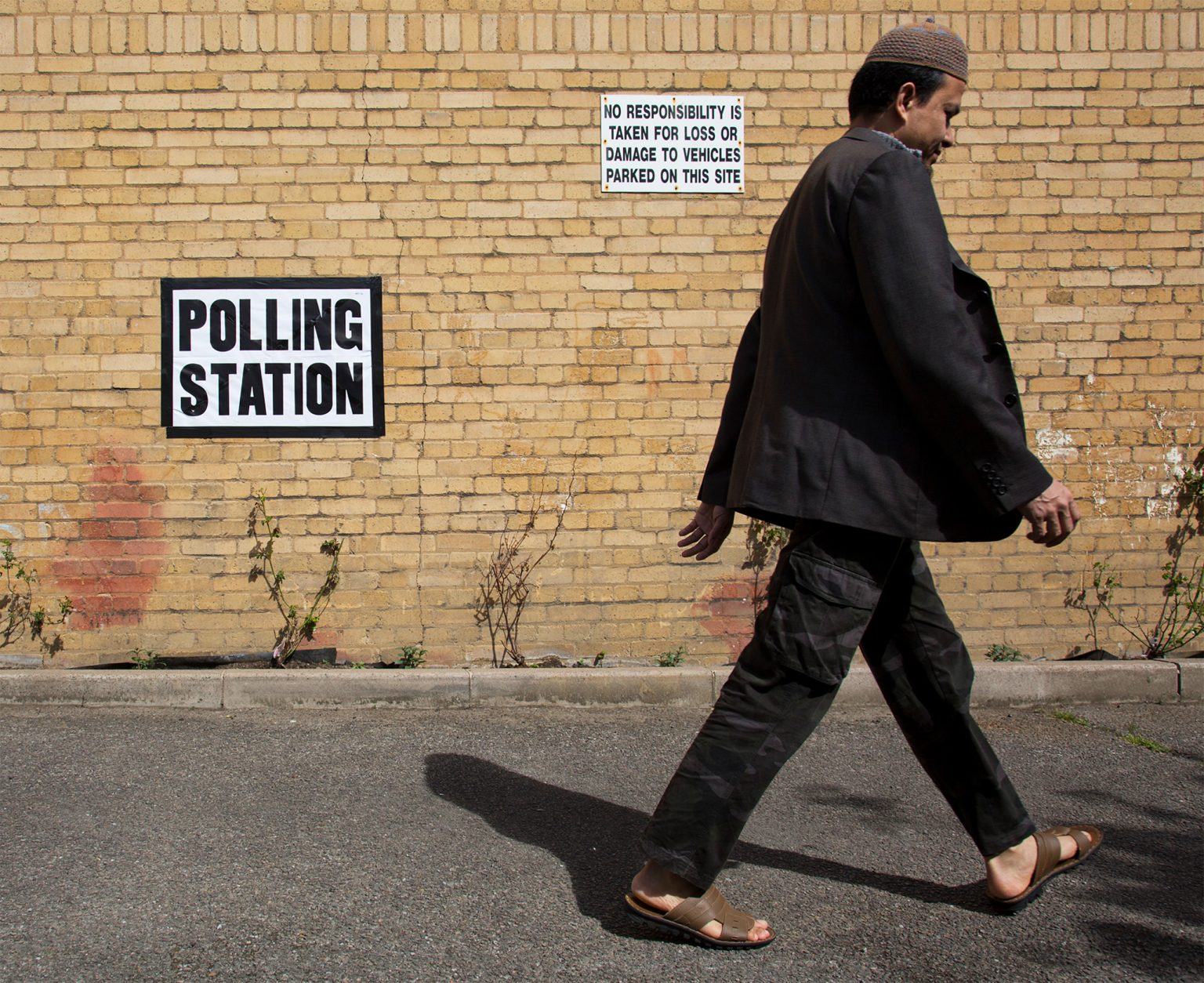
A new study warns that the rise of independent Muslim councillors in Britain is reshaping local politics through a growing movement described as “Islamopopulism.” Photo: Mike Kemp/In Pictures Ltd./Corbis via Getty Images
The Rise of “Islamopopulism” in Britain
With more than 100 independent Muslim councillors winning seats in Britain’s local elections in April, a new study has tackled the rise of one of the country’s newest political forces: “Islamopopulism”.
While the big story of the recent local elections in Britain was the collapse of two-party dominance and the rise of Nigel Farage’s Reform, a smaller but notable one was the growth in independent Muslim councillors.
Their presence indicates both the fragmentation of the Muslim vote, as it abandons its traditional home in the left-wing Labour Party, and its electoral significance as a new movement termed “Islamopopulism” by a recent study.
Of the more than 1,000 seats up for grabs on councils across England, Scotland and Wales in the April vote, more than 100 Muslim councillors were elected, adding to the dozens already in place and four independent MPs.
A New Force in Local Politics
In one sense, their election should not come as a surprise, given the growth of the Muslim population in Great Britain. Muslims now comprise more than 30% of voters in 20 of Britain’s 650 constituencies. In 2011, just ten seats had such a large Muslim electorate, a sign of how quickly Britain’s Muslim population is growing, at almost four million now and expected to pass six million sometime in the 2030s.
A recent report from the Muslim Council of Britain (MCB) suggests that Muslims make up 6.5% of the population of England and Wales, with a median age of 27 – 13 years younger than the national average.
If the Labour government succeeds in getting its bill to lower the voting age to 16 ahead of the next general election in 2029, the Muslim vote will become an increasingly powerful force in British politics, the 15 May report suggests.
However, the MCB’s report argues against thinking of Muslims as a homogenous voting bloc.
“This is a young, British-born, highly educated generation, and politicians who still think of Muslims as outsiders are reading from a script that is 20 years out of date”, Miqdad Asaria, associate professor in health policy at the London School of Economics and Political Science, told the Arab news site Al Jazeera.
“There is no Muslim voting bloc. There never was”, he continued. “What you have is nearly four million people with the full range of political views you would expect in any population that size.”
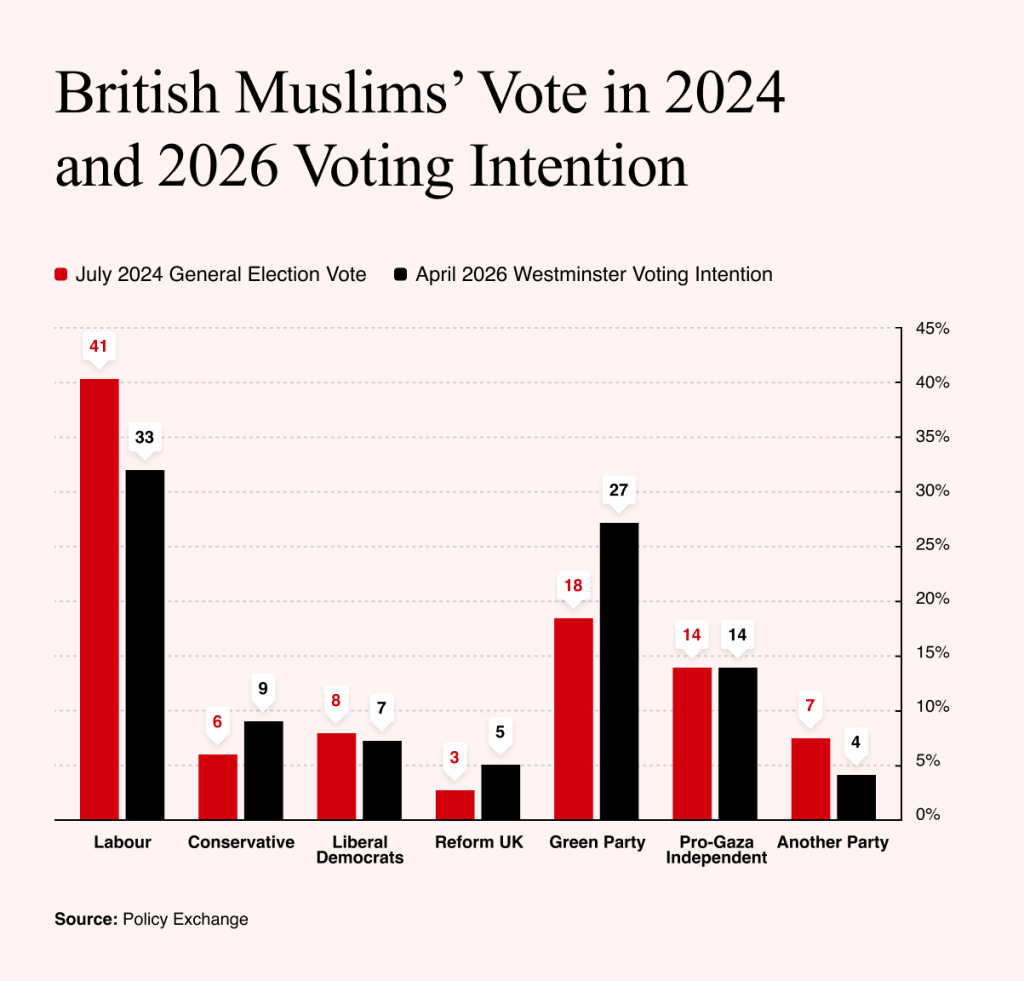
British Muslims’ vote in polled areas in the July 2024 general election and voting intention for April 2026. Source: Policy Exchange
The Voters Behind Islamopopulism
However, anecdotal evidence of pro-Palestinian mobs chasing down Labour candidates and a multi-part study titled Islamopopulism suggest a significant number of Muslim voters share priorities that are less popular with the general public and reflect sectional interests.
These include views on the Israel-Palestine conflict, religious versus national identity, gender segregation and blasphemy.
The study, titled Understanding Islamopopulism: Views of Concern, comes from the conservative think-tank Policy Exchange. The authors, Dr Rakib Ehsan, Andrew Gilligan and Dr Paul Stott, aim to identify Islamopopulism’s goals and methods, and assess where it draws its support from.
It raises a series of questions it describes as “fundamental for the future cohesion of the UK”.
These include the degree of support for Islamopopulism in Britain’s diverse Muslim community, whether it is a sectarian movement and whether a small number of Islamopopulist MPs could act as kingmakers in future governments given Britain’s increasingly fractured political environment.
The first report focuses on the views of the new political movement’s potential voters, zeroing in on the Muslim population in areas such as Greater London, the West Midlands, Greater Manchester and West Yorkshire.
The authors say the pool of respondents represents a community “which disproportionately lives in parts of the country characterised by intense forms of social, residential, and economic segregation” and “where challenges continue to persist over matters of integration, cohesion, and identity”. As such, the survey is not nationally representative.
Policy Exchange conducted a survey of 1,000 Muslims living in those areas and contrasted the results with a bespoke representative national survey to highlight differences in the social, political and religious ideals of the Islamic minority in these areas.
Gaza and the Break With Labour
As the report highlights, the Islamopopulist movement first came to national prominence in the 2024 general election, which saw four independent MPs oust mostly Labour candidates after campaigns that hinged on Gaza.
Among Muslim voters of Asian origin, Labour’s vote share dropped by a “remarkable” 28% between the 2019 and 2024 general elections, according to the authors.
Polling from their study suggests that support for Labour among Muslim voters has collapsed from a high of 80% down to just 33%.
Some six in 10 Muslim voters in key battleground councils said they would back Gaza-focused independent candidates to “punish” Labour, the report states, with a similar number saying they would back the left-wing Green Party for the same reason.
Already, in last year’s Gorton-Denton by-election, where Muslims make up 30% of the electorate, voters from the community supported Green candidates to keep Labour out. The Greens deliberately targeted the Muslim vote, visiting mosques, printing leaflets in Urdu and campaigning largely on the Israel-Gaza conflict.
The study shows the “strong degree” to which British Muslims across the polled areas are “Gaza-oriented” when expressing their political preferences, the authors argue. Some 14% said they would vote for a pro-Gaza independent candidate, compared with 1% of the general population.
While the cost of living dominated the polled Muslim voters' concerns - as it did in the comparative survey - the Gaza conflict came in second place at 25%, compared with 5% of the general population.
Support for the pro-Gaza Green Party leapt nine percentage points between the 2024 general election and the 2026 council elections, reaching 27%, compared with just 10% of the general population.
But interestingly, Reform (from 3% to 5%) and the Conservatives (6% to 9%) also see increased support, suggesting that the Muslim vote in these areas may be facing some of the political fragmentation experienced by the wider population.
Fraud Concerns and Social Segregation
The survey suggests that electoral fraud “disproportionately” affects “segregated Muslim communities”, despite such concerns being widely dismissed as “Islamophobia”. The concerns were raised after the Gorton-Denton by-election was mired in claims of “family voting”, in which one person’s vote is influenced by one or more other people.
Democracy Volunteers, a charity that monitors electoral practices, issued a statement saying its observers had seen “the highest levels of family voting at any election in our 10-year history of observing elections in the UK”.
The Policy Exchange study lends credence to these claims, suggesting that the polled Muslim voters reported potential indicators of electoral fraud at a higher rate, such as having their postal vote collected by a political candidate (14% compared with 8% of the general population) and handing their ballot paper to another person (9% compared with 4%).
When it comes to religious and ethnic identity, those polled showed a stronger allegiance to both compared with the general population.
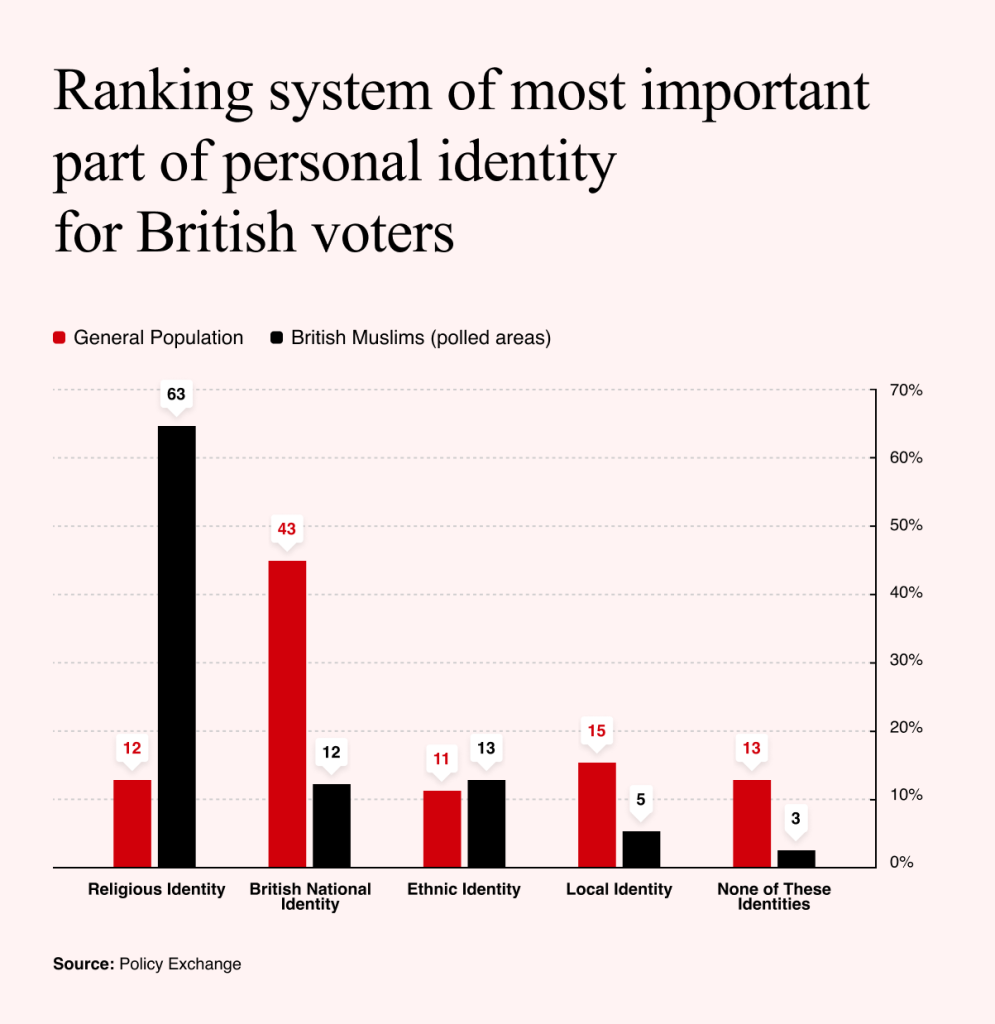
While 12% of the general population placed their religious identity first in terms of importance, the corresponding figure for the British Muslim respondents was 63%.
On ethnicity, British national identity was seen as important by 75% of Muslim voters, but ranked behind ethnic identity at 79%. By comparison, 63% of the general population said their ethnicity was important.
Ranking system of most important part of personal identity for British voters Source: Policy Exchange
Religion, Identity and Public Life
The influence of Islamic religious beliefs on voter intention was also explored. For instance, a majority of polled Muslim voters supported making the depiction of the Prophet Muhammad a criminal offense.
Support for gender-segregated spaces also showed a significant divergence between Muslim voters and the general population. Half of the general public strongly oppose greater encouragement of gender segregation in public spaces, but this drops to 14% for British Muslim respondents from the polled areas.
The report also describes what it calls “elevated” levels of antisemitism expressed by Muslims who participated in their survey.
In the general-population survey, 36% of respondents reported a favorable view of Jews and 11% an unfavorable view, giving what the authors call a net favorability rating of +25. Among British Muslim respondents, 26% expressed a favorable view of Jews and 21% an unfavorable view of Jews as a group, giving a net favorability rating of +5.
Lead author Dr Rakib Ehsan warned that the poll “reveals that there are fundamental differences between the wider general population and British Muslims living in parts of England where problems over integration continue to persist”.
“Among the British Muslims living in the polled areas, there are worrying levels of antisemitic conspiratorial beliefs and support for the criminalisation of blasphemy. The findings show that the UK is far from being a stable multi-faith democracy”, he added.
Welcome to the comments section of the Štandard daily. Please take note of our guidelines, comments are moderated by us. You can contact the moderators at support@statement.com.
Participate in the discussion
Comments are available to subscribers only. If you'd like to join the discussion, choose a subscription starting at €6.72 per month.
All comments 0
Register
Comments are available to registered users only. If you'd like to join the discussion, register here.