
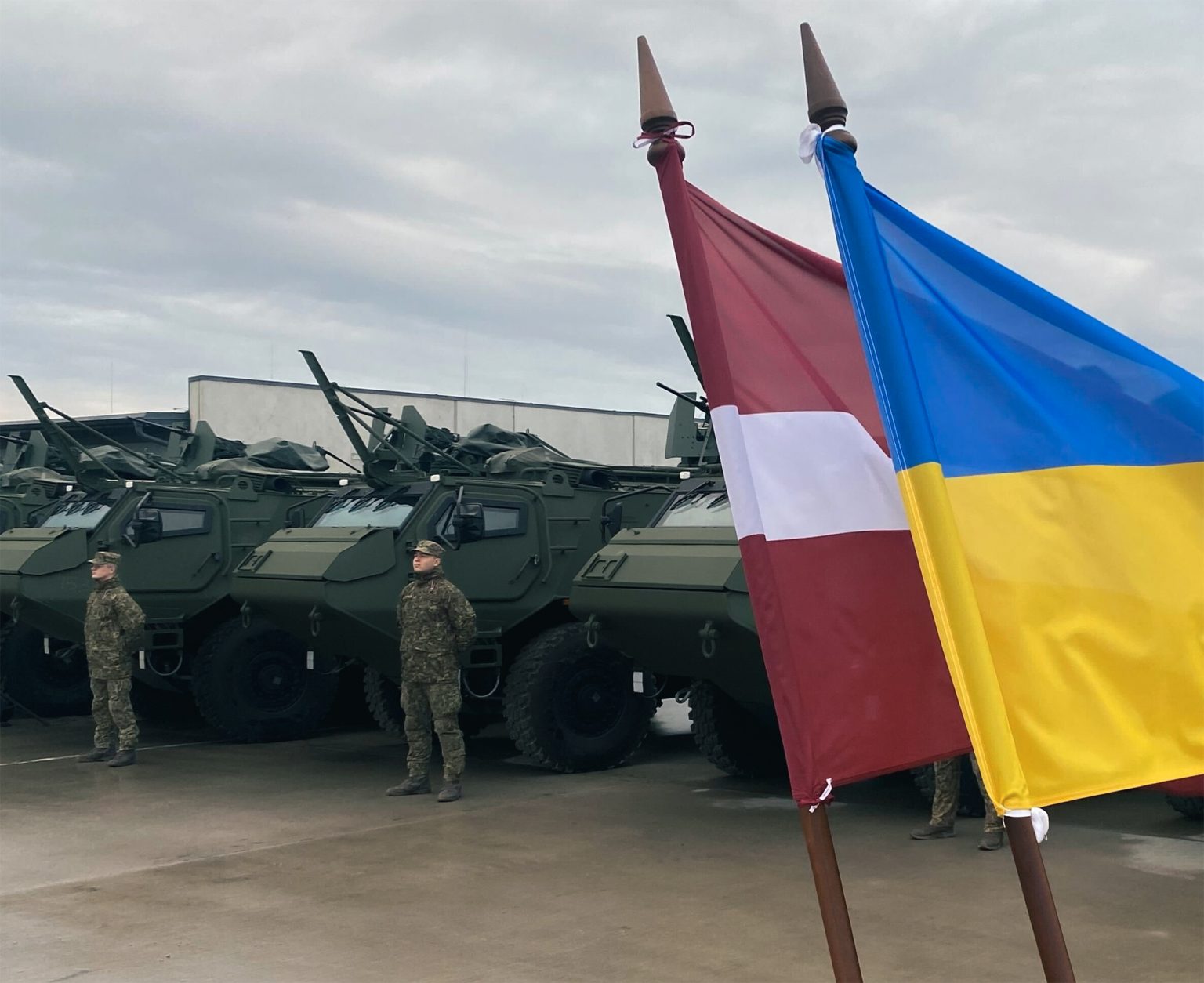
Russian intelligence has warned Latvia against involvement in Ukrainian drone strikes on Russian territory. Until now, the Baltic states merely tolerated Ukrainian drones crossing their airspace, but Moscow now claims that some of those drones are launching directly from Latvian bases.
If that is true, Latvia – a NATO member – could eventually face a Russian strike. Europe would move one step closer to direct confrontation with Russia, an outcome some Ukrainian officials may see as strategically beneficial. The Russian warning may also help explain why the Latvian government collapsed just days ago.
The recent Ukrainian attacks on Russian energy infrastructure succeeded in part because the drones exploited the airspace of Russia’s neighbors. Some eventually crashed there, either because of Ukrainian mistakes or Russian interception efforts. In Finland, drones reportedly fell into forests without causing damage. In Latvia, they landed on supposedly empty oil storage tanks.
Finnish President Alexander Stubb, one of Kyiv’s strongest supporters in the West, responded by calling his Ukrainian counterpart. Publicly, both sides insisted Russia ultimately bore responsibility. Yet Stubb also spoke openly about the need to protect Ukrainian drones from the Ukrainians themselves.
When Ukrainian drones again crossed into Finnish airspace last week, Prime Minister Petteri Orpo warned Kyiv that such incursions were unacceptable. Finland supports Ukraine, but it clearly does not want Ukrainian drones falling on Finnish territory – nor does it want to be dragged into war with Russia. It cannot be excluded that the Finns coordinate with Ukraine behind closed doors, but by publicly denying involvement, they shield themselves from possible Russian retaliation. Qatar, Turkey and Saudi Arabia never openly admit support for jihadist groups either.
The Collapse of the Latvian Government
Latvia reacted differently.
Defense Minister Andris Spruds – a progressive politician and former academic with limited political experience – downplayed the incidents. If Ukraine is legitimately attacking Russia, he argued, it is inevitable that some drones occasionally end up over neighboring territory. Military officials expressed similar views. When forests are cut down, splinters fly.
The prime minister, facing pressure from both the opposition and public opinion ahead of autumn elections, refused to accept that explanation and forced Spruds from office. Kyiv’s insistence that Russia had diverted the drones, as well as its offer to send Ukrainian experts to Latvia, changed nothing. Spruds’ party subsequently left the coalition, bringing down Prime Minister Evika Siliņa’s government.
Against this backdrop, Russian intelligence issued an even more serious warning earlier this week. According to Moscow, Latvia is allowing Ukraine to use military bases for drone attacks on Russia, and five facilities were reportedly identified by name. Ukrainian drone operators are allegedly already present in the country. Russian intelligence also mocked Latvian officials for supposedly believing it is impossible to trace where drones originate.
Most ominously, Moscow warned that it knows the locations of Latvia’s political and military command centers and suggested these would become the first targets of a Russian strike should Latvia become directly involved in attacks on Russia – regardless of its NATO membership.
This is an extraordinarily serious threat.
The Threat of a Russian Strike
One should not automatically believe everything Russian intelligence says. Intelligence agencies rarely release information publicly in order simply to inform. They do so to shape events. So in this case, Moscow may be trying either to deter Latvia from deeper involvement or to prepare the political ground for future retaliation.
Both possibilities make strategic sense. Russia has suffered substantial infrastructure damage from recent drone attacks. And it is increasingly obvious that Ukraine’s European allies have played supporting roles – through intelligence, supplies or access to airspace. Voices inside Russia are growing louder in demanding that Europe itself “learn a lesson”.
Nor can it be ruled out that the Russian allegations are partly true. Cooperation between Latvian and Ukrainian military or intelligence structures may have evolved beyond the direct oversight of politicians in Riga. The goal may have been simply to support Ukrainian operations – or perhaps to provoke Russian retaliation and thereby trigger the direct NATO confrontation Kyiv has long sought.
The political turmoil in Latvia lends some plausibility to this interpretation.
Unconditional support for Ukraine had never previously fractured Latvia’s ruling coalition. On the contrary, it usually strengthened it. Yet after the drone affair, the prime minister suddenly declared she had lost confidence in the defense minister.
Spruds himself, an academic until entering politics after the 2022 elections, may not even have fully understood what was occurring within his ministry. He may simply have repeated to journalists what officials told him. He would hardly be the first politician in such a position.
If Finland’s president now speaks about the need to protect Ukrainian drones from the Ukrainians themselves, Latvia may need to protect its own officers and politicians from Ukrainian influence as well.
Expanding the War?
Ukrainian motives are obvious. A wider war would likely ease pressure on Ukraine and could improve Kyiv’s position in any future negotiations with Moscow. But Latvia’s own calculation is harder to explain.
Perhaps some figures within the country believe war with Russia is inevitable and see it as their role to force the issue. Yet the deeper question is who truly exercises influence inside this small, weak and politically fragmented state.
Latvia resembles a Baltic version of Bulgaria: poor, unstable and heavily dependent on external structures despite membership in the EU, NATO and the eurozone. Its population has fallen by nearly a million people since 1990, driven not only by demographics but by mass emigration. Roughly a quarter of its population is ethnic Russian.
Its political system is fragmented, with governing coalitions built from parties that share little beyond temporary convenience. The recently collapsed coalition of centrists, progressives and Euroskeptic conservatives was no exception.
Weak democratic politics inevitably creates space for other power centers: oligarchs, entrenched state institutions and foreign actors. Those external actors then cultivate their own preferred political elites.
Valdis Dombrovskis illustrates this model. As Latvian prime minister during the financial crisis, he imposed severe austerity measures that drove vast numbers of working-age Latvians abroad while pushing many who remained deeper into poverty.
Brussels and Washington nevertheless praised him relentlessly. Latvia joined the eurozone in 2014, and Dombrovskis moved seamlessly into the European Commission, where he remains today.
Latvia is not the only Eastern European country where political advancement depends on serving supranational interests over domestic ones. But in Latvia, the consequences may be more dangerous than elsewhere.
In 2010, the country suffered an economic shock imposed from the West. Today, it risks a military shock from the East.
Perhaps Latvia’s democratic forces have now awakened and halted this dangerous slide toward war. If not, the responsibility falls to other NATO members to reject such recklessness clearly and publicly.