
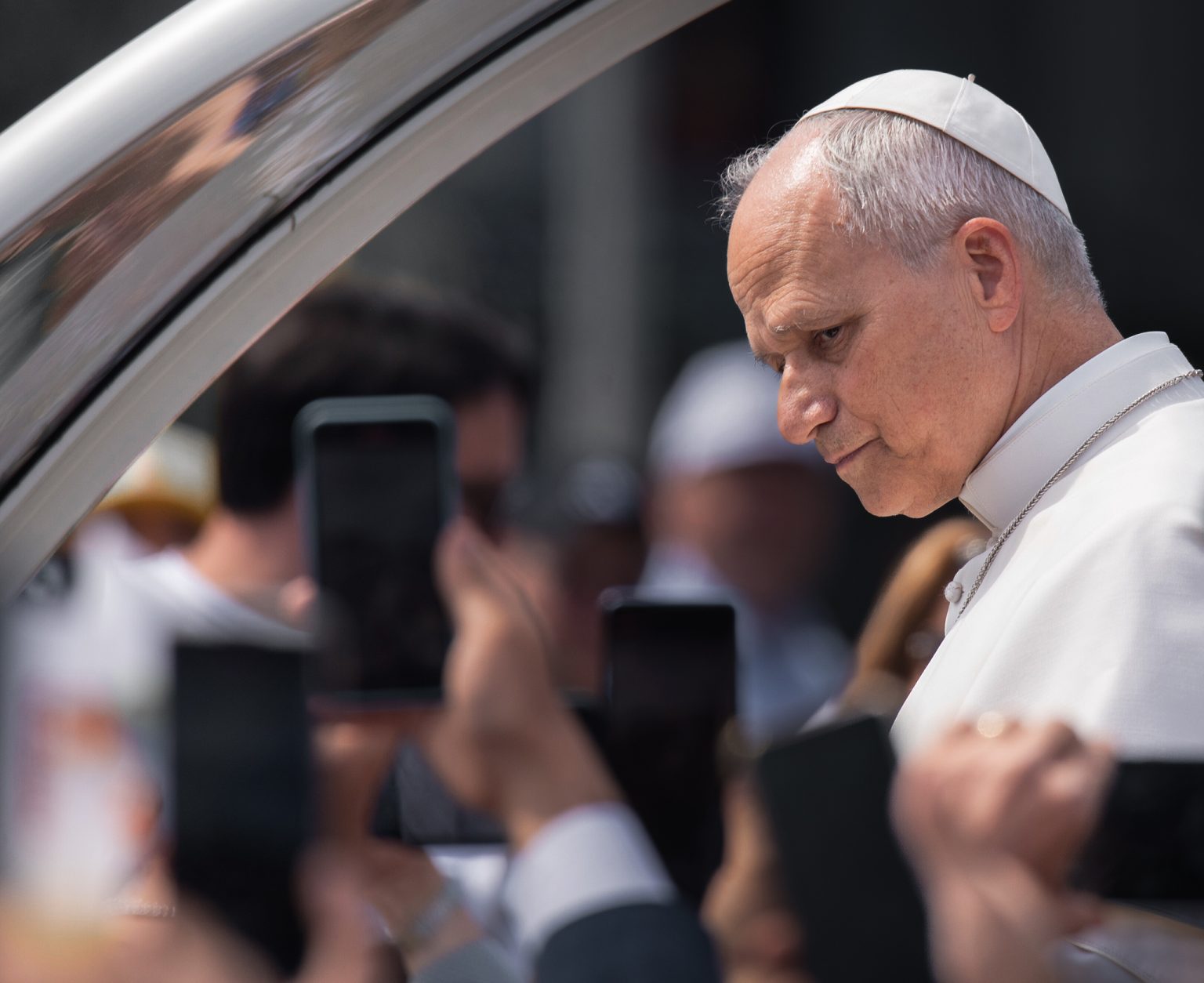
In the first encyclical of his pontificate, issued on Monday, Pope Leo XIV called on governments and technology companies alike to slow the pace of artificial intelligence development and place it under rigorous regulatory oversight.
Rerum Novarum, Revisited
At more than 200 pages and nearly 43,000 words, the encyclical is divided into five chapters. Leo and his Vatican staff began work on it shortly after last year's conclave.
"Humanity, created by God in all its grandeur, is today facing a pivotal choice: either to construct a new Tower of Babel or to build the city in which God and humanity dwell together", are the opening words of the document, which the Bishop of Rome signed on 15 May - the 135th anniversary of Rerum Novarum, the landmark encyclical issued by his namesake, Leo XIII.
The document ranges beyond AI to address social justice, the dignity of work and the abuse of the just war doctrine. Issued as an exercise of the sacred magisterium (teaching office), it represents the Church's first official word on these questions for the approximately 1.4 billion faithful who profess the Catholic faith.
Neither Neutral Nor Inevitable
Among the encyclical's sharpest charges is that AI systems spread misinformation, favor confrontation over communication and risk pushing the world toward perpetual conflict.
Leo called for AI training data to be removed from exclusively private ownership, for politicians to protect workers' rights and for children to be shielded from the technology's dangers. He also urged less rivalry among AI firms.
What is needed is a more active political involvement that is capable of slowing things down when everything is accelerating", he wrote, also calling for "robust legal frameworks, independent oversight, informed users and a political system that does not abdicate its responsibility".
Technology is not a "force antagonistic to humanity", Leo assured, nor "inherently evil". Yet no technology "is ever neutral, because it takes on the characteristics of those who devise, finance, regulate and use it", he warned.

A Fragile Interval Between Conflicts
The encyclical also condemns the wars raging around the world, which the Vatican attributes to the weakening of multilateral organizations and the profits of the arms industry. "The past sixty years have been marked by conflicts of astonishing brutality, often affecting civilian populations on a massive scale", the pontiff noted.
"Humanity is slipping into a violent culture of power, where peace no longer appears as a responsibility to be taken on, but as a fragile interval between conflicts", he declared.
The Pope went on to condemn the abuse of the just war doctrine, a concept invoked by Catholic monarchies since at least the fifth century. The same arguments, centered on the defense of civilian populations and the intrinsic value of human life, have more recently been made by the administration of US President Donald Trump.
"The 'just war' theory, which has all too often been used to justify any kind of war, is now outdated", Leo wrote. The use of armed force, he continued", reflects a relational poverty that always has disastrous consequences for civilian populations".
From Endless War to Endless Upgrade
Leo also warned that leaders might resort to war as a distraction from domestic problems. "We cannot rule out the possibility that some leaders may consider armed conflict as an effective way of diverting attention from domestic problems and a cynical tool for managing difficulties", he wrote.
Turning to AI in warfare, Leo called for the technology to be "disarmed" - by which he meant removing autonomous decision-making from the military sphere entirely. Any use of AI in combat "must be subject to the most rigorous ethical constraints", he wrote, calling it "not permissible" to entrust such systems with decisions carrying deadly consequences.
Beyond regulation, Leo called for an end to the equation of technical power with the right to rule and for AI to be freed from monopolies. He also turned his attention to transhumanism, a movement that seeks a "new evolutionary stage" through the merging of humans and technology, devoting a pointed passage to its critique.
Transhumanism understands progress as the overcoming of human limits. Leo rejected that premise entirely. The limit, he argued, is not a "defect to be corrected" but an essential feature of the human person: it is precisely in fragility and finitude that relationship and openness to God and neighbor mature.

Tech Giants Take Note
The encyclical's critique of the technology industry extends beyond regulation and monopoly. Leo denounced the "new forms of slavery" he sees arising from the stark differential between those who own and operate data centers and those who toil in technology factories.
"In some regions of the world, children and adolescents work in dangerous conditions, crushing the materials from which rare earth elements are extracted", he wrote. "The bodies of these people are scarred, injured and worn down so that computational flow may continue uninterruptedly" - a reality, he added, that "deeply challenges the moral conscience of our time".
At Monday's Vatican presentation, Anthropic co-founder Chris Olah thanked Leo for addressing the challenges posed by the technology, acknowledging that companies like his face strong commercial pressures and need external scrutiny.
"Every AI lab on the cutting edge, including Anthropic, operates within a set of incentives and constraints that can sometimes be at odds with doing the right thing", Olah said. Anthropic, the developer behind the Claude large language model, has long engaged with the Vatican on the ethics of AI and is widely known for its emphasis on safety.
The encyclical has been closely watched across the industry. Executives from Amazon, Google and Meta met with Leo in late April, seeking his support for what they described as responsible AI development.
Leo urged the world not to abandon the search for answers to the risks posed by AI, closing with a direct appeal: "With the heart of a shepherd and a father, I ask everyone to abandon the construction of yet another Tower of Babel and to join forces in building up the common good".
"A subtle temptation may emerge, namely the thought that the problems are too big and we are too small, and that our choices, therefore, cannot make a difference", he wrote. "Certainly, not everyone has the same power to make a difference. Yet, no one is without responsibility. We all have our own areas for action", he concluded.
(vatican news, reuters, sab)