
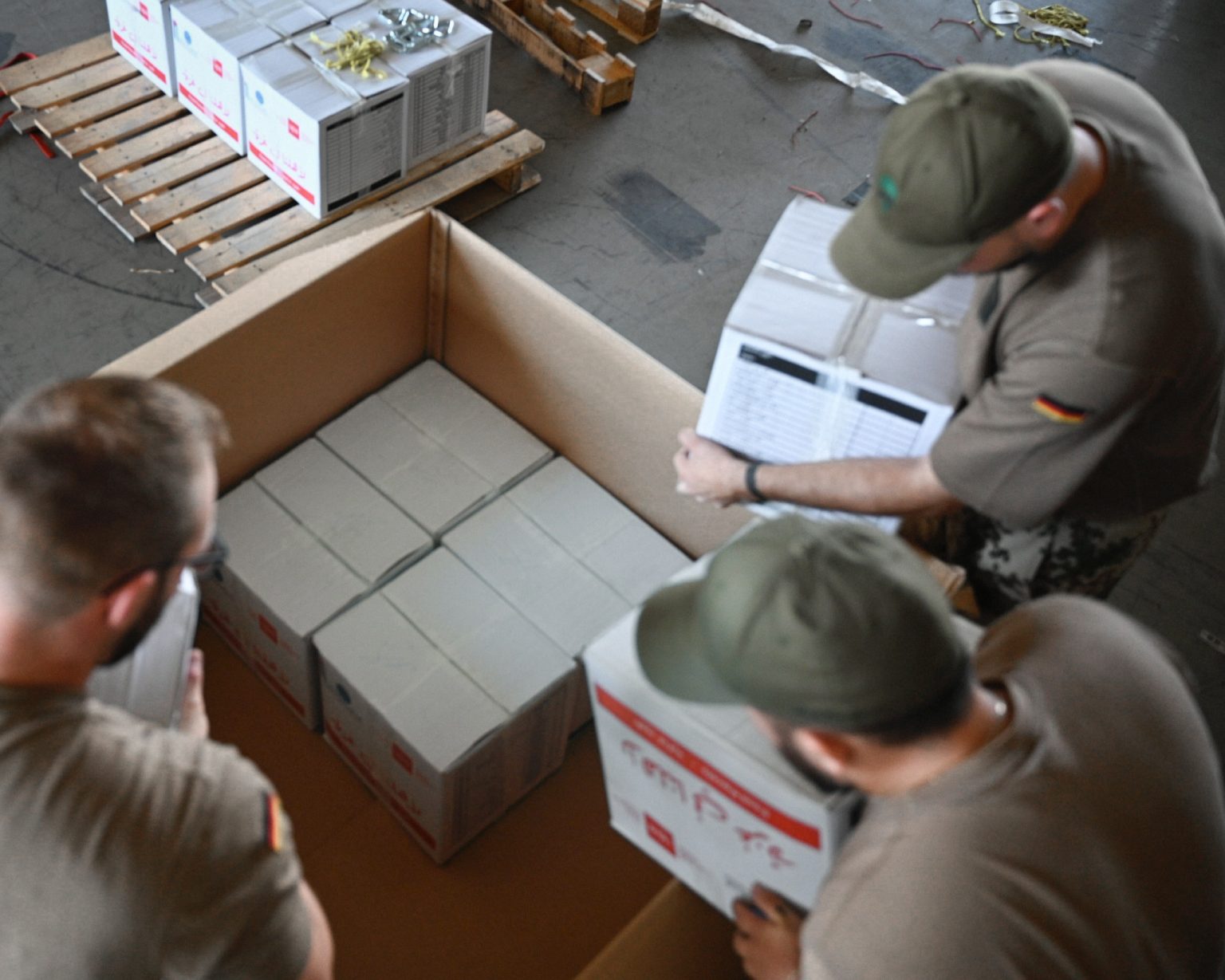
Money is short almost everywhere in Germany. The economy is failing to gain momentum and industry is deep in crisis. Municipalities warn that they are overstretched, bridges and roads are waiting to be repaired, and citizens and companies are regularly told that the state must set priorities. Not every task can be completed at once, not every demand can be funded and not every problem can be solved with money.
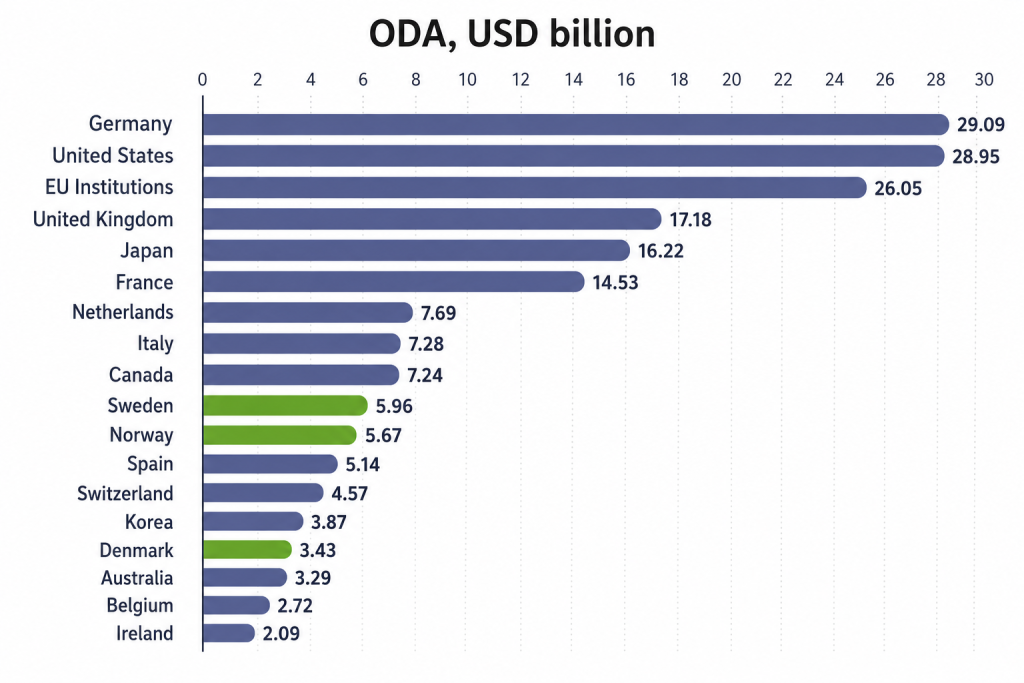
Yet in precisely this situation, Germany became the world’s largest foreign aid donor for the first time in 2025. According to preliminary figures from the Organisation for Economic Co-operation and Development (OECD), Germany provided $29.1bn in official development assistance, narrowly ahead of the United States, which contributed $29.0bn.
The top position was made possible above all by the sharp decline in US payments under President Donald Trump, who drastically cut back the USAID program. Globally, total contributions by donor countries fell by 23.1% to $174.3bn. Humanitarian aid was hit particularly hard, declining by 35.8%, according to the OECD.
Anyone who wants to know what Germany spends development money on does not have to look far. The project lists of the Federal Ministry for Economic Cooperation and Development (BMZ) and the German Agency for International Cooperation (GIZ) include initiatives that have only a limited connection to classic emergency aid, hunger relief or infrastructure support. They involve the film industry with an LGBTQI focus, positive masculinity, gender-transformative approaches and eco-feminist development alternatives.
Germany is therefore funding more than ever precisely the kind of projects that Trump has tried to starve of money in the US.
When Development Aid Becomes Social Policy
One particularly striking example is the GIZ project "Strengthening the Film Industry in Selected African Countries". It runs in Ghana, Kenya and Rwanda and is commissioned by BMZ. Its current project budget is €4m. According to GIZ, the project is intended to improve the film industry in Kenya and Rwanda, train filmmakers and implement state funding strategies.
The project description explicitly states that a special focus is placed on women and members of the LGBTQI+ community. In this case, development aid does not mean building wells, emergency relief or medical care, but film funding with a social-policy mission.
The case in Cameroon is similar. There, BMZ is funding a project titled Promoting Gender-Transformative Approaches to Strengthen the Resilience of Civil Society in Cameroon. A total of €21m has been earmarked for it until 2028.
A parliamentary question by the Alternative for Germany (AfD) group examined the project more closely in the German Bundestag. In its response, the federal government referred, among other things, to disadvantages faced by women in politics, education, employment, family law and property rights in Cameroon.
At the same time, it acknowledged that the project, launched in March 2024, had not yet been evaluated. The measures to be implemented include training, awareness-raising, support for civil society organizations, one-stop shops for victims of gender-based violence, health vouchers and measures in the area of sexual and reproductive health.
In other words, money is flowing to NGOs equipped with the “right” mindset, while even the government itself does not know exactly what happens to the money and does not strictly monitor it.
In Rwanda, a project on positive masculinity has been publicly discussed. According to research by the weekly magazine Focus, a full €520,000 flowed into the project from 2022 to 2025. A similar predecessor project was reportedly funded with €390,000.
On the German side, the aid organization Bread for the World is responsible. According to the concept, the project is intended to prevent violence against women and children, promote reproductive health and help contain HIV and AIDS.
Politically, however, one point is hard to ignore: Germany is financing programs on models of masculinity in East Africa while at home it is regularly debating a lack of funds for core state responsibilities.
South Africa also appears in German funding lists with a project whose title alone reveals the distance between bureaucratic language and public perception: "Raw Materials Extraction and Eco-Feminist Development Alternatives". In a Bundestag paper on climate finance, the project is listed at €250,000.
Strictly speaking, the document mentions only the climate-relevant share, not necessarily the total project budget. Yet the title alone shows how closely development policy is now intertwined with climate, gender and social-policy agendas.
The Open Question of Priorities
Another project concerns Algeria. There, GIZ is promoting female entrepreneurship in Algeria’s green economy. The project runs from 2024 to 2027. It is again commissioned by BMZ, with the Algerian industry ministry as partner. Its current contract value is €6m.
The project focuses on developing services, access to finance, women’s associations, incubators, natural cosmetics and products made from high-value raw materials. The political contrast is hard to miss: Germany is funding a green-economy entrepreneurship program in an oil- and gas-rich country while debating energy prices, competitiveness and weak investment at home.
Climate-friendly cooking stoves in Kenya and Senegal also belong in this category. The GIZ project has a current contract value of about €53.6m, of which €40.82m comes from the Green Climate Fund. According to GIZ, the project is intended to promote more efficient cooking technologies, support manufacturers, expand distribution structures and raise consumer awareness.
Open fireplaces and inefficient fuels are a health and environmental problem in many countries. Politically, however, the figure is hard to ignore: about €53.6m for cooking technologies in Kenya and Senegal while Germany itself is struggling with high energy costs, rising levies and a weak economy.
The issue, therefore, is not simply whether the country should help abroad, but how it chooses, describes and justifies that help.
In Germany, development policy is often treated as a moral given. Cuts to those budgets are framed as a human rights violation. Yet the more visible the economic and fiscal problems at home become, the less convincing that argument is.
Anyone who uses public money abroad for LGBTQ film funding, eco-feminist gender programs or climate-related model projects must explain more clearly why those expenditures should take priority over the needs of the domestic population that finances it all through taxes.
In the end, the conclusion is sober: the project lists say more about Germany’s development priorities than any ministerial speech. They contain not only emergency aid, food security and health programs, but a dense web of climate, gender, cultural and social policy.
That is exactly where the real debate begins: not over whether Germany should help abroad, but over which agenda it is funding and pursuing with taxpayers’ money.