France wants to count toilets, showers and running water as extra taxable space in millions of homes. Officially, it is a cadastral update. In practice, the French taxman has found his way behind the bathroom door.
If there is a problem that European politicians cannot seek to solve by increasing taxes on their own citizens, it has yet to reveal itself. Even by those standards, the latest stunt from France is astonishing: millions of people are to see their homes classified by the tax authority as substantially larger than they actually are, just for the now taxable privilege of having a shower, a bath or even running water.
According to the Directorate General of Public Finances (DGFiP), properties are getting a “notional” bump in their “taxable surface area”. That is to say, if a home is a certain size, the government is going to start counting it, for tax purposes, as bigger, depending on what it contains. To be precise: 4 sq m for running water, another 4 sq m for a shower, 5 sq m for a bathtub, 3 sq m for a toilet and so on for electricity, heating and the rest. The average home with taps, a bath, a shower and a toilet will suddenly be 16 sq m larger than it actually is, for tax purposes.
That is about two normal-sized car-parking spaces.
A Tax Base With Running Water
This “reliabilisation of the cadastral records”, a fine example of clear legislative language if ever there was one, is expected to hit around 7.4 million homes with an average increase of €63 ($73) per year. That might not sound like much on the face of it, but for pensioners and families already squeezed by energy costs and inflation, it is probably a bit of a kick in the teeth, or indeed somewhere even more painful.
The whole thing is undergirded with some classic administrative wool-pulling. According to the French, they are not actually increasing taxes at all, even though millions of French people will pay more. Instead, the move is being presented as an “update to the tax base”, where the tax paid per square meter stays the same but the home is suddenly treated as much larger than it actually is. Overnight, it will be as if millions of Frenchmen and women had decided to build massive extensions to their homes.
French reaction has been predictably furious. Property owners’ federation UNPI president Sylvain Grataloup was irate in the best traditions of French discontent: “It’s wrong that the tax office can impose an increase based on changes that it has no knowledge of. They have never visited all the properties… The objective is clear: it is to bring in money for the state.”
Outlets such as Le Figaro have highlighted the absurdity, noting that nearly 13% of French homes still lack proper heating in some regions, while hundreds of thousands lack indoor toilets or running water, particularly in rural areas such as Corsica or south-west France. Taxing the rest for having caught up with modernity feels less like fair valuation and more like punishment for not living as if it were still 1975.
Of course, France already collects one of the highest shares of property-related revenue as a proportion of GDP in Europe, around 3.7% in recent figures, far above Germany’s more modest burden or lower-tax Eastern states.
Germany keeps its property taxes low but piles on energy levies and Energiewende costs that have hammered households. Spain and Italy have their own wealth and property surcharges. The common thread is the climate agenda: every basic necessity, from heating a home to driving to work or having a wash, becomes an opportunity for behavioral modification through the tax code.
This is the secret behind the Green Revolution, yet it is something that ordinary voters seem to struggle to grasp. The climate can only be saved by human beings doing fewer of the things that have generated carbon emissions, goes the theory. And that theory becomes practice by making normal everyday things ever more expensive, including, now, having a shower or filling a kettle. This is the reason for all environmental taxes: fuel taxes are designed to make people drive less, energy taxes are designed to make them consume less energy, and France’s shower tax is designed to make them have fewer showers.
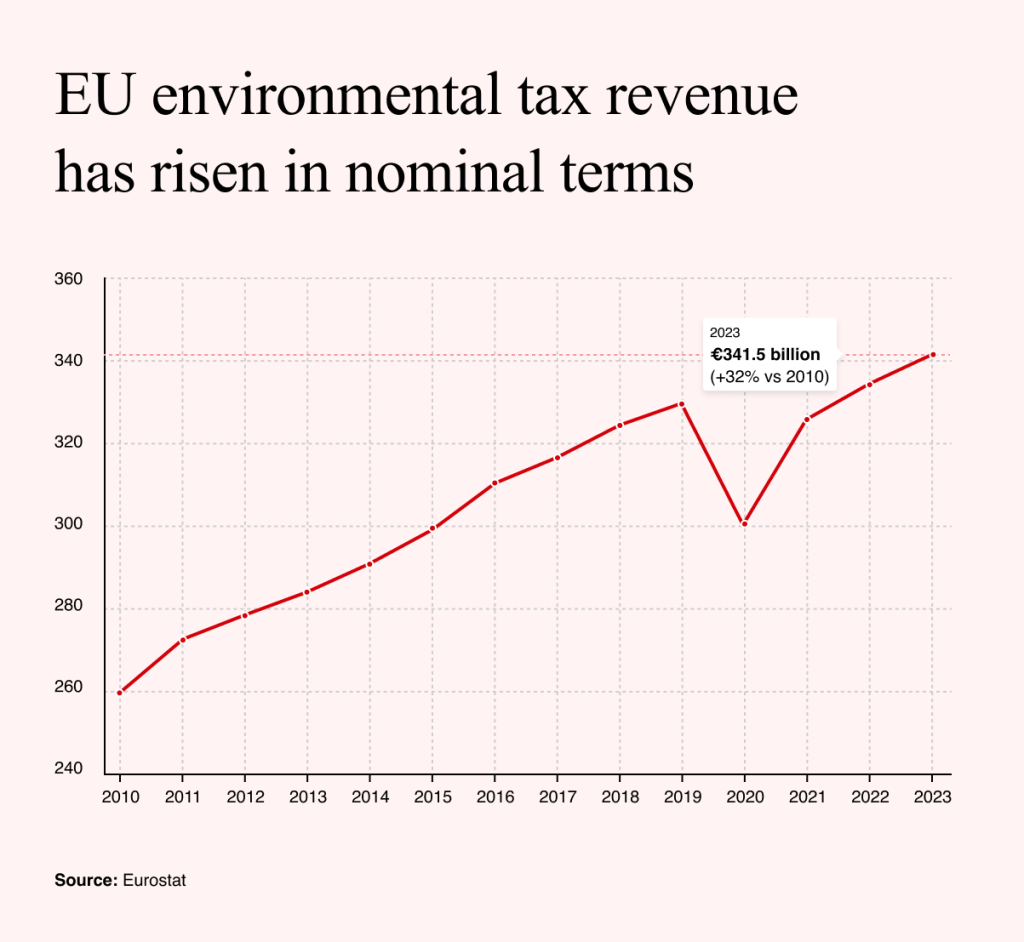
The numbers tell the story. Europe now extracts more than a third of a trillion euros, or more than €333bn ($388bn), from its own citizens every year, all of it with the same specific and miserable intent: to make the things people like doing more expensive, so that they will do them less often. It is a third of a trillion designed to make people eat less, drink less, drive less, use fewer plastic bags, sit in the cold more often and now, in France, have fewer showers.
Source: Eurostat
There are arguably two things at play here. From a sheer money-grabbing point of view, the obvious point is that France’s debt is high, its welfare commitments enormous and its green transition costly. Property owners, especially outside the big cities, are an easy target for politicians. They cannot easily relocate. Their asset is fixed. They are subject to what economists call price inelasticity.
The second thing at play is, of course, the political obsession on the continent with climate taxes, and with governments coming up with new ways to make the public less of a threat to the elemental balance of the atmosphere. Other countries should therefore watch closely. After all, the political class across the continent adores the concept of European “best practice”, whereby an unpopular policy can be justified in one country on the basis that everyone else is doing it, and so it must be the right thing to do. Soon enough, some European Union functionary may decide that harmonizing the shower tax across the continent is the kind of thing Brussels was absolutely born to do.
The script writes itself. The French, for their part, have a reputation for taking to the streets when pushed too far. Actually, scratch that. The French will take to the streets at almost any excuse.
Whether this taxe sur la douche sparks another round of protest remains to be seen. It should. And it should not be permitted to be regarded as a simple property tax, because it is not a tax on property at all, but a tax on toilets, showers and taps. There is a pretty obvious and colorful label one might apply to it, but decorum prevents spelling it out.
Welcome to the comments section of the Štandard daily. Please take note of our guidelines, comments are moderated by us. You can contact the moderators at support@statement.com.
Participate in the discussion
Comments are available to subscribers only. If you'd like to join the discussion, choose a subscription starting at €6.72 per month.
All comments 0
Register
Comments are available to registered users only. If you'd like to join the discussion, register here.