France’s Far-Right Presidential Hopeful Sets His Sights on EU
The leader of France’s right-wing National Rally party proposes a hard-nosed policy toward the EU, laying out his aim as reconstruction not destruction of the union.
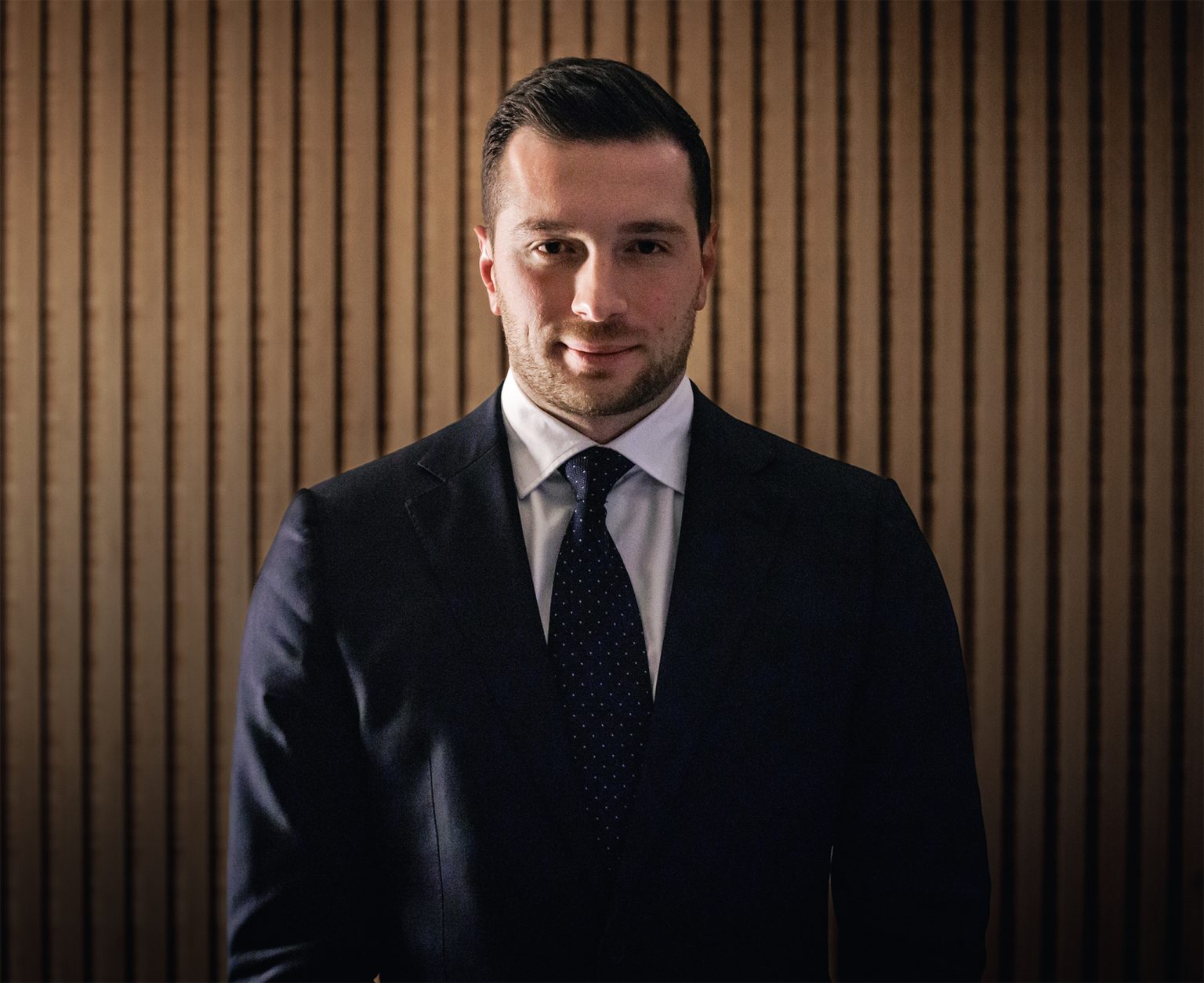
French politician Jordan Bardella. Photo: Samuel Corum/Getty Images
|
French presidential hopeful and National Rally (RN) leader Jordan Bardella is considering how the party will approach the European Union (EU) if it wins next year's election. He is eyeing links with right-wing leaders from across the continent, while proposing to “change everything without destroying anything”.
Bardella laid out his plans in a 15 June interview with Politico, one of the premier EU news outlets. In it, he castigated the EU as “completely obsolete” and in need of an overhaul, leaving Europhiles fearing that the far-right politician could be the next Viktor Orban.
However, while Bardella was bullish about the need to cut the EU budget and stated that he would halve France’s financial contribution, he did not mention Orban – who was frequently at loggerheads with the EU as Hungary’s prime minister – and instead name-checked Italian PM Giorgia Meloni, whose approach has been to work with Brussels while remaining critical of it.
His comments appear to confirm speculation that if RN wins the 2027 presidential election, it will seek closer ties with Meloni and the right-wing European Conservatives and Reformists (ECR) grouping in the European Parliament.
If it did so, it would increase the bargaining power of the right-wing bloc at a time when it is starting to make its influence on EU policy felt, as is shown in the recent negotiations over the union’s Migration Pact.
France holds a significant position within the union as its second-largest economy and, with Germany, one of the key drivers of the European project. Bardella is leading the polls to be France’s next president. However, he is awaiting the results of Marine Le Pen’s appeal against her fraud convictions before knowing whether he will actually be the party’s candidate. The appeals court will hand down its ruling on 7 July. Regardless, what he says carries significant weight, indicating how RN might approach the EU should he or Le Pen win the race.
The 31-year-old stated bluntly in his Politico interview that while RN “do not wish to leave the European Union”, the party does “wish to change everything without destroying anything”.
He described the union’s foundational commitments as being “profoundly outdated” and “obsolete”, highlighting its commitment to “positive globalization, absolute market power” and “uncontrolled immigration” as well as “excessive regulations on the economy”.
Bardella pledged to cut France’s contribution to the EU budget in half, while describing efforts to rush through the union’s budget ahead of the 2027 French elections as “profoundly anti-democratic” and saying that the next French government should be allowed to have its say on behalf of the French electorate.
Working With Meloni
He was speaking while on a visit to Poland, where he is pursuing plans to expand partnerships with like-minded parties – including the conservative Polish Law and Justice Party (PiS) – and governments.
Bardella noted that RN already works regularly with the ECR grouping, of which PiS is a member, along with Meloni’s Brothers of Italy party.
He added that his party’s ambition is to “think big and to build a new European architecture”, saying that to achieve this “we will certainly need the largest group possible”.
Bardella is currently president of the Patriots for Europe (PFE) grouping, which was one of two new right-wing blocs founded in 2024. The other, Europe of Sovereign Nations (ESN), is the home of Germany’s Alternative for Germany (AfD). Both are often branded as far-right for their approach to immigration, climate and nationalist policies.
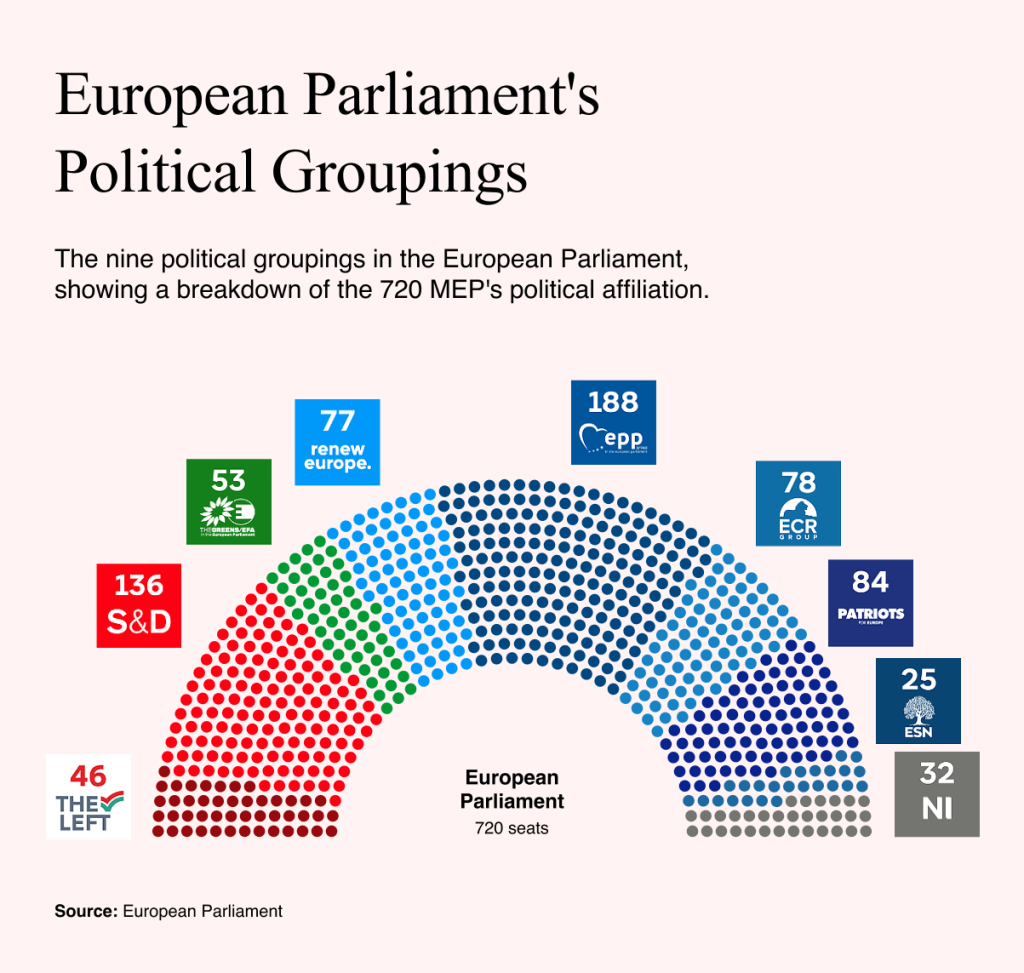
The 720 members of the European Parliament (MEPs) are broken up into eight political groupings, plus a small number of non-attached members. The largest grouping with 188 MEPs is the center-right European People’s Party (EPP), which currently holds the presidency thanks to a centrist alliance, with some support from the 78 MEPs from the right-wing ECR.
Source: European Parliament
Breaking the Cordon Sanitaire
There is a so-called cordon sanitaire designed to keep the far right from power. It was threatened, but not broken, in the 2024 parliamentary vice-presidential elections, which saw candidates from the PFE and ESN blocked by the centrist and left-wing parties.
The move to block both groupings meant that neither was represented in the EP’s bureau, which shapes Parliament’s rules and budget. This is despite the fact that between them, the groupings have more than 100 MEPs.
The other four groupings range from center-left to far-left, comprising Renew Europe (77 MEPs), the Greens/European Free Alliance (53), the Progressive Alliance of Socialists and Democrats (136) and the Left (46).
The prospect of a closer alignment or even merger between the ECR and the PFE grouping raises the possibility of an end to the cordon sanitaire, given the success of the ECR in getting two vice-presidents elected in 2024 and its more recent successes in challenging the EU’s status quo over migration and green policies.
It has been noted that Bardella and RN do not seem inclined to encourage links with the AfD. When Bardella visited Germany, he likened his positions to those of Chancellor Friedrich Merz rather than those of the far-right German party. In the EP, the two parties split from each other in 2024, following comments by an AfD candidate about the Nazi SS paramilitary force. AfD’s home in Europe, the ESN, is currently under investigation by a Brussels watchdog, which is moving to ban the political grouping.
While this was the final straw, a significant reason for RN’s desire to maintain its distance from AfD is that Le Pen’s enthusiasm for Brexit contributed to her defeat in the 2017 presidential election, even though polling suggests the French population is broadly eurosceptic.
Both RN and AfD pursue eurosceptical, nationalist policies, but the proposals from Bardella are not as immediately threatening to the future of the EU as AfD's suggestion that it would take Germany out of the EU.
Given their strong position in the presidential race, Bardella and Le Pen must tread carefully when it comes to Brussels, balancing RN’s desire to promote a France-first policy with the need to be seen as responsible in handling the nation’s foreign policy.
So while Bardella maintained a bullish tone as regards the union’s foundations, his attitude is one of reconstruction rather than destruction.
Welcome to the comments section of the Štandard daily. Please take note of our guidelines, comments are moderated by us. You can contact the moderators at support@statement.com.
Participate in the discussion
Comments are available to subscribers only. If you'd like to join the discussion, choose a subscription starting at €6.72 per month.
All comments 0
Register
Comments are available to registered users only. If you'd like to join the discussion, register here.