Ideology is an increasingly important factor in explaining different fertility rates between political affiliations in America, according to a new study.
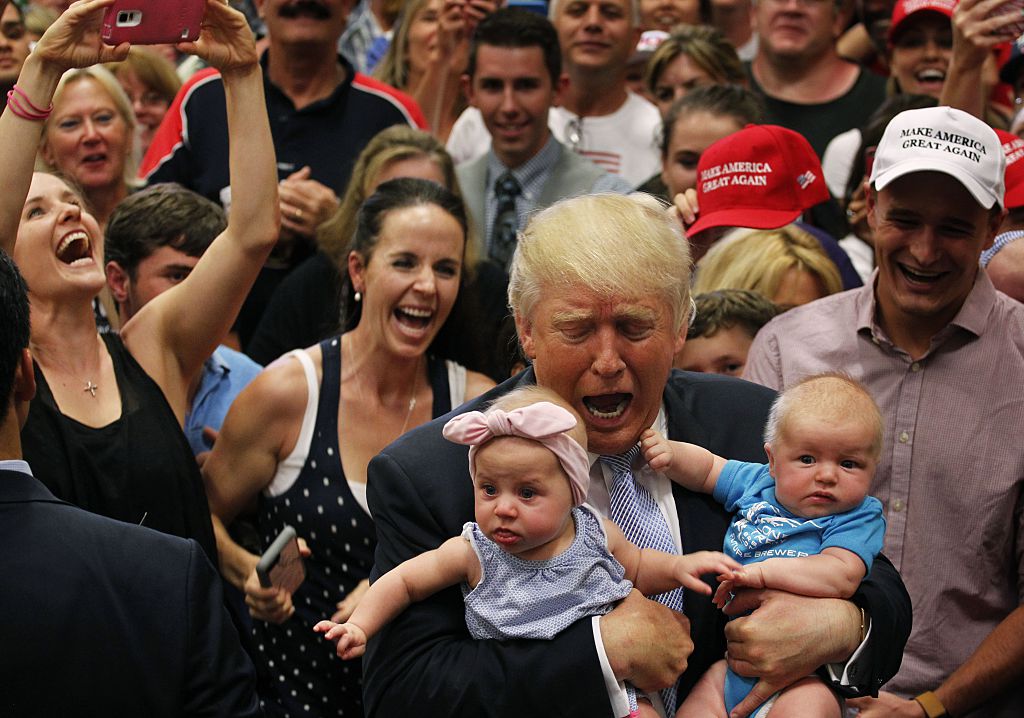
America's politically polarized society may be reflected in its fertility rates, a new study shows. Photo: Joe Mahoney/Getty Images
|
Gaps in fertility between the political left and right in America have been a phenomenon for decades, but whereas religiosity was once credited as a prime driver, a new study suggests the divide is increasingly driven by ideological differences.
Liberal parents are more likely to be anxious about parenting than conservatives, according to a report from the Institute for Family Studies (IFS), expressing less confidence in their parenting ability and greater fears about passing on bad genes.
The study, titled The Ideological Fertility Divide, highlights the role ideology plays in shaping expectations around parenting and desire for children. Its results also lend some credence to conservative critiques of prevailing liberal narratives around parenting, particularly a perception that liberal media emphasizes the negative aspects too much.
Partisan Divide
Fertility has consistently declined in America across the board over the past six decades. However, in the last 30 years, this decline has taken on a noticeably partisan flavor, both in terms of the number of children parents have and their expressed desire for children, according to the study.
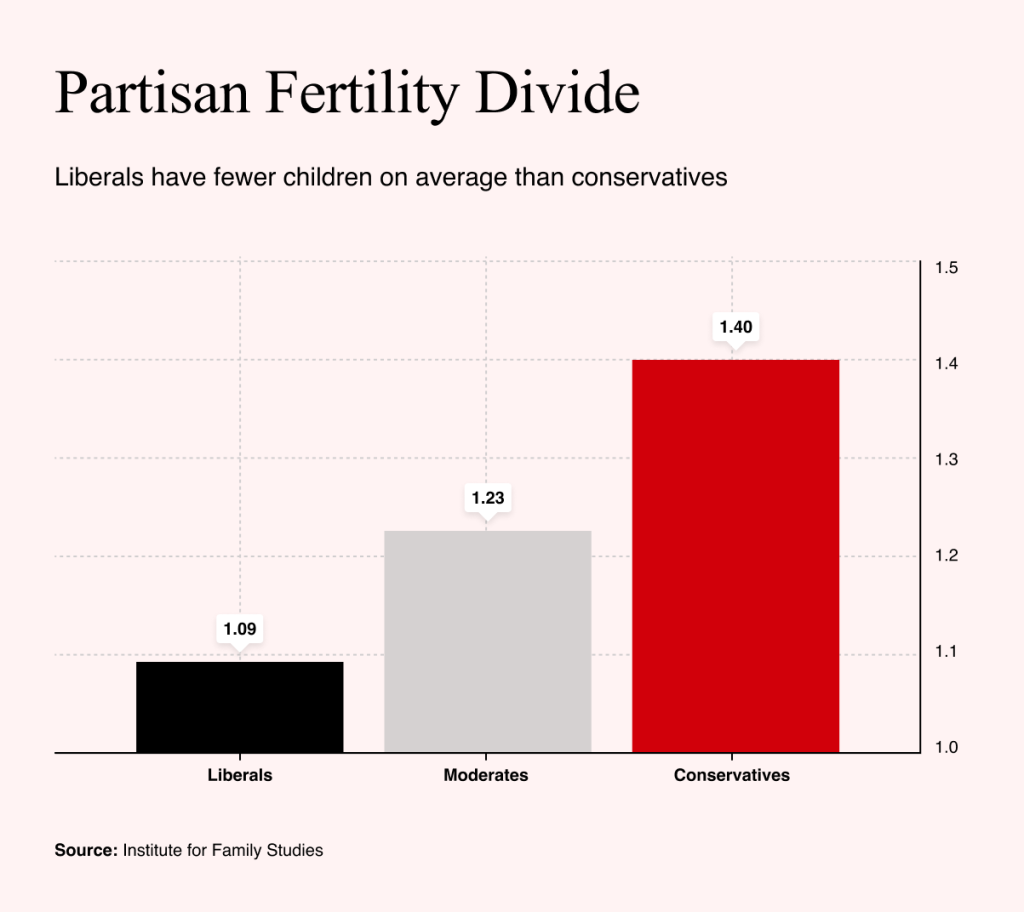
The fertility rate among conservatives born between 1975 and 1979 was 2.1, compared to 1.5 for liberals. While the rate for both has dropped, the gap remains today as the graph below shows.
Contemporary fertility rates show that there is a stark liberal-conservative divide in the United States. Source: IFS
The partisan divide is also evidenced in the number of desired children, a pattern first identified in 1989 and initially put down to differences in religiosity.
But the gap has grown and can no longer be explained purely by religious differences, the authors of the IFS study argue, with the difference proving statistically significant even when accounting for important confounding variables including religion, sex, race, income, age, marital status and education.
Instead, they propose that people’s political worldview is playing a “meaningful role” in the ideological fertility divide. They offer two possible explanations for this development: first, that conservatives are “substantially” more confident about their parenting abilities; and second, that liberals are “significantly more likely to be anxious about their mental health or genetic conditions”.
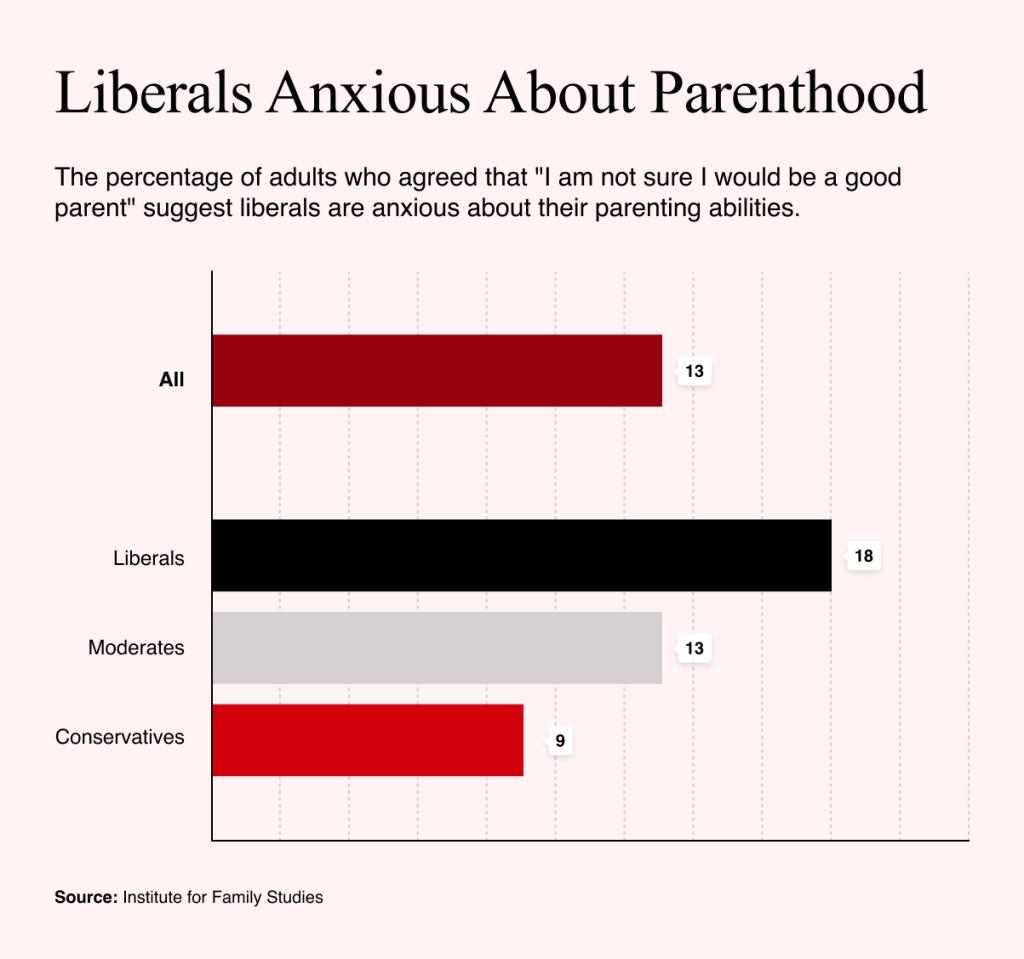
While a majority of liberals and conservatives express confidence in their parenting abilities, almost a fifth of liberals (18%) express parenting fears, compared with just 9% of conservatives.
Anxiety about parenting correlates closely with decreased fertility, the study avers, with respondents who believe they might not be good parents reporting 63% fewer children on average than those who do not hold this belief.
The study found liberals were less confident than conservatives about their parenting abilities. Source: IFS
It is the largest difference in the variables observed and “speaks strongly to the power of perceived competence in parenting”, according to the authors. After controlling for this factor, they found that the difference in childlessness percentages between conservatives and liberals was no longer statistically significant.
Liberals are also more likely to view parenting as difficult, with more than a third (36%) of liberals believing this to be the case, compared with a quarter (24%) of conservatives.
Taken together, the results suggest a clear difference between the worldviews of those on opposite ends of the political spectrum when it comes to parenting.
Health Fears
This pattern is further supported when looking at liberals’ anxieties over mental and physical health.
Liberals are almost twice as likely as conservatives to report concerns about passing on bad genes, at 18% compared with 10%. They are also more likely to cite their mental health as a reason for postponing having children, at 19% compared with 10%.
The IFS study found that groups identifying with each anxiety tend to have significantly fewer children than those who do not, and the authors suggest that such attitudes tie into broader concerns about the state of the world.
The consistency of these associations, between confident conservatives and anxious liberals, suggests that worldview and self-perception may play “a meaningful role” in the emerging partisan fertility gap, according to the authors.
The IFS is up front about the survey’s limitations. Political positions are difficult to define neatly, and it is unclear whether the differences lead people to have fewer children or instead reflect the fact that they spend less time around children. Nevertheless, the authors are confident in their findings.
Parenting in the Void
The study appears to give some credence to debates regarding liberal versus conservative narratives around parenting, as outlined by prominent commentators like the British “reactionary feminist” and mother Mary Harrington.
While conservatives tend to hold to a concrete model of a good life in which parenthood is not only a viable but a desired option, Harrington argues that liberals have to contend with a formless questioning of every traditional role, including parenthood.
Rather than motherhood presenting itself “as a normative step on an expected journey”, it becomes a “series of anxious questions posed in a void”, the journalist wrote in a 2024 essay.
She states that those of family-forming age are given little aid by prevailing – generally liberal – narratives surrounding children, so that it is hard to understand “why they should do their bit” to ensure that humans “continue to exist at all”.
Many of these narratives are driven by the media environment in which liberals move, which some critics – including the IFS – believe to be a contributory factor to their unease around parenthood in general and motherhood in particular.
While liberal media tend to stress the importance of gender equality as regards women in the workplace and celebrate solo living, their language around motherhood stresses difficulties and limitations.
Given this, it is unsurprising that Gen Z women (aged 18-29) place getting married and having children at the bottom of a list of their priorities, whereas jobs and money sit at the top.
While the issue is broader than just women and mothers, the study from the IFS shows how important ideological factors are in shaping attitudes to parenthood, suggesting this is an area that both the left and the right need to address if the fertility crisis is to be reversed.
Welcome to the comments section of the Štandard daily. Please take note of our guidelines, comments are moderated by us. You can contact the moderators at support@statement.com.
Participate in the discussion
Comments are available to subscribers only. If you'd like to join the discussion, choose a subscription starting at €6.72 per month.
All comments 0
Register
Comments are available to registered users only. If you'd like to join the discussion, register here.