Canada Rethinks Psychiatric Euthanasia as Dutch Cases Rise
Canada is backing away from plans to extend assisted dying to people with mental illness, citing concerns over suicidality and the sharp rise in psychiatric euthanasia cases in the Netherlands.
Canada is moving toward permanently excluding people whose sole underlying condition is mental illness from assisted dying. Photo: Getty Images
|
The number of assisted deaths is rising in both Canada and the Netherlands. Ottawa, however, is now stepping back from plans to extend its Medical Assistance in Dying (MAID) program to people whose sole underlying condition is mental illness.
A parliamentary committee has recommended permanently excluding the group from MAID. It cited unresolved difficulties in determining whether a psychiatric condition is incurable, distinguishing a request for assisted death from suicidal intent and ensuring adequate access to psychiatric treatment. The committee also pointed to warning signs from other countries, particularly the Netherlands.
A Permanent Exclusion
On 1 February 2024, the Canadian government introduced legislation extending the exclusion of people with mental illness as their sole underlying condition from the euthanasia program until 17 March 2027. It had intended to make the group eligible once the deadline expired. The newly published report is now likely to bring that debate to an end.
The Canadian parliamentary report, Medical Assistance in Dying and Mental Disorder as the Sole Underlying Medical Condition: A Complex and Challenging Conversation Among Canadians, was published on 17 June 2026. It recommends amending the Criminal Code so that people whose sole underlying condition is mental illness remain permanently excluded from MAID.
Canada should therefore continue to exclude such patients from Medical Assistance in Dying without setting a new expiry date. The report explicitly cites the Netherlands as both a point of comparison and a warning. Dutch psychiatrist Dr Jim van Os described the Dutch experience as a cautionary example for Canada.
A Warning From the Netherlands
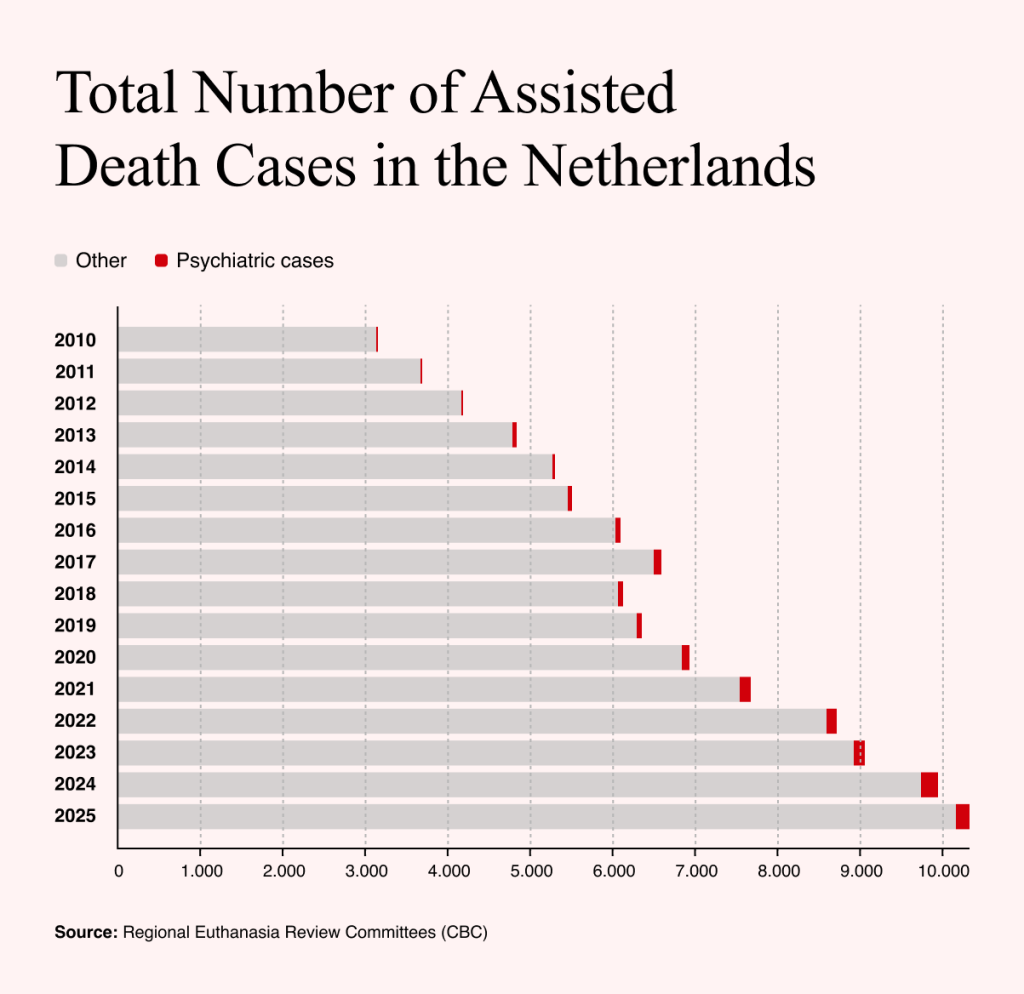
The number of assisted deaths among psychiatric patients in the Netherlands has risen sharply since the law was introduced in 2002. There were only two documented cases in 2010, compared with 219 in 2024. The figure fell slightly to 174 in 2025.
Between 2021 and 2025, the number of euthanasia cases involving psychiatric illness rose by 51.3%, significantly outpacing the overall increase of 34.9% and the 29.3% rise in cases involving physical illnesses.
In Canada, a case before the country’s highest court brought down the strict prohibition on assisted dying. On 6 February 2015, the Supreme Court of Canada ruled unanimously in Carter v Canada that an absolute ban was unconstitutional.
The court permitted physician-assisted death under clearly defined conditions. Its ruling applied to competent adults who clearly consented to ending their lives and suffered from a serious and incurable medical condition causing enduring and intolerable suffering.
Rising Numbers in Canada
The Canadian government adopted the Medical Assistance in Dying program, which came into force on 17 June 2016. The original law was narrowly designed for competent adults with a serious and incurable illness whose natural death was “reasonably foreseeable”.
The Canadian system has repeatedly faced criticism over cases in which patients were offered euthanasia as an alternative to treatment even though they had not requested it. The number of assisted deaths has risen sharply since the program was introduced.
MAID nevertheless became an established part of end-of-life care in Canada. In 2021, the program was extended to people whose natural death was not foreseeable.
In 2019, when reporting became mandatory, 5,400 deaths through assisted dying were recorded. By 2024, the figure had risen to 16,500, more than three times the 2019 total. Assisted dying now accounts for more than 5% of all deaths in Canada.
Since 2023, the country has debated a further extension of euthanasia to people whose sole underlying condition is psychiatric. The Dutch experience is particularly instructive because the country took the same step years ago and its consequences can now be assessed.
Maak Mij Niet Dood
Articles 293 and 294 of the Dutch Criminal Code provide the legal basis for euthanasia in the Netherlands and govern the criminal liability attached to active euthanasia and assisted suicide.
Doctors are exempt from prosecution for euthanasia or assisted suicide if they comply with the statutory due-care criteria. The procedure is permitted only for patients whose unbearable suffering has no prospect of improvement and has a medical basis.
That can include physical illnesses such as cancer or cardiovascular disease, but also psychiatric disorders, dementia and multiple geriatric syndromes.
Unlike Canada, the Netherlands allowed euthanasia for patients with psychiatric illnesses from the outset. The law also permits euthanasia for minors aged 12 and over. In Canada, it remains limited to adults.
In the Dutch euthanasia debate, the striking phrase “Maak mij niet dood, dokter” – “Do not kill me, doctor” – became a symbol of criticism of the practice.
Some older patients and nursing-home residents still carry notes bearing the phrase. It reflects fears that a right to assisted dying could develop into social or medical pressure to die.
Under Dutch law, euthanasia remains exempt from punishment only under strict conditions. Yet the figures tell a different story. More than 10,000 people died through euthanasia in 2025, accounting for almost 6% of all deaths in the Netherlands.
The Figures Bear Out the Concerns
The laws in Canada and the Netherlands may differ in detail, but both countries show the same trend: the numbers continue to rise.
Death is a low-cost alternative to care and palliative treatment. In Canada, euthanasia comes with a price tag of only $2,327 per case, while years of medical treatment or nursing care can run into the hundreds of thousands.
A vial of pentobarbital used for euthanasia and lethal injection in a hospital. Photo: iStock/Getty Images Plus
Critics have argued for years that suicidal thoughts and a wish to die are common symptoms of many psychiatric illnesses. Even an explicitly stated wish to die may be a symptom of illness in someone who needs help rather than assisted death.
Depression is the most obvious example, since it is often accompanied by suicidal thoughts that may be latent or acute.
From an economic perspective, however, death is considerably cheaper than years of psychotherapy. The Dutch figures send a clear message: once a legal entitlement is established, the system itself creates pressure for its use to expand.
Welcome to the comments section of the Štandard daily. Please take note of our guidelines, comments are moderated by us. You can contact the moderators at support@statement.com.
Participate in the discussion
Comments are available to subscribers only. If you'd like to join the discussion, choose a subscription starting at €6.72 per month.
All comments 0
Register
Comments are available to registered users only. If you'd like to join the discussion, register here.