

In its coverage of the Court of Justice of the European Union's (CJEU) ruling in the Wojewoda Mazowiecki case, Statement noted that the judgment was delivered by judges who were not only publicly associated with progressive circles and non-governmental organizations, but also included two former politicians who had supported legislation on same-sex marriage.
Judge François Biltgen, who sat on the Grand Chamber, is a former long-serving politician in Luxembourg who as justice minister in 2010 advocated opening marriage to same-sex couples. Another judge, Eugene Regan, served as a senator from 2007 to 2011 for Ireland's Fine Gael party, which describes itself as a reformist and progressive movement. The party counts the introduction of marriage equality among its achievements and had already proposed civil partnerships for same-sex and opposite-sex couples in 2004.
Given the significance of the ruling, which established an obligation to recognize same-sex marriages concluded elsewhere in the European Union, Statement submitted 20 questions to the Court concerning judicial impartiality, judges' backgrounds and the mechanisms used to safeguard independence.
The questions asked how the Court assesses actual or apparent conflicts of interest, whether judges' political backgrounds are examined before adjudication and whether any potential conflicts were considered in the Wojewoda Mazowiecki case.
The response came from Juan Carlos Gonzalez, head of the Court's press and information department.

A Narrow Test
The Court began by stressing that its members are appointed on the basis of "their independence and professional qualifications" and that throughout their term they must perform their duties with "complete impartiality, integrity and independence". It added that the role of a judge is "in no way ... to advance personal, political or policy preferences" but rather "to interpret and apply European Union law".
The Court also emphasized that judges may come from a variety of professional backgrounds, including politics, and that "such an experience does not, in itself, call into question their impartiality".
That is a legally convenient answer, but it is also where the problem begins.
The issue is not whether former politicians may become judges, but whether prior advocacy on a contentious political question can create the appearance of bias when a judge later rules on a closely related matter.
The Court's answer, in effect, is no.
The Biltgen Question
On conflicts of interest, the CJEU pointed to Article 18 of its Statute.
According to the Court, a judge is in a conflict-of-interest situation "if – and only if – he or she has been called upon to pronounce ... on a subject-matter which later on would have been a subject-matter of a case before the CJEU".
The Court concluded that this was not the case for Biltgen.
It explained: "The subject-matter of the case was not about the legal assessment of the ban on same-sex marriages under Polish law, but about the issue of the non-recognition under this law of same-sex marriages validly contracted in another Member State (Germany) in view of the EU rules on citizenship and the right to move and reside freely within the territory of the Member States. Judge Biltgen did not pronounce on the latter in any former capacity."
This distinction does most of the work in the Court's reasoning.
Because Biltgen had not previously expressed a view on the precise question of cross-border recognition and free movement rights, his earlier support for same-sex marriage legislation in Luxembourg was deemed irrelevant.
The Court concluded, "There can therefore be no appearance of a conflict of interest here, unless the notion of conflict of interest is – unduly – extended beyond its meaning as provided for by the legal framework".
Freedom in Name Only
The Court also referred to paragraphs 47 and 48 of its judgment.
In paragraph 47, it stated: "The Member States are thus free to decide whether or not to allow marriage for persons of the same sex under their national law."
But paragraph 48 immediately qualifies that freedom: "[E]ach Member State must comply with EU law ... by recognising, for that purpose, the civil status of persons that has been established in another Member State."

This is a familiar feature of EU law.
Formally, member states remain free to decide whether to allow same-sex marriage. In practice, they must recognize same-sex marriages concluded elsewhere whenever EU free-movement rights are engaged.
The Court's reasoning on bias follows a similar logic. Formally, Biltgen had not spoken on the exact legal question before the Court. In practical terms, however, the judgment still created a binding obligation concerning the recognition of same-sex marriages.
No Questions Asked
The Court confirmed that no judge in the Wojewoda Mazowiecki case was replaced or excluded.
Asked whether any judge had raised concerns about impartiality, it replied: "Taking into account reply to questions 1 to 4 above, there was no reason to raise such questions."
Nor did Biltgen disclose his earlier political involvement in same-sex marriage legislation as a potential issue.
The reason is clear. The Court viewed the case as one about free movement and civil-status recognition rather than about same-sex marriage itself.
Yet that narrow definition is precisely what many critics find unconvincing. The more narrowly a case is defined, the easier it becomes to exclude broader political and moral considerations from any assessment of apparent bias.
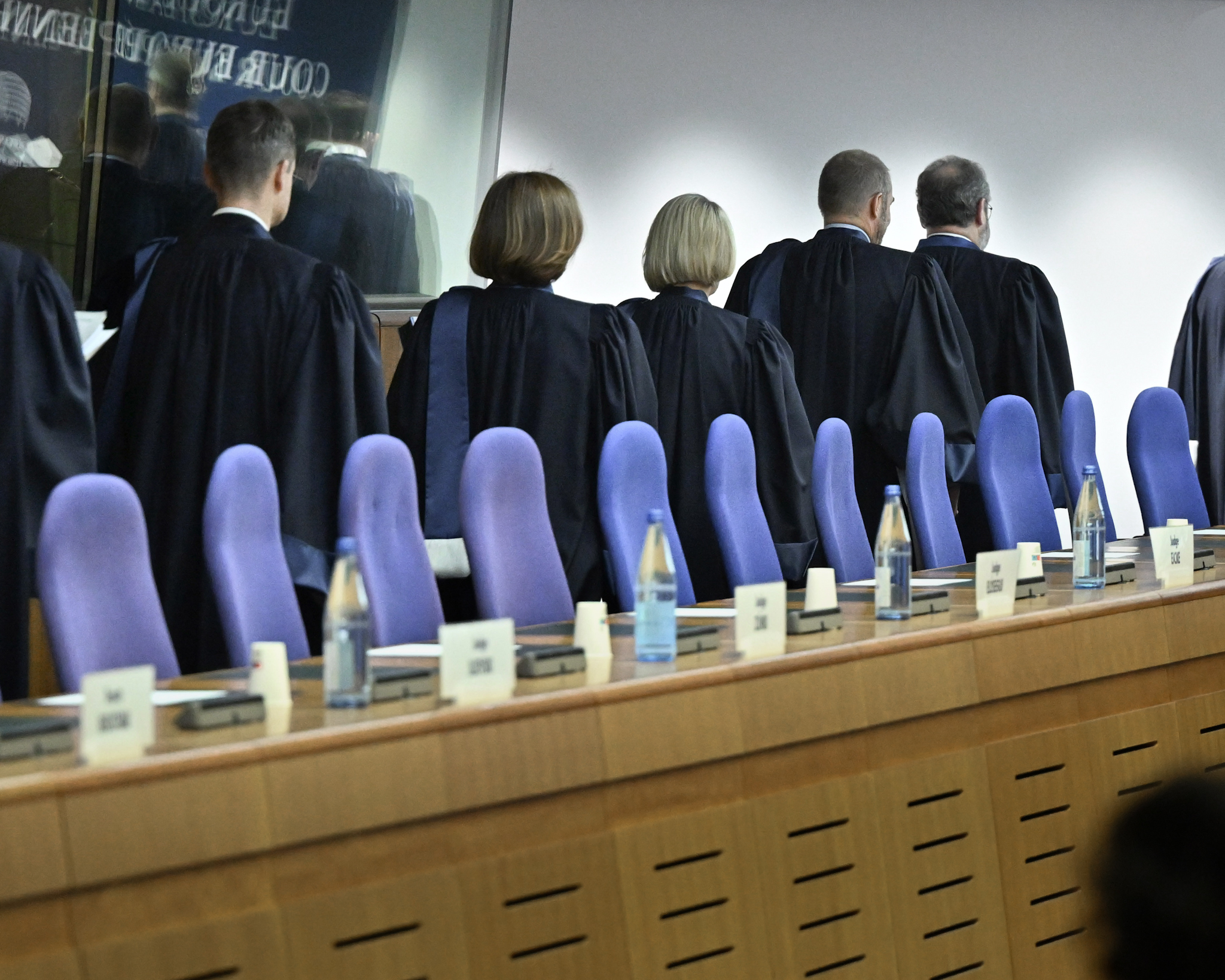
Bias Behind Closed Doors
The Court also confirmed that recusals and replacements are documented internally.
However, those records are not available to the public because they relate to "the exercise of the judicial functions of the Court".
As a result, the public cannot know how questions of bias are assessed in specific cases or whether similar concerns have arisen in other politically sensitive rulings.
When asked about politicians, NGOs or public campaigns, the Court repeatedly referred back to its earlier answers.
The decisive question, in its view, is whether the judge previously ruled on the same legal issue.
The Trust Problem
Statement also asked whether a Grand Chamber judgment could be reviewed if it later emerged that a judge with a conflict of interest had participated.
The Court referred to existing appeal and revision procedures but did not address a more difficult question: what happens when the relevant facts were already public, but the Court simply did not consider them disqualifying?
On transparency, the Court replied: "No publication of information of this kind is required by the current applicable rules."
That may be legally correct, but it is not necessarily reassuring.
The Court's explanation is coherent in a narrow legal sense, but it is also highly formalistic. Bias is assessed primarily through direct involvement in the same legal question. Prior political advocacy, publicly expressed values or legislative activity are not regarded as sufficient grounds in themselves.

The Reverse Test
The point becomes clearer if the political direction is reversed.
Imagine a former politician who actively campaigned for restrictions on LGBT advocacy in schools and later became a CJEU judge. He is then assigned to a case that appears technical on the surface but whose practical effect is to uphold such restrictions.

Under the Court’s logic, that would be acceptable provided he had never previously pronounced on the exact legal question before him.
Would critics on the progressive side accept that explanation? Would they conclude that there was no appearance of bias?
If only a direct statement on the exact same legal issue counts as a conflict, a substantial part of a judge's ideological background falls outside scrutiny. Yet in politically sensitive cases, that may be precisely where concerns about impartiality arise.
A court that decides some of the most value-sensitive questions in Europe cannot rely solely on formal legal definitions. Public trust requires convincing explanations and transparent safeguards showing that judgments are the result of independent legal reasoning rather than the personal commitments of those delivering them.