
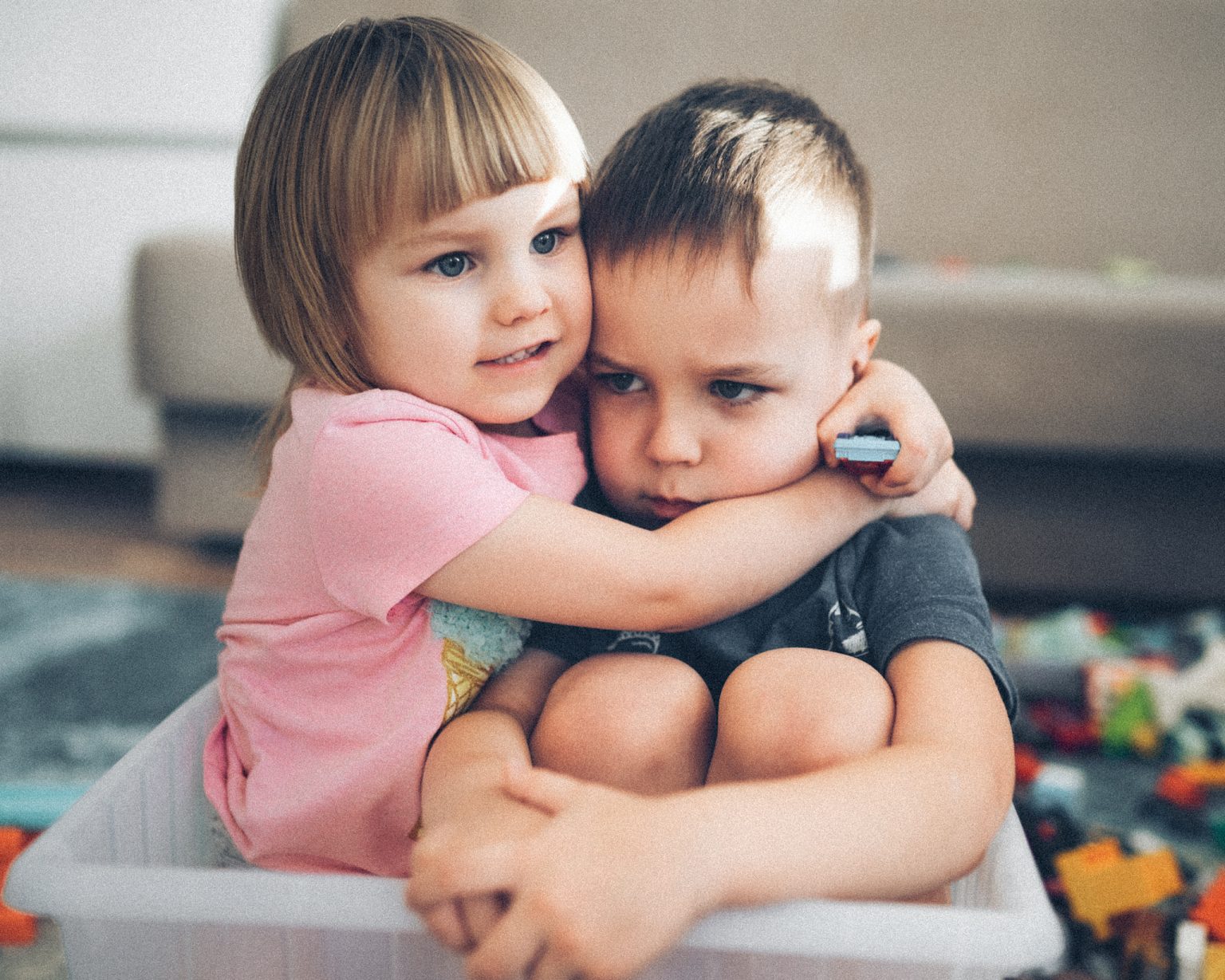
In 1976, the share of American mothers who had just one child was 11%. Today, it is 20%.
In that same year, 40% of women ended their childbearing years with four or more children. Today, that same figure is just 14%.
These numbers were cited in the New York Times this week by economist Dr. Catherine Ruth Pakaluk, who might well have been writing about the well-worn and much-discussed phenomenon of falling birth rates. But in actual fact, Pakaluk sought to draw attention to a downstream consequence of declining fertility that has not been much discussed: the rise in siblingless children.
In most European countries, one-child families now outnumber those with three or more children.
This is one of those statistics that, at first glance, feels like a piece of harmless and inconsequential social trivia. Nobody, after all, has a human right to a brother or a sister. Many only children are perfectly happy, perfectly normal and perfectly well-adjusted. Some of them will read this column, roll their eyes and point out – not unreasonably – that having siblings is no guarantee of lifelong companionship or happiness. Cain, after all, had Abel. Prince William has... Prince Harry. The list of unhappy sibling relationships is long.
Yet unhappiness remains the exception most of the time. For almost all of human history, sibling relationships were one of the basic facts of life. They were, in a sense, the first social institution most people ever encountered. Before school, before work, before marriage, before politics, before the state, there was the brother or sister: the person with whom a child learned that they were not, tragically, the center of the universe.
In fact, anyone who grew up with siblings knows that the family home is not usually a Hallmark advert. As in this writer's own – hopefully typical – experience, it is often much more like a very small Balkan state: shifting alliances, contested territory, ancient grievances, occasional outbreaks of violence and my poor blighted mother trying desperately to negotiate a ceasefire before dinner.
But that is the point. The sibling relationship is one of the first places where human beings learn that life with other people is difficult, unavoidable and, arguably, just about worth it.
The rise of the only child therefore matters not because only children are doomed – they are not – but because a society in which more children grow up without siblings is a society in which one of the oldest and most natural schools of socialization is being effectively abolished, without much attention being paid to the potential social and societal consequences.
The Cost of "Children as Economic Units" Rhetoric
Modern politics tends to discuss children almost entirely in economic terms. Politicians talk about the cost of childcare, the cost of housing, the cost of education, the cost of taking time out of the workforce, the cost of maternity leave, the cost of schoolbooks and the cost of college. These are all real political issues, to be sure – it is much easier to have four children in a detached house with a stay-at-home parent than in a two-bedroom apartment while both parents commute 90 minutes a day to pay a mortgage that would have stunned Crassus.
But the habit of politicians and the culture speaking about children mainly as costs to be borne has consequences. Eventually, people begin to believe it.
For decades, Western societies have sent young adults a very clear message: establish yourself first. Get the degree. Get the job. Get the second degree. Travel. Find yourself. Buy the house. Achieve security. Then, once – and only once – all the adult boxes have been ticked, consider having a child – provided, of course, that the child does not interfere too much with everything you have spent 15 years building.
And then observers are astonished – astonished! – to discover that people have fewer children.
The Cost and Consequence of Delay
The siblingless child is one consequence of that delay. By the time many couples have their first baby, the possibility of a large family has not been rejected so much as quietly timed out. Biology – that stubborn, unprogressive reactionary – has not adjusted itself to the expectations of the modern graduate labor market.
This is one reason why so much of the political debate around fertility feels inadequate. Governments reach, understandably, for financial incentives: child benefit, tax credits, subsidized childcare and parental leave – the list of potential economic gimmicks, most of them relentlessly embraced and advocated for by conservatives, is near endless. To be sure, some of these things are useful. Some of them are arguably even necessary. But they all reinforce the same message: kids are a burden, and you need help with them. That, to the childless, is not necessarily an attractive message.
Or to put it bluntly: the state can help people afford children. It cannot make them desire children. That is the deeper problem. And the more it helps, the more it sends the message that having kids is, well, likely to put you in an economic hole.
Shearing All the Branches from the Family Tree
The other problem, of course, is that the modern world has built a society in which children are cherished individually but discouraged collectively. Everyone, naturally, loves their own child. But public culture is ambivalent, at best, about children in general. They are too loud in restaurants, too disruptive on planes, too expensive for taxpayers, too inconvenient for employers, too damaging to women’s careers, too carbon-intensive for environmentalists and too much work for adults – like, arguably, this childless writer – who have been taught to think of freedom as the absence of obligation.

In that atmosphere, the second kid becomes almost a luxury good. Nice, perhaps. Desirable, perhaps. But optional.
The problem is that the downstream consequences of this culture have yet to be felt – but inevitably will be. Children growing up without siblings will have a child of their own without aunts or uncles, or perhaps cousins. The wider family structure is certain to thin over time so that eventually society becomes even more atomized than it already is. This will create yet more obligation for the state, as it is forced to take on ever more of the duties and roles in society that were once performed by extended family structures.
This is the part of the fertility debate that is almost entirely absent: a falling birth rate is not just a problem for pension systems, labor markets or GDP projections. It is a problem for what might be poetically termed “the intimate architecture of human life”.
Perhaps this is why the subject makes us uncomfortable. Falling fertility can be discussed in the abstract, with charts and projections and anxious talk about pensions. But the disappearance of siblings brings the matter closer to home. It asks not merely whether the economy will have enough workers in 2050, but whether the child born today will have anyone who remembers the same childhood bedroom, the same family jokes, the same awful embarrassing dad moments, the same mother before she became old.
That is not an economic question. It is a civilizational one. It is probably as close as modern Western society gets to an existential question. To be blunt about it – as things stand, society is in the process of shearing all the branches from the family tree. It is an experiment unprecedented in human history, with consequences yet to be fully felt.
And yet it is one that politicians and commentators have somehow contrived to treat as a private lifestyle preference, rather than one of the great social transformations of our age.